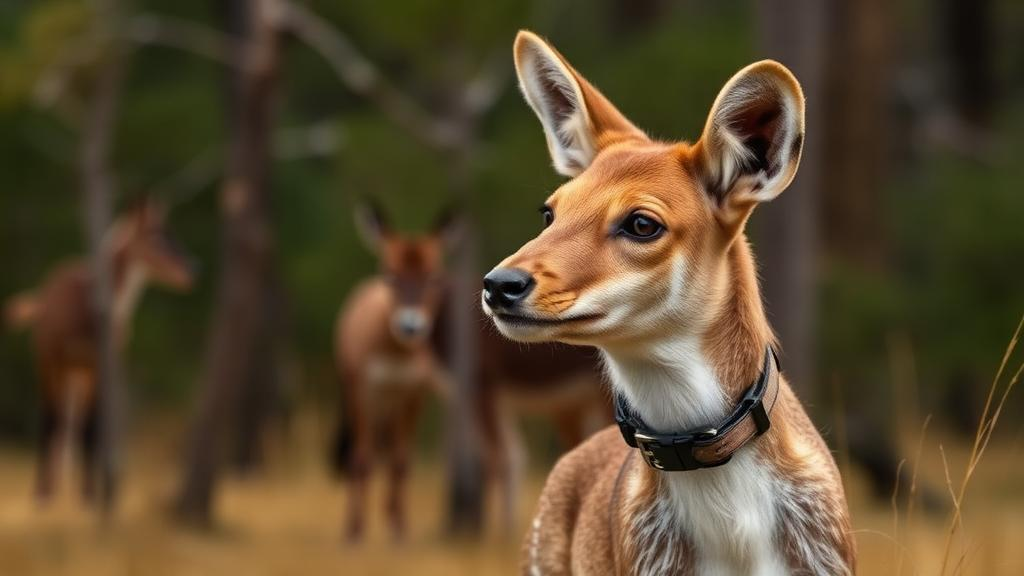
When a wildfire fills the sky with smoke, the human response is simple and instinctive: we close the windows, switch on an air purifier, or drive out of the plume. Wildlife has no such escape. Animals living in forests, mountains, and grasslands must simply endure whatever the atmosphere delivers, breathing the same hazy air for days or weeks at a time. Yet despite the growing frequency of these events, scientists have had almost no way to measure what wild animals actually experience when smoke rolls over their habitat. Air quality monitoring stations are built for cities and towns, not for remote wilderness, and the exposure of a deer, a cougar, or an elk to a passing smoke plume has remained essentially invisible to science. A team at Colorado State University, working with the U.S. Forest Service, has now built a tool designed to close that gap, and the early results suggest that the air an animal breathes can be dramatically different from what the nearest official sensor reports.
The device, called a smoke logger, is a small, solar-powered air quality monitor that can be attached to the same collars wildlife biologists already use to track animal movements and physiology. Its design and programming have been released as an open-source package, published alongside the team’s initial results in the journal Methods in Ecology and Evolution, so that researchers anywhere in the world can build their own units. The cost of materials is roughly $100 per logger, a figure that matters enormously in a field where wildlife studies, particularly those involving capturing, collaring, and recapturing animals, are notoriously resource intensive. By making the tool cheap and freely available, the Colorado State team hopes to turn smoke exposure from an unmeasured unknown into a standard data stream in wildlife research, one that can be layered onto the GPS coordinates and heart rate readings that many existing collar studies already collect.
At the technical heart of the device is a low-cost, commercially available particulate sensor of the same type used by the PurpleAir citizen-science monitoring network. These sensors use a laser to count and size airborne particles, focusing on what scientists call particulate matter 2.5, or PM2.5: particles with a diameter of 2.5 micrometers or less. That size threshold is not arbitrary. Particles this small are fine enough to penetrate deep into the lungs and cross into the bloodstream, and they are the components of smoke most strongly linked to cardiovascular and respiratory harm in humans. Measuring PM2.5 concentrations at the level of an individual animal therefore provides a direct, biologically meaningful index of the pollution that animal is actually inhaling, rather than an estimate interpolated from a station many kilometers away.
The engineering choices behind the smoke logger reflect the harsh realities of field deployment. Transmitting data from a collar in remote terrain would require costly satellite or cellular connectivity that simply does not exist in most wildlands, and the energy demands of radio transmission would quickly drain a small battery. The team’s solution is to record and store air quality readings locally every 30 minutes, powered by a small solar panel, and to recover the data later when the collar is retrieved. This makes the device suitable for medium and large animals that can carry the added weight, and it fits naturally into the workflow of long-term wildlife studies in which collars are routinely recovered after months or years. The trade-off is that the data arrives on the timescale of the study rather than in real time, but for questions about chronic exposure and behavioral response, that is often exactly what researchers need.
The first deployments on mule deer produced one of the most striking findings of the project. When the researchers compared readings from the deer-borne sensors with data from the closest official monitoring stations, they found that air quality differed by an order of magnitude, meaning the animals were experiencing conditions either ten times better or ten times worse than the nearest station recorded. Air quality, in other words, varies enormously at the microscale, shaped by local terrain, vegetation, wind patterns, and the animal’s own movements through the landscape. George Wittemyer, the CSU professor who led the project, described that discovery as eye-opening, and it carries a broader implication: without sensors on the animals themselves, any estimate of wildlife smoke exposure drawn from regional monitoring networks is likely to be badly wrong.
That variability cuts both ways, and it hints at one of the most intriguing possibilities raised by the research. If air quality shifts dramatically over short distances, then some parts of a landscape may function as refugia during smoke events, places where animals can find measurably cleaner air while the rest of their range chokes under haze. Adam Parlin, who designed the smoke logger as a postdoctoral researcher in CSU’s Department of Fish, Wildlife and Conservation Biology, pointed to exactly this kind of insight as the tool’s promise. Identifying where animals go and how they adjust their behavior during severe smoke events, from the wildlife’s own perspective, could give conservation managers actionable information about which habitats matter most during fire season and how to protect them.
Not every test animal encountered dangerous smoke during the study period. Deer monitored in Colorado and Utah this year were not exposed to unhealthy levels of wildfire smoke, a reminder that exposure is highly episodic and that multi-year deployments will be needed to capture the worst events. But the team demonstrated that the sensors are sensitive enough to register even minimal pollution spikes from traffic for deer living in urban environments, a sign that the devices can resolve subtle gradients in air quality rather than only extreme events. That sensitivity matters because chronic, low-level exposure may carry health costs that accumulate over time, and because behavioral responses to mild smoke may differ from responses to severe events in ways that only fine-grained data can reveal.
The research team is now scaling up through partnerships. They are collaborating with researchers across the western United States to attach smoke loggers to existing studies tracking cougars, deer, and elk, effectively piggybacking on fieldwork that is already underway rather than launching costly new capture programs. They have also stationed stationary sensors in the habitat of the Sierra Nevada fisher, an endangered small mammal related to weasels, to characterize the air quality within the species’ range. Those results will appear in future publications, but the strategy is clear: by combining animal-borne and stationary sensors, researchers can map both the exposure of individual animals and the broader atmospheric conditions of the landscapes they inhabit.
The implications extend beyond wildlife. The U.S. Environmental Protection Agency monitors air quality in populated areas through its AirNow network, leaving vast rural and wilderness regions effectively unmonitored. Sensors carried by animals roaming those unmonitored spaces could fill gaps in the national picture of smoke exposure, offering health-relevant data for rural communities and people who work outdoors as well as for the animals themselves. In a year when massive smoke plumes have degraded air quality for weeks at a time across North America, a chronic problem that Wittemyer notes now affects everyone, that dual benefit gives the technology an unusually broad appeal for a device built to hang around a deer’s neck.
For land managers, the most practical payoff may come in the planning of prescribed burns. Deliberate, controlled fire is one of the most important tools for reducing fuel loads and limiting the severity of future wildfires, but it generates its own smoke, and managers currently have little way of knowing when or where that smoke actually reaches wildlife. Mark Ditmer, the U.S. Forest Service wildlife ecologist who co-led the project, emphasized that a stronger understanding of smoke exposure could allow burns to be timed and located to meet forest-management goals while avoiding sensitive periods and important habitats. As wildfires grow in frequency, size, and severity, and as smoke becomes a recurring seasonal stressor rather than a rare event, tools like the smoke logger offer something conservation biology has never had before: a way to see the air through an animal’s lungs, and to act on what that view reveals.
Subject of Research: Animal-borne air quality sensors for measuring wildfire smoke exposure in wildlife
Article Title: Novel device will help show how wildfire smoke impacts wildlife
Article References: Novel device will help show how wildfire smoke impacts wildlife. (n.d.). Original publication
Image Credits: AI Generated
DOI: Not provided
Keywords: wildfire smoke, wildlife, PM2.5, air quality, smoke logger, Colorado State University, mule deer, animal-borne sensors, conservation, prescribed burns, Methods in Ecology and Evolution, open-source technology
News Source: Gavin Prescott. (October 8, 2026). New $100 collar sensor reveals what wildfire smoke does to wild animals. Scienmag.