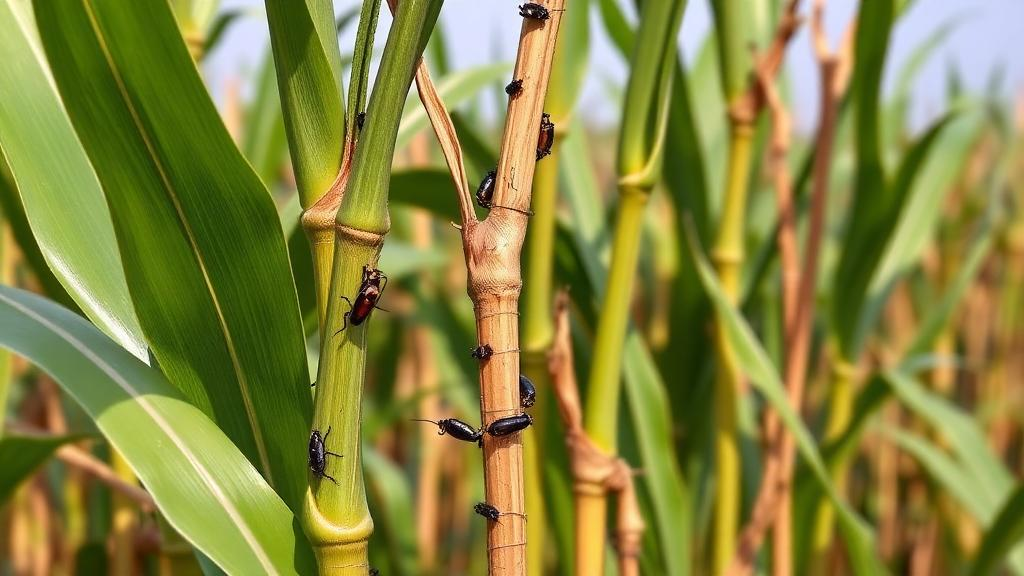
Sugarcane growers have long relied on a crude arithmetic to judge one of the world’s most damaging crop pests. Cut open a stalk, count the internodes bored by the sugarcane borer, and express the result as a percentage. That single number, the infestation index, has anchored pest management decisions for decades. A new study published in Smart Agricultural Technology argues that this convention hides far more than it reveals, and that a convolutional neural network can see what the human eye has been averaging away.
Researchers in São Paulo State, Brazil, led by Gustavo César Costa Gomes, Rodrigo Cupertino Bernardes and Odair Aparecido Fernandes, set out to replace the blunt presence-or-absence accounting of pest injury with a continuous, quantitative measure of how much internal tissue a pest actually destroys. Their target pests were two of the most economically important insects in Brazilian sugarcane: the sugarcane borer Diatraea saccharalis, a moth whose larvae tunnel longitudinally through successive internodes, and the sugarcane weevil Sphenophorus levis, a beetle whose larvae riddle the basal stalk and rhizome region with irregular galleries. Both insects attack tissues that are invisible from outside the plant, which is precisely why injury assessment has remained so primitive.
The distinction the researchers draw is central to the entire enterprise. In entomology, injury refers to the direct physical effect of insect feeding on plant physiology, while damage refers to the measurable loss of yield or quality that may or may not follow. Injury does not necessarily produce damage, and conflating the two has historically distorted estimates of how much a pest actually costs a crop. For sugarcane, previous work suggested that every 1 percent of tillers attacked by S. levis translates into roughly 1 percent yield loss, while every 1 percent of bored internodes costs between 0.7 and 2.9 percent of productivity, alongside degradation of juice quality. But those figures rest on simplified visual scoring. What has been missing is a rigorous, reproducible way to quantify the true structural extent of internal lesions and then relate that severity directly to plant performance.
The team conducted the work during the 2023/2024 growing season in two commercial fields representing sharply contrasting production environments. The first, in Barrinha, sat at 559 meters elevation on a nutrient-rich Rhodic Ferralsol and grew the high-yielding variety RB 005014. The second, in Itirapina, at 819 meters on a sandy Arenosol, grew CTC 1007, a variety bred for unfavorable conditions. In each field, eight plots of 600 square meters were established in a completely randomized design, and no chemical or biological pest control was applied, preserving the natural gradient of infestation for analysis. Shortly before harvest, workers excavated entire sugarcane stools, roots and all, digging roughly 30 centimeters deep to capture the rhizome region where the weevil prefers to feed. The haul totaled 607 stalks, each labeled, weighed, measured and photographed.
Back in the laboratory, every stalk was sliced longitudinally to expose its interior, then photographed under standardized conditions: a 50-megapixel camera fixed exactly one meter above the samples, optical axis perpendicular to the image plane, with a five-centimeter reference scale in the same focal plane for spatial calibration. These images served double duty. Manual delineation of lesion boundaries in ImageJ produced ground-truth measurements, while a parallel automated pipeline extracted stalk morphometric traits. That pipeline converted images to HSV color space, segmented stalks using a refined Otsu threshold, applied a sequence of dilation, closing and opening morphological operations, and filtered out spurious objects. Sensitivity testing on 80 images showed the measurements were robust: across wide ranges of parameter variation, median stalk area shifted by at most 3.4 percent and injury severity by less than 5 percent.
The deep learning component was built on YOLOv11x-seg, an instance segmentation architecture chosen for its speed, a decisive factor if the method is ever to run at mill reception or during field scouting. The team annotated 404 images, with a 20 percent overlap between two independent annotators to check consistency, then expanded the dataset to 1,118 images through geometric and photometric augmentation, including rotations, zoom cropping and brightness adjustments. Training ran for 100 epochs on inputs resized to 420 by 420 pixels, initialized from COCO-pretrained weights. The resulting model achieved a precision of 0.81, recall of 0.70, an F1-score of 0.75 and a mean average precision at 50 percent overlap of 0.67. Training and validation loss curves converged in parallel with no divergence, indicating the network generalized rather than memorized. Applied to the full sample, it detected 400 individual lesions, with lesion coverage ranging from 0.4 to 64 percent of a stalk’s sectioned area.
Agreement with manual measurement was substantial. Automated lesion area correlated with the manual reference with a coefficient of determination of 0.77, and stalk-level classification against the manual reference yielded a precision of 0.74, recall of 0.88 and accuracy of 0.78. The stratified analysis revealed a telling pattern: detection was nearly perfect for larger lesions, reaching 100 percent for the biggest third of injuries, but fell to 66.7 percent for the smallest, where the model also overestimated area by nearly 99 percent on average. In practice this matters less than it might seem, because severity is expressed as a proportion of each stalk and tiny lesions contribute little to that proportion. The method, in other words, discriminates moderate from heavy infestation far more reliably than it flags incipient injury, and Bland-Altman analysis found no systematic bias in lesion area estimation.
The payoff came when the team linked continuous injury severity to plant biometrics across 514 stalks in 76 stools, using regression models with cluster-robust standard errors that accounted for stalks nested within stools. Each percentage-point increase in the proportion of stalk length occupied by borer lesions was associated with a 0.85 percent reduction in stalk fresh weight, a 0.43 percent reduction in stalk length and a 0.53 percent reduction in internode number, all statistically significant. The occurrence of weevil injury, meanwhile, was associated with an 8.2 percent reduction in stalk weight, though not with height or internode count. Crucially, when injury was represented merely as present or absent, no significant association with any biometric trait emerged. Only the continuous severity measure carried the signal, a result that directly challenges the conventional infestation index and suggests that decades of binary scoring have been discarding the very information that matters.
The contrast between the two pests also illustrates why injury metrics must respect pest biology. Borer galleries run longitudinally through vascular tissue, so the proportion of stalk length affected captures the cumulative disruption of transport and structural integrity, and the associated rot complex involving Fusarium and Colletotrichum fungi extends the damage beyond the gallery itself. The weevil, by contrast, attacks the thick basal and rhizome tissues irregularly, so its injury was scored by occurrence rather than continuous extent. The authors are careful to note the observational limits of the design: infestation reflected natural field variation, larger stalks may attract more larvae, and because each variety was tied to a specific field, variety and environment were statistically inseparable. Controlled infestation experiments across cultivars will be needed to fully disentangle cause from correlation.
The immediate application is end-of-season assessment: evaluating pest impact, auditing control programs and building the quantitative injury-response relationships that economic injury levels require. Because the method depends on destructive stalk sectioning, it cannot yet serve in-season scouting, but the researchers envision it as a calibration reference for non-destructive tools, including near- and mid-infrared spectroscopy already being tested for borer diagnosis in sugarcane, and volumetric imaging techniques such as X-ray computed tomography that could map three-dimensional gallery architecture. What the study ultimately delivers is a methodological framework: a reproducible, continuous measure of hidden injury, validated against manual ground truth, and a demonstrated link between that measure and the plant’s own growth. For a crop that supplies most of the world’s sugar and a growing share of its ethanol, teaching machines to read the scars inside a stalk may prove one of the more consequential applications of agricultural artificial intelligence yet.
Subject of Research: Image-based deep learning for quantifying insect injury severity and plant biometric responses in sugarcane
Article Title: Assessing insect injury severity and plant biometric responses in sugarcane using image-based deep learning
Article References: Gomes, G. C. C., Bernardes, R. C., & Fernandes, O. A. (2026). Assessing insect injury severity and plant biometric responses in sugarcane using image-based deep learning. Smart Agricultural Technology, 15, Article 102601. https://doi.org/10.1016/j.atech.2026.102601
Image Credits: AI Generated
DOI: Not provided
Keywords: sugarcane, deep learning, image segmentation, Diatraea saccharalis, Sphenophorus levis, integrated pest management, economic injury level, precision agriculture, convolutional neural networks, crop pests, YOLOv11, injury severity
News Source: Alan Morgan. (October 7, 2026). AI Reads Sugarcane Stalks to Measure Hidden Insect Damage. Scienmag.