

• HOME
  • NEWS
  • EXPLORE
    • CAREER
      • Companies
      • Jobs
    • EVENTS
    • iGEM
      • News
      • Team
    • PHOTOS
    • VIDEO
    • WIKI
  • BLOG
  • COMMUNITY
    • FACEBOOK
    • INSTAGRAM
    • TWITTER
Monday, July 6, 2026
BIOENGINEER.ORG
No Result
View All Result
  • Login
  • HOME
  • NEWS
  • EXPLORE
    • CAREER
      • Companies
      • Jobs
        • Lecturer
        • PhD Studentship
        • Postdoc
        • Research Assistant
    • EVENTS
    • iGEM
      • News
      • Team
    • PHOTOS
    • VIDEO
    • WIKI
  • BLOG
  • COMMUNITY
    • FACEBOOK
    • INSTAGRAM
    • TWITTER
  • HOME
  • NEWS
  • EXPLORE
    • CAREER
      • Companies
      • Jobs
        • Lecturer
        • PhD Studentship
        • Postdoc
        • Research Assistant
    • EVENTS
    • iGEM
      • News
      • Team
    • PHOTOS
    • VIDEO
    • WIKI
  • BLOG
  • COMMUNITY
    • FACEBOOK
    • INSTAGRAM
    • TWITTER
No Result
View All Result
Bioengineer.org
No Result
View All Result
Home NEWS Science News Biology

FOXI3 gene is involved in dental cusp formation

Bioengineer by Bioengineer
July 17, 2017
in Biology
Reading Time: 2 mins read
1
Share on FacebookShare on TwitterShare on LinkedinShare on RedditShare on Telegram
IMAGE

Credit: MPI f. Evolutionary Anthropology

Hairless dog breeds differ from other dogs not only by lacking a coat, but also in the number and nature of their teeth. Scientists at the Max Planck Institute for Evolutionary Anthropology in Leipzig and the Friedrich Schiller Universität Jena studied the skulls and teeth of pedigreed hairless dogs from the collection of the Phyletisches Museum of the University of Jena. Thus, they furthered our understanding of the involvement of the FOXI3 gene in the development of teeth – not only in hairless dogs, but potentially also in other mammals including humans.

Hairless dogs such as the Chinese crested dog or the Mexican hairless dog are among the oldest dog breeds worldwide and already attracted the attention of the great naturalists Carl Linnaeus and Charles Darwin. The missing hair of these dog breeds is the result of a mutation of the forkhead box I3 gene (FOXI3) which belongs to a transcription factor gene family and is also, among others, involved in tooth development.

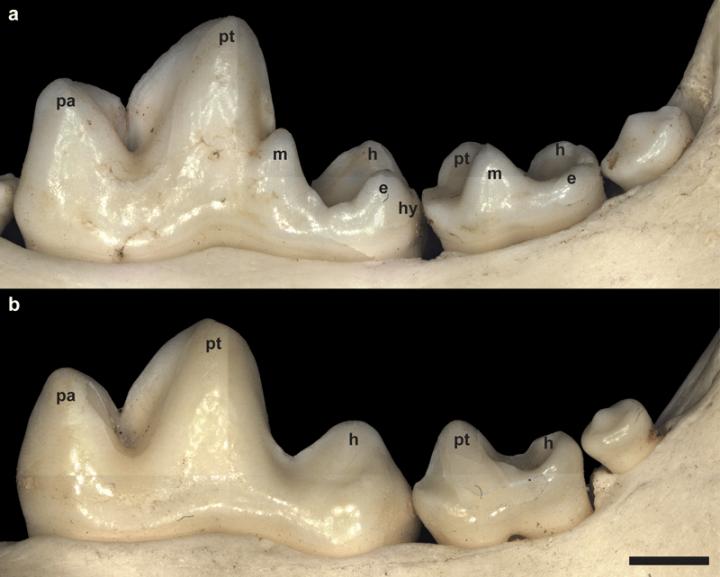
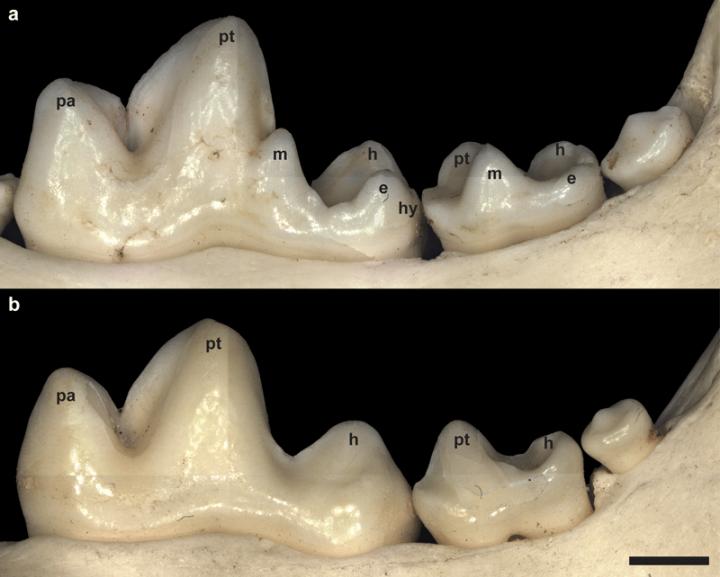
By studying a historical skull collection of hairless and coated dogs, a team led by Kornelius Kupczik of the Max Planck Institute for Evolutionary Anthropology and Martin S. Fischer of the Friedrich Schiller Universität Jena found that hairless dogs are almost completely missing their replacement teeth (i.e., incisors, canines and premolars). The molars, however, were present. It was also remarkable that the deciduous premolars and permanent molars of the hairless dogs repeatedly lacked specific lingual cusps. On the basis of DNA sampled from the more than 100 years old dog skulls of the museum's collection in Jena, the researchers demonstrated that these morphological findings are also associated to FOXI3 gene variation.

The preserved original skulls and taxidermy samples of hairless dogs date back to the former director of the Phyletisches Museum, Ludwig Plate, who, in the early 20th century, conducted an experiment of crossbreeding hairless and coated dogs. His article on the study already stated that the hairless individuals showed a partially lacking dentition. "Our new study impressively demonstrates the immense value of scientific collections for research purposes", says Fischer.

Interestingly, the molar phenotype of the hairless dogs can be found in wild forms of living and extinct carnivores, and the molars of humans and great apes also show varying expressions of the lingual cusps. The researchers from Leipzig and Jena therefore suggest that FOXI3 may be of general importance in mammalian tooth development. "It is therefore possible that this gene may have played a role in evolutionary changes of human tooth morphology as well", says Kupczik.

###

Original publication:

Kornelius Kupczik, Alexander Cagan, Silke Brauer & Martin S. Fischer

The dental phenotype of hairless dogs with FOXI3 haploinsufficiency.

Scientific Reports; 14 July, 2017 (DOI: 10.1038/s41598-017-05764-5)

Media Contact

Kornelius Kupczik
[email protected]
49-341-355-0861
@maxplanckpress

http://www.mpg.de

Original Source

https://www.mpg.de/11400186/hairless-dogs-tooth-evolution http://dx.doi.org/10.1038/s41598-017-05764-5


Share13Tweet8Share2ShareShareShare2

Related Posts

Bacteria evolve faster with unconventional gene copies — Biology

Bacteria evolve faster with unconventional gene copies

July 6, 2026
Neighbours rewire soil feedback via root microbiome shifts — Biology

Neighbours rewire soil feedback via root microbiome shifts

July 6, 2026

Evolution-Inspired Biosensors Revolutionize Lipid Tracking in Real Time

July 2, 2026

New Study Reveals How to Reduce Risk of Dangerous Wildlife Encounters This Summer

July 2, 2026
Please login to join discussion

POPULAR NEWS

  • Detection of EDCs in Breast Milk and Infant Urine Up to Six Months Highlights Early Exposure Risks

    77 shares
    Share 31 Tweet 19
  • New Drug Candidate Developed at McMaster Shows Potential for Treating Brain Cancer

    58 shares
    Share 23 Tweet 15
  • Saying Goodbye to PGY-6: Pediatric Fellowship Realities

    103 shares
    Share 41 Tweet 26
  • KTU Researchers Explore Ultrasound’s Role in Enhancing Blood Flow Beyond Diagnostics

    53 shares
    Share 21 Tweet 13

About

We bring you the latest biotechnology news from best research centers and universities around the world. Check our website.

Follow us

Recent News

From Anxiety to Overwhelm: Tracing the Hidden Stress Escalation in Dementia Caregiving

Human milk fortifier cuts NEC risk in preemies

AI’s Moon Crater Maps Don’t Agree: SwRI Study Reveals Surprising Discrepancies

Subscribe to Blog via Email

Enter your email address to subscribe to this blog and receive notifications of new posts by email.

Join 83 other subscribers
  • Contact Us

Bioengineer.org © Copyright 2023 All Rights Reserved.

Welcome Back!

Login to your account below

Forgotten Password?

Retrieve your password

Please enter your username or email address to reset your password.

Log In
No Result
View All Result
  • Homepages
    • Home Page 1
    • Home Page 2
  • News
  • National
  • Business
  • Health
  • Lifestyle
  • Science

Bioengineer.org © Copyright 2023 All Rights Reserved.
