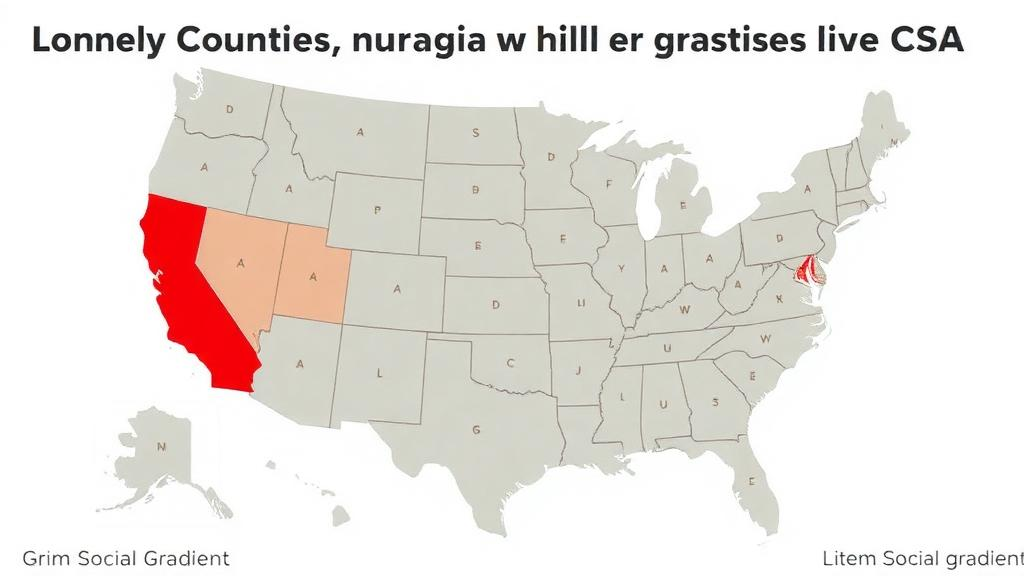
A new ecological study has found that American counties where more adults report feeling lonely also tend to have higher rates of cancer mortality, even after accounting for a wide range of socioeconomic and behavioral factors. The research, published in the journal Supportive Care in Cancer, analyzed county-level data from more than 1,300 US counties and adds a striking new dimension to the growing body of evidence that social connection is not merely a matter of emotional wellbeing but a measurable determinant of population health. As loneliness has been elevated to the status of a public health crisis by the US Surgeon General, the finding that this subjective experience tracks with one of the nation’s leading causes of death is likely to intensify debates about whether social isolation should be monitored and addressed with the same seriousness as smoking, obesity, or air pollution.
The study, led by Ingrid Jacobson of the Rural Cancer Institute in Staples, Minnesota, together with colleagues affiliated with several US medical institutions, set out to answer a question that had been surprisingly underexplored: does loneliness function as a population-level indicator associated with variation in cancer mortality between communities? While individual-level studies have previously linked loneliness and social isolation to cancer incidence and survival, the authors note that little to no research had examined this relationship at the community scale, where public health surveillance and intervention decisions are actually made. By shifting the analytical lens from the individual to the county, the researchers aimed to determine whether loneliness could serve as a practical signal for identifying communities at elevated risk.
Methodologically, the investigation drew on two large, publicly available data sources. Cancer mortality came from the National Cancer Institute’s State Cancer Profiles, which provides five-year age-adjusted, all-site cancer mortality rates per 100,000 population covering 2018 through 2022. Age adjustment is a critical technical step in this kind of comparison, because counties differ substantially in the age structure of their populations; without it, a county full of retirees would appear to have a cancer problem simply because cancer risk rises with age. Loneliness, meanwhile, was measured using 2022 County Health Rankings data capturing the percentage of adults who report subjective feelings of loneliness, a self-reported measure that reflects the psychological experience of perceived social disconnection rather than the more objective condition of living alone.
To isolate any independent contribution of loneliness, the researchers merged these data with a battery of covariates from the County Health Rankings system, spanning sociodemographic characteristics, health behaviors, and rurality as classified by the US Department of Agriculture’s rural-urban continuum codes. The analysis proceeded through a series of general linear models, beginning with unadjusted estimates and progressively adding controls. In the crude, unadjusted analysis, the association between county-level loneliness and cancer mortality was pronounced: each unit increase in the percentage of lonely adults was associated with a beta coefficient of 1.88 in the age-adjusted mortality rate, a relationship that was highly statistically significant with a p-value below 0.001.
The more consequential result, however, emerged from the fully adjusted models. When the researchers controlled simultaneously for sociodemographic factors, health behaviors, and rurality, the association between loneliness and cancer mortality was attenuated but persisted, with the coefficient falling to 0.88 while remaining statistically significant at p < 0.001. In practical terms, this means that roughly half of the raw association can be explained by the fact that lonely counties also tend to have other characteristics linked to cancer deaths, such as higher smoking prevalence, lower educational attainment, or economic disadvantage. Yet a substantial, independent signal remains, suggesting that loneliness captures something about community health that conventional covariates do not fully absorb.
The authors report that the sociodemographic and health covariates in their models were differentially associated with cancer mortality, meaning some factors carried more explanatory weight than others. This pattern is consistent with a broader epidemiological literature. Prior work has documented strong geographic inequalities in cancer mortality across US counties tied to social determinants, and umbrella reviews have established socioeconomic status as a robust correlate of cancer outcomes. Behavioral pathways are also well characterized: tobacco smoking remains a dominant driver of cancer incidence and death, alcohol consumption contributes to a measurable share of cancer mortality, insufficient sleep has been linked to cancer risk, and rural populations face documented disparities in risk factors and screening access. Loneliness may plausibly intersect with several of these pathways, influencing health behaviors, delaying care-seeking, or reflecting underlying community resource deprivation.
The new county-level findings also dovetail with individual-level evidence that has accumulated over the past decade. A cohort study of Finnish middle-aged men found that loneliness and social isolation were associated with increased cancer incidence, and a 2025 systematic review and meta-analysis published in BMJ Oncology examined the impact of loneliness on cancer mortality among patients. Research using SEER-Medicare data has shown that isolation affects survival among non-Hispanic Black women diagnosed with breast cancer, and a Colombian cohort study identified loneliness as a predictor of mortality in cancer patients. What the new study adds is the ecological perspective: the observation that the burden of cancer death is geographically patterned alongside the burden of loneliness, which matters for how health departments allocate attention and resources across communities.
At the same time, the study’s design imposes important interpretive limits that the authors themselves acknowledge by framing the work as an ecological analysis. Ecological studies examine groups rather than individuals, so the finding that lonely counties have higher cancer mortality does not prove that lonely individuals are more likely to die of cancer, nor that loneliness causes cancer deaths at all. This is the classic ecological fallacy problem: correlations observed at the aggregate level may not hold, or may hold for different reasons, at the individual level. Residual confounding is another concern, since no model can fully adjust for every characteristic that distinguishes one county from another, and cause-of-death data themselves carry well-documented limitations, including under-recording of certain conditions. The five-year mortality estimates and the single-year loneliness measure also come from different windows, complicating any causal sequencing.
Nevertheless, the policy context gives the findings real weight. Loneliness has been formally recognized as a health issue in leading medical journals, and the 2023 US Surgeon General’s advisory on the epidemic of loneliness and isolation called for social connection to be treated as a public health priority. Legislative and governmental responses have followed at multiple levels, including a proposed National Strategy for Social Connection Act in the US Senate, a Combating Loneliness Act in the House, resolutions in New Jersey, California community college districts, and Thurston County in Washington, and earlier national initiatives in the United Kingdom and Japan. If county-level loneliness is indeed a usable indicator of cancer mortality risk, as the study suggests, it could be incorporated into public health surveillance systems alongside measures like smoking prevalence and screening rates, helping to identify communities where social connection interventions might yield the greatest health returns.
The evidence base for such interventions is itself maturing. Meta-analytic work has identified effective approaches to reducing loneliness, and randomized trials have tested internet-based self-help programs with human or automated guidance, one-to-one peer support in mental health services, home-based interventions for older adults, and neighborhood-level efforts to build social connectedness. Telemedicine is also being explored as a tool for expanding access to care in isolated communities, which is particularly relevant given the rurality adjustments in the new analysis and the rural focus of the research team itself. None of this establishes that reducing loneliness would lower cancer mortality, a question that would require longitudinal and interventional study designs. But the study’s central message is difficult to ignore: the communities where Americans report feeling most alone are also the communities where cancer is most lethal, and a public health apparatus that tracks one but not the other may be missing an important part of the picture.
Subject of Research: The association between county-level loneliness and cancer mortality rates in the United States
Article Title: Loneliness is correlated with cancer mortality in US counties: an ecological analysis
Article References: Jacobson, I., Swenson, A., Schroeder, Z., McGovern, E., Northrup, G., & Swenson, W. (2026). Loneliness is correlated with cancer mortality in US counties: an ecological analysis. Supportive Care in Cancer, 34(10), Article 1016. https://doi.org/10.1007/s00520-026-11258-w
Image Credits: AI Generated
DOI: 10.1007/s00520-026-11258-w
Keywords: loneliness, cancer mortality, ecological study, public health, social determinants of health, social isolation, County Health Rankings, National Cancer Institute, rurality, cancer epidemiology, health surveillance, United States
News Source: Nathaniel Bowman. (October 6, 2026). Lonely Counties, Higher Cancer Deaths: New Study Maps a Grim Social Gradient. Scienmag.