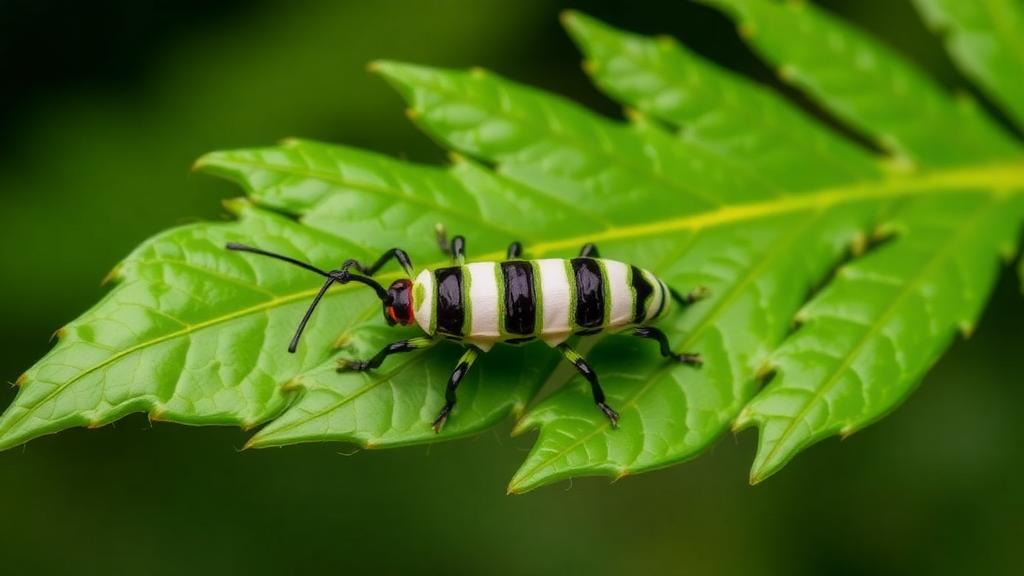
High in the eastern Himalayas, large cardamom is more than a spice. For thousands of smallholder families across Nepal, India, and Bhutan, the shade-loving perennial is a lifeline crop, generating cash income and export earnings from steep, humid slopes where few other high-value crops thrive. Yet production has been slipping for decades, battered by aging plantations, erratic weather, disease, and a persistent roster of insect pests. Among the most damaging of these is the leaf-eating caterpillar Artona chorista, a small zygaenid moth whose larvae can strip a cardamom clump of its foliage with alarming speed. A new study from Taplejung district in eastern Nepal now offers farmers and researchers a carefully quantified comparison of four non-synthetic treatments against this pest, and its results carry a lesson that reaches well beyond cardamom fields.
The research, conducted by a team affiliated with Tribhuvan University, Fort Valley State University, and the Prime Minister Agriculture Modernization Project, evaluated neem oil, horticultural mineral oil, titepati (Artemisia vulgaris) oil, and a fermented cow-dung urine preparation against naturally infested cardamom plants. The work was carried out between March and May 2023 in a farmer-managed plantation of the Ramsey cultivar at 1,541 meters above sea level, a setting typical of the eastern Himalayan cardamom agroecosystem. Crucially, the investigators ran two parallel experiments: a randomized complete block design in the field and a completely randomized laboratory bioassay, allowing them to compare how the same treatments behaved under natural and controlled conditions.
The pest itself is a formidable adversary. Female Artona chorista moths lay eggs in clusters on the underside of cardamom leaves, and after roughly thirteen days the larvae emerge to begin a seven-instar development spanning nearly fifty-nine days. Early instars feed gregariously on the lower leaf surface, consuming the mesophyll while leaving the epidermis intact and producing a characteristic papery skeletonization. Later instars become far more destructive, often devouring the entire leaf blade down to the midrib and slashing the plant’s photosynthetic capacity. With a total egg-to-adult development period approaching one hundred days and multiple seasonal population peaks, the caterpillar can build up rapidly when conditions favor it, which is precisely what happened in the experimental field during the spring infestation window.
In the field trial, each treatment was applied three times at seven-day intervals using a knapsack sprayer, with larval populations counted on tagged clumps before spraying and at two, five, and six days after each application. The results were striking. Neem oil at 2.5 milliliters per liter delivered the numerically greatest suppression, cutting mean larval density from 180.1 to just 3.4 live larvae per sampled clump, a 98.1 percent reduction relative to the pre-treatment baseline. Mineral oil at 10 milliliters per liter ranked second with an 86.3 percent reduction, followed by titepati oil at 79.6 percent and the cow-dung urine extract at 65.5 percent. Meanwhile, larval populations in the untreated control plots surged by 88.3 percent over the same period, climbing from 143.1 to 269.4 larvae per clump and illustrating just how explosive unmanaged infestations can become.
The laboratory bioassay told a different story. Third-instar larvae were confined in rearing jars with cardamom leaves dipped in the same treatment concentrations, and mortality was assessed across three spray cycles. Here, mineral oil dominated, killing 98.5 percent of larvae by raw count, or 98.3 percent after Abbott’s correction for the 10 percent background mortality observed in controls. Neem oil came second at 87.5 percent raw mortality, followed by titepati oil at 70.0 percent and cow-dung urine at 42.5 percent. By the final observation, the five treatments occupied five distinct statistical groupings, meaning every treatment differed significantly from every other. Mineral oil also produced the fastest knockdown, driving live larval counts to a quarter of a larva per jar or less within six days of each application.
The reversal in ranking between the two settings is the study’s most intriguing finding, and the authors attribute it to fundamental differences in how these materials kill insects. Neem oil owes its activity primarily to azadirachtin and related limonoid compounds, which act as antifeedants, repellents, growth regulators, and disruptors of molting and metamorphosis. These effects are slow-acting and cumulative, becoming more pronounced as larvae continue feeding on treated foliage over days and weeks. In the field, where larvae remained exposed to treated leaves between spray cycles, that prolonged exposure appears to have allowed neem’s sublethal effects to accumulate, driving the progressive population decline observed across successive sprays.
Mineral oil, by contrast, works through brute physical force. Horticultural oils suffocate insects by coating the body and blocking the spiracles, the tiny openings through which insects breathe. This contact mechanism depends entirely on the oil film actually reaching the pest, which is far easier to guarantee in a rearing jar than in a shaded, sloping cardamom plantation. Under field conditions, rainfall, ultraviolet degradation, leaf curvature, canopy structure, and the habit of larvae clustering on leaf undersides all conspire to reduce direct contact, plausibly explaining why mineral oil’s laboratory dominance did not translate into field leadership.
The two traditional treatments performed more modestly in both settings. Titepati oil, prepared by local farmers and applied at 0.5 milliliters per liter, achieved intermediate suppression consistent with the insecticidal, repellent, and fumigant properties of the terpenoid compounds found in Artemisia essential oils. The fermented cow-dung urine extract, a preparation known locally as Jholmol and long used by eastern Himalayan farmers for combined pest suppression and soil fertility, showed the weakest activity, though it still reduced larval populations significantly compared with the control. The authors note that variability in the composition of traditionally prepared formulations and limited residual effect may account for its lower performance, and they emphasize that indigenous practices deserve rigorous scientific evaluation before being recommended as standalone controls.
The study is candid about its limitations. At the final field observation, the four active treatments differed significantly from the untreated control but not from one another, so the field ranking is numerical rather than statistically confirmed. Relatively high coefficients of variation at some field dates reflect the naturally aggregated distribution of the larvae and the inherent heterogeneity of a fifty-year-old farmer-managed agroforestry system. The field and laboratory experiments were also analyzed separately and on different efficacy scales, so the contrast between settings was described rather than formally tested. No yield data, cost-benefit analysis, economic thresholds, or non-target safety assessments were included, meaning the findings speak to larval suppression alone rather than to complete farmer-level recommendations.
Even with those caveats, the combined field-laboratory approach yields practical guidance. Neem oil emerges as a promising botanical option for suppressing Artona chorista under real-world conditions, particularly where organic or low-residue production is the goal, though applications should avoid flowering periods to protect pollinators such as the bumblebee Bombus haemorrhoidalis. Mineral oil merits consideration as a rotational or supplementary treatment where rapid knockdown is needed and thorough spray coverage can be achieved. Titepati oil may serve as a supplementary botanical tool during moderate infestations, while cow-dung urine requires further evidence before standalone use. More broadly, the work delivers a methodological message for pest management everywhere: laboratory toxicity alone cannot predict field performance, and only by testing treatments under both controlled and farmer-managed conditions can researchers build recommendations that actually work on the mountain slopes where the crop, and the caterpillar, live.
Subject of Research: Comparative efficacy of botanical and mineral-based treatments against the leaf-eating caterpillar Artona chorista in large cardamom in eastern Nepal
Article Title: Comparative field and laboratory efficacy of botanical and mineral-based treatments against Artona chorista in large cardamom in eastern Nepal
Article References: Lamichhane, P., Adhikari, J., Bhattarai, P., & Yogi, L. N. (2026). Comparative field and laboratory efficacy of botanical and mineral-based treatments against Artona chorista in large cardamom in eastern Nepal. Discover Agriculture, 4(1), Article 311. https://doi.org/10.1007/s44279-026-00788-w
Image Credits: AI Generated
DOI: 10.1007/s44279-026-00788-w
Keywords: large cardamom, Artona chorista, neem oil, mineral oil, botanical pesticide, Artemisia vulgaris, cow-dung urine, Nepal, pest management, field trial, laboratory bioassay, integrated pest management
News Source: Alan Morgan. (October 5, 2026). Neem Oil Tops Field Trials Against Cardamom Caterpillar in Nepal, but Mineral Oil Wins in the Lab. Scienmag.