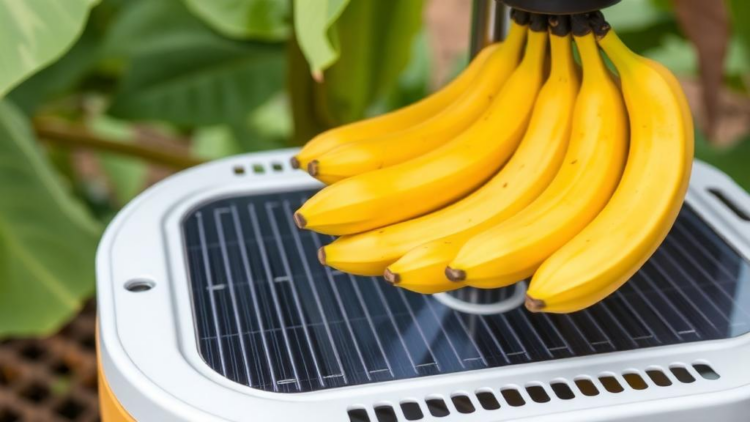
Solar drying has long promised a low-carbon way to preserve tropical fruit, but it has always carried an awkward secret: nobody can be entirely sure when the product is actually finished. Sunlight shifts, clouds roll in, humidity swings, and a fixed drying schedule that works perfectly one afternoon can leave bananas soggy or rock-hard the next. Now a research team in Thailand has built a solar dryer that solves this problem in an unusually rigorous way, using internet-connected load cells, formal measurement-uncertainty analysis, and a conservative stopping rule to decide, in real time, exactly when the fruit has reached its target moisture content.
The study, published in the Journal of Agriculture and Food Research, was conducted by Narathip Sujinda and Sasitorn Nakthong using a pilot-scale parabolic solar dryer in Nakhon Pathom province. The researchers dried whole peeled bananas of the local Kluai Namwa Mali Ong cultivar, pressed to a uniform thickness of about three centimeters, starting from an initial moisture content of roughly 73 percent on a wet basis. Their target endpoint was 18 percent moisture, with an acceptable window of 17 to 19 percent, a range chosen to match established practice for dried banana while avoiding the energy waste and quality damage of over-drying.
The heart of the system is a set of load-cell monitoring trays installed at the front, middle, and rear of the drying chamber. Each tray rests on two 5-kilogram load cells read through a 24-bit analog-to-digital converter and an ESP-32 microcontroller, which transmits mass, air temperature, and relative humidity to a cloud database every ten minutes. Because the dry-solid mass of each banana is known from its initial mass and moisture, any change in weight translates directly into moisture content through a simple mass-balance calculation. In principle, this turns an ordinary weighing scale into a continuous moisture sensor for the product itself, rather than merely for the air around it.
What distinguishes the new work is its refusal to trust that raw number. Load cells in a real solar dryer face vibration from ventilation fans, thermal drift, calibration residuals, load-position effects, and short-term signal noise, all of which feed into the endpoint decision. Following the Guide to the Expression of Uncertainty in Measurement, the team propagated every uncertainty source through the moisture equations, producing an expanded uncertainty attached to each reading. Readings whose uncertainty exceeded 2 percent moisture, or whose apparent moisture changed implausibly fast between consecutive ten-minute intervals, were flagged as anomalies and excluded. Of 411 evaluated time points, only about 5 percent were filtered out, and a sensitivity analysis showed the final drying endpoints were unchanged across a wide range of screening thresholds.
The remaining position-specific estimates were combined using an uncertainty-weighted average, in which more reliable sensors count for more, and then passed through a linear bias-correction model calibrated on three complete drying runs and validated on three entirely separate runs. The effect was dramatic. Raw IoT moisture estimates tracked the reference measurements closely, with a coefficient of determination near 0.99, but systematically overestimated moisture by nearly 2 percentage points. After filtering, weighting, and correction, the root-mean-square error fell from 2.62 to 1.21 percent, and the prediction bias collapsed to almost nothing. In the critical 17 to 19 percent range where the drying decision is actually made, the corrected estimates agreed with a halogen moisture analyzer to within roughly 0.4 percent.
The endpoint rule itself is deliberately conservative. Drying stops only when all three monitored positions, front, middle, and rear, simultaneously show corrected moisture within the target window and an upper uncertainty bound that does not exceed 19 percent, sustained for two consecutive valid readings. This prevents a single dry spot from masking a wetter region elsewhere in the chamber. In practice, the rear position repeatedly held the process back: at one point during each run its uncertainty bound still exceeded the limit, forcing the dryer to keep running until the criterion was genuinely met at every location.
Compared against a conventional fixed 25-hour drying schedule, the uncertainty-aware endpoint control cut active drying time by 20 percent under sunny conditions and 8 percent under mixed clouds, while matching the conventional duration under overcast skies. Final moisture contents landed at 18.51, 18.87, and 18.71 percent across the three validation runs, all comfortably inside the target window. The energy consequences followed directly: under sunny conditions the accounted energy input dropped by 23.4 percent and specific energy consumption fell from 11.64 to 9.12 kilowatt-hours per kilogram of water removed, simply because the dryer stopped cooking fruit that was already dry enough.
Product quality moved in the same direction. Bananas stopped at the moisture-based endpoint showed less total color change and lower instrumental hardness than samples dried for the full fixed time, which under sunny conditions had been driven down to 14.6 percent moisture. The authors are careful to note that these quality differences reflect the higher residual moisture at the smart endpoints rather than a direct effect of the control strategy itself, since the two treatments did not finish at identical moisture levels. Drying kinetics fitted across the runs showed the two-term exponential model describing the moisture curves almost perfectly, and apparent effective moisture diffusivity ranged from 1.94 to 2.70 times ten to the minus nine square meters per second, tracking the available solar energy in each run.
The researchers are candid about the limitations. Each weather condition was represented by a single drying run, chamber airflow was never directly measured, solar radiation came from a meteorological station nearly two kilometers away, and overnight refrigerated storage between daily drying sessions could have caused internal moisture redistribution that the mass measurements alone could not capture. The energy indices, lacking on-site uncertainty data for the solar input, are treated as descriptive system-level estimates rather than metrologically validated efficiencies.
Even so, the study marks a meaningful step in the evolution of solar food drying. The individual ingredients, load-cell weighing, uncertainty propagation, anomaly filtering, and bias correction, are all established techniques; the contribution lies in welding them into a single validated workflow where measurement uncertainty becomes part of the stopping decision itself. For smallholder and pilot-scale producers in tropical regions, where closed-loop climate control is unaffordable but smartphones and cheap microcontrollers are not, a dryer that weighs its own cargo and refuses to stop until the fruit is provably, conservatively dry could turn one of the oldest preservation technologies into a genuinely intelligent one. The team suggests future work should extend the framework across seasons, different products, and matched-moisture quality comparisons, and ultimately link the endpoint algorithm to automated system shutdown.
Subject of Research: Uncertainty-aware IoT-based real-time moisture monitoring and endpoint control for solar drying of bananas
Article Title: Uncertainty-aware IoT-based moisture monitoring and endpoint control for banana drying in a parabolic solar dryer
Article References: Sujinda, N., & Nakthong, S. (2026). Uncertainty-aware IoT-based moisture monitoring and endpoint control for banana drying in a parabolic solar dryer. Journal of Agriculture and Food Research, 31, Article 103328. https://doi.org/10.1016/j.jafr.2026.103328
Image Credits: AI Generated
DOI: 10.1016/j.jafr.2026.103328
Keywords: solar drying, IoT, load cell, moisture monitoring, measurement uncertainty, banana, food preservation, drying kinetics, endpoint control, renewable energy, postharvest technology, bias correction
Cite Scienmag News
APA MLA Chicago
Alan Morgan. (October 4, 2026). Smart Solar Dryer Knows When Bananas Are Done, Cutting Drying Time by 20 Percent. Scienmag. https://scienmag.com/smart-solar-dryer-knows-when-bananas-are-done-cutting-drying-time-by-20-percent/
Alan Morgan. “Smart Solar Dryer Knows When Bananas Are Done, Cutting Drying Time by 20 Percent.” Scienmag, 4 October 2026, https://scienmag.com/smart-solar-dryer-knows-when-bananas-are-done-cutting-drying-time-by-20-percent/. Accessed 4 October 2026.
Alan Morgan. “Smart Solar Dryer Knows When Bananas Are Done, Cutting Drying Time by 20 Percent.” Scienmag. October 4, 2026. https://scienmag.com/smart-solar-dryer-knows-when-bananas-are-done-cutting-drying-time-by-20-percent/
Copy citation Download RIS
Tags: adaptive drying schedules using internet of thingsautomated control of banana drying processbananabias correctiondrying kineticsendpoint controlfood preservationformal measurement-uncertainty analysis in food preservationinnovative approaches to reduce drying timeintelligent solar drying systemsinternet-connected load cells for fruit dryingIoTload celllow-carbon tropical fruit preservation methodsmeasurement uncertaintymoisture monitoringpostharvest technologyprecision in solar drying of fruitsreal-time moisture content measurement in solar dryingRenewable Energysolar dryer technologysolar dryingsustainable food processing technologiestropical fruit drying optimization