For men diagnosed with localized prostate cancer, radiation treatment has long meant a difficult trade-off: either endure seven to eight weeks of daily hospital visits with conventional fractionated radiotherapy, or accept a compressed schedule that historically carried a heavier burden of urinary side effects. A new prospective clinical trial from Japan now suggests that a middle path—proton beam therapy delivered in just 12 fractions over three weeks—can dramatically shorten treatment time while keeping acute genitourinary toxicity remarkably low. The study, published in Holistic Integrative Oncology, followed 100 patients treated at Sapporo Kojinkai Memorial Hospital between March 2021 and June 2024, and its findings are generating attention for what they imply about the future of precision radiotherapy.
The central result is striking in its simplicity. Among the 100 enrolled patients, only 8 percent developed grade 2 acute genitourinary toxicity—defined in this trial as urinary frequency severe enough to require two or more medications—with a 95 percent confidence interval of 2.6 to 13.4 percent. Not a single patient experienced grade 3 or higher acute genitourinary toxicity, and no grade 2 or worse urinary retention, urinary pain, urinary urgency, or hematuria was recorded. Grade 1 urinary frequency, the mildest form, occurred in 46 percent of patients, but even this figure reflects a symptom burden that many patients with enlarged prostates already live with before treatment begins. No acute gastrointestinal adverse events were observed at all, a notable outcome given that rectal toxicity is often the limiting factor in prostate radiotherapy.
The radiobiological logic behind the regimen is what makes the result scientifically interesting. Prostate cancer cells carry an unusually low alpha/beta ratio—estimated at approximately 1.4 Gy—which describes how sensitive a tumor is to the size of each radiation fraction. A low alpha/beta value means the cancer is more vulnerable to large individual doses than the surrounding healthy organs are. Hypofractionation exploits this vulnerability: by delivering bigger doses per session, clinicians can inflict disproportionate damage on tumor cells while the nearby bladder and rectum, which have higher alpha/beta values, theoretically tolerate the schedule better. Conventional fractionated radiotherapy delivers 2.0 Gy per fraction across 38 to 40 sessions over nearly two months; the Japanese trial delivered 51.6 Gy in relative biological effectiveness terms across just 12 sessions in a median overall treatment time of 20 days, with no interruptions or delays in any patient.
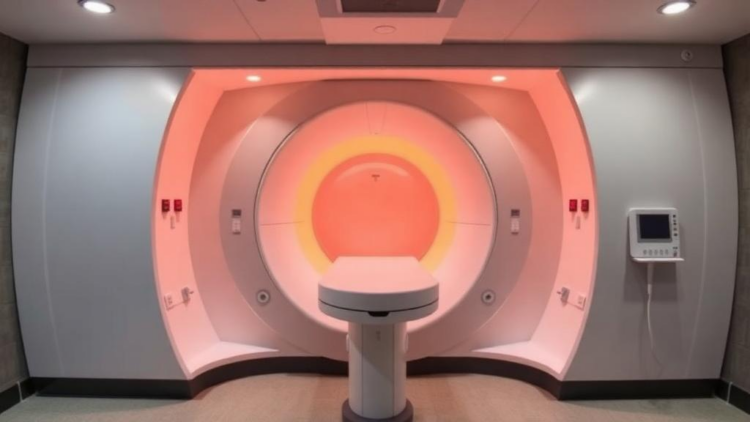
Protons add a second layer of physical advantage on top of this radiobiological one. Unlike photon beams, which deposit radiation along their entire path through the body and exit on the far side, protons stop at a depth determined by their energy—the Bragg peak—releasing their maximum dose precisely at the tumor and falling off rapidly beyond it. This means minimal energy is deposited in normal tissue in front of the target and essentially none behind it. The trial used the IBA Proteus ONE system, a compact gantry with spot-scanning beam delivery, and planned treatments in RayStation version 10A using a single-field uniform dose algorithm applied to a beam-specific planning target volume, an approach shown to improve conformity and organ sparing compared with uniform-dose planning target volumes.
The technical preparation was equally meticulous. Before treatment, urologists implanted transperineal ultrasound-guided gold fiducial markers into each patient’s prostate and injected SpaceOAR, a hydrogel spacer that physically separates the prostate from the rectum, reducing the dose the rectal wall receives. Daily treatments began with image-guided bony alignment followed by fiducial-based registration, maintaining positional accuracy within a 1-millimeter margin. Patients were instructed to arrive with a comfortably full bladder and an empty rectum, immobilized supine on a vacuum pad. Simulation used 1-millimeter-thick CT slices fused with 3.0 Tesla MRI. The clinical target volume encompassed the prostate and, depending on risk group, part of the seminal vesicles—none for low-risk patients, the proximal third for intermediate-risk, and the proximal half for high-risk—expanded by 5 to 6 millimeters to form the planning target volume. Elective pelvic lymph node irradiation was deliberately omitted.
The trial’s design reflects a careful, staged approach to safety. Built on Simon’s minimax two-stage design with a significance level of 0.05 and 90 percent power, the protocol set acceptable and unacceptable toxicity thresholds at below 5 percent and above 15 percent respectively. In the first stage, 30 patients were enrolled; only two developed grade 2 genitourinary toxicity, satisfying the continuation criterion. In the second stage, the cohort grew to 83 patients with seven grade 2 events, again passing the checkpoint. A protocol-specified expansion then brought the total to 100 patients. Any grade 4 or 5 normal tissue toxicity would have mandated immediate suspension of the study, an event that never occurred. The researchers also adopted a modified grading system from earlier work by Nakajima and colleagues, because standard CTCAE version 5.0 criteria struggle to distinguish radiation-induced urinary symptoms from the baseline symptoms of benign prostatic hyperplasia, which many older prostate cancer patients already have. Under the modified criteria, one dysuria medication counted as grade 1 and two or more as grade 2.
Perhaps the most puzzling finding is a counterintuitive pattern in the subgroup analysis. Multivariate logistic regression revealed that high-risk patients—those with higher PSA levels, more advanced T stage, or Gleason scores of 8 or above—had a significantly lower likelihood of developing grade 2 genitourinary toxicity than lower-risk patients, with an odds ratio of 0.023 and a P value of 0.042. High-risk patients received both neoadjuvant and adjuvant androgen deprivation therapy, while intermediate-risk patients received neoadjuvant hormone therapy alone. One earlier hypothesis held that androgen deprivation shrinks the prostate and thereby reduces toxicity, but the intermediate-risk group, which also received hormone therapy, did not show the same protective pattern. The authors are candid that the mechanism behind this trend toward low toxicity in the high-risk group is unknown and warrants further investigation.
The analysis also confirmed benign prostatic hyperplasia as an independent risk factor for grade 2 genitourinary toxicity, with an odds ratio of 0.040 and a P value of 0.018. This aligns with clinical intuition: a gland already compromised by enlargement has less functional reserve when radiation inflames the urinary tract. The finding underscores why the modified grading criteria matter, since disentangling treatment effects from pre-existing conditions is essential for honest toxicity reporting. It also hints at a practical implication for future trials—baseline urinary function may need to be a stratification factor when comparing fractionation schedules across institutions.
How does this compare with photon-based alternatives? The evidence base for shorter prostate radiotherapy is already strong: randomized trials of hypofractionated and ultra-hypofractionated photon therapy, including the HYPO-RT-PC trial of ultra-hypofractionated treatment, have confirmed efficacy comparable to conventional schedules. But acute toxicity data have been less favorable. A pilot study of ultra-hypofractionated intensity-modulated radiation therapy delivering 54 Gy in 15 fractions reported acute grade 2 genitourinary toxicity in 21 percent of patients—more than double the 8 percent seen in the proton trial. Earlier proton work by Nakajima’s group using 60 to 63 Gy in 20 to 21 fractions reported a 5.9 percent rate, and carbon-ion radiotherapy studies using the same 12-fraction, 51.6 Gy regimen achieved rates of 3 to 4 percent. Because carbon ions and protons differ fundamentally in physical characteristics and biological modeling, the question of whether the carbon-ion schedule could be safely transplanted to proton therapy had lacked prospective evidence—until now. A related phase II effort by Iwata and colleagues reported a 6.3 percent incidence using similar modified criteria in a 300-patient proton cohort, closely mirroring the present result.
The study has acknowledged limitations. It was conducted at a single institution, and patients with severe baseline urinary symptoms were excluded, which ensures a clean read on radiation-induced toxicity but limits generalizability to men with poor baseline urinary function. The current report covers only acute toxicity within three months; late genitourinary and gastrointestinal effects, local control rates, and biochemical recurrence-free survival await the ongoing expansion cohort, which targets 300 evaluable patients. Still, the early signal is compelling: a three-week proton regimen that matches the safety profile of far longer schedules, spares the bowel entirely in the acute setting, and returns patients to their lives weeks earlier. If the long-term data hold, the combination of the Bragg peak’s physics, hypofractionation’s radiobiology, and hydrogel spacer technology may redefine what men can expect from curative prostate radiotherapy—fewer visits, fewer side effects, and no compromise on the medicine itself.
Subject of Research: Acute genitourinary toxicity of hypofractionated proton beam therapy for localized prostate cancer
Article Title: Analysis of acute genitourinary toxicity in hypofractionated proton beam therapy for localized prostate cancer
Article References: Yang, W., Mizoe, J., Osaka, Y., Miyabe, Y., Seki, H., Nakamura, H., Sugawara, H., Miyajima, N., Iwata, H., Hashimoto, T., & Komaki, R. (2026). Analysis of acute genitourinary toxicity in hypofractionated proton beam therapy for localized prostate cancer. Holistic Integrative Oncology, 5(1), Article 35. https://doi.org/10.1007/s44178-026-00246-z
Image Credits: AI Generated
DOI: 10.1007/s44178-026-00246-z
Keywords: prostate cancer, proton beam therapy, hypofractionation, genitourinary toxicity, radiation oncology, Bragg peak, CTCAE, androgen deprivation therapy, benign prostatic hyperplasia, SpaceOAR, clinical trial, urinary frequency
Cite Scienmag News
APA
MLA
Chicago
Nathaniel Bowman. (October 4, 2026). Three-Week Proton Therapy for Prostate Cancer Shows Low Urinary Side-Effect Rate. Scienmag. https://scienmag.com/three-week-proton-therapy-for-prostate-cancer-shows-low-urinary-side-effect-rate/
Nathaniel Bowman. “Three-Week Proton Therapy for Prostate Cancer Shows Low Urinary Side-Effect Rate.” Scienmag, 4 October 2026, https://scienmag.com/three-week-proton-therapy-for-prostate-cancer-shows-low-urinary-side-effect-rate/. Accessed 4 October 2026.
Nathaniel Bowman. “Three-Week Proton Therapy for Prostate Cancer Shows Low Urinary Side-Effect Rate.” Scienmag. October 4, 2026. https://scienmag.com/three-week-proton-therapy-for-prostate-cancer-shows-low-urinary-side-effect-rate/
Copy citation
Download RIS
Tags: advanced radiation techniquesandrogen deprivation therapybenign prostatic hyperplasiaBragg peakclinical trialclinical trial on prostate cancerCTCAEgenitourinary toxicityhypofractionated radiotherapyhypofractionationlow urinary side effectsnon-invasive prostate cancer treatmentprecision radiotherapyprostate cancerproton beam therapyproton therapy for prostate cancerradiation oncologyshort-course radiation treatmentside effect management in radiotherapySpaceOARtreatment duration in prostate cancerurinary frequencyurinary toxicity rates