• HOME
  • NEWS
  • EXPLORE
    • CAREER
      • Companies
      • Jobs
    • EVENTS
    • iGEM
      • News
      • Team
    • PHOTOS
    • VIDEO
    • WIKI
  • BLOG
  • COMMUNITY
    • FACEBOOK
    • INSTAGRAM
    • TWITTER
Saturday, December 27, 2025
BIOENGINEER.ORG
No Result
View All Result
  • Login
  • HOME
  • NEWS
  • EXPLORE
    • CAREER
      • Companies
      • Jobs
        • Lecturer
        • PhD Studentship
        • Postdoc
        • Research Assistant
    • EVENTS
    • iGEM
      • News
      • Team
    • PHOTOS
    • VIDEO
    • WIKI
  • BLOG
  • COMMUNITY
    • FACEBOOK
    • INSTAGRAM
    • TWITTER
  • HOME
  • NEWS
  • EXPLORE
    • CAREER
      • Companies
      • Jobs
        • Lecturer
        • PhD Studentship
        • Postdoc
        • Research Assistant
    • EVENTS
    • iGEM
      • News
      • Team
    • PHOTOS
    • VIDEO
    • WIKI
  • BLOG
  • COMMUNITY
    • FACEBOOK
    • INSTAGRAM
    • TWITTER
No Result
View All Result
Bioengineer.org
No Result
View All Result
Home NEWS Science News Biology

Two significant warming intervals in southern China since 1850

Bioengineer by Bioengineer
July 6, 2017
in Biology
Reading Time: 2 mins read
0
Share on FacebookShare on TwitterShare on LinkedinShare on RedditShare on Telegram
IMAGE

Credit: Yang Liu

Regular meteorological observations in most of China only started in the 1950s, meaning it is therefore necessary to reconstruct regional temperature series from high-resolution temperature proxies to compensate for the deficiency.

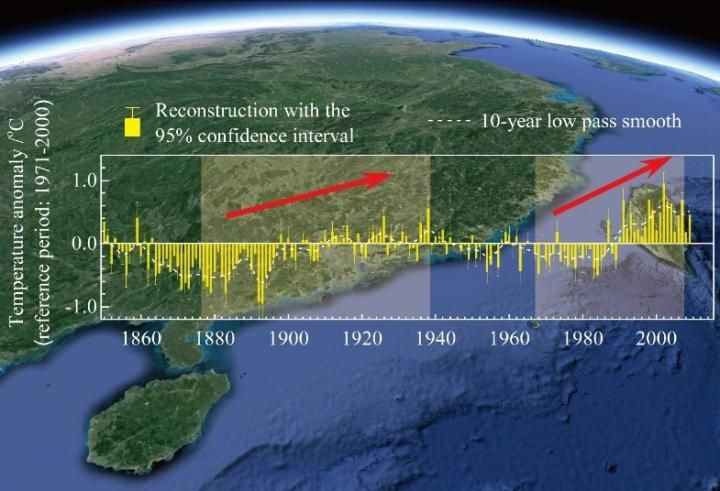
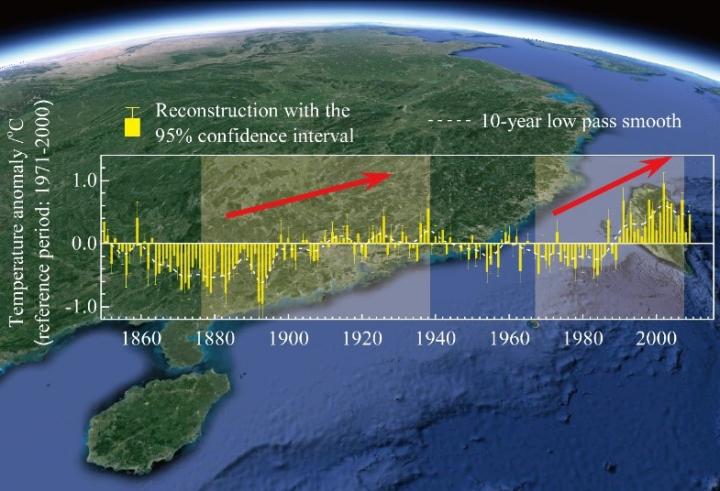
Scientists from the Institute of Geographic Sciences and Natural Resources Research, Chinese Academy of Sciences, reconstructed the annual temperature anomaly in southern China during 1850-2009 based on the southern limit of snowfall recorded in Chinese documents, chronologies of tree-ring width, and tree-ring stable oxygen isotope (δ18O), using the method of signal decomposition and synthesis. The reconstructed series captures 65.8% of the variance of observations during 1952-2009, and the variance contributions of different frequency domains for the result is closer to those of temperature observations than reconstruction from a single proxy.

This multi-proxy-based temperature reconstruction shows robust centennial warming, with a linear trend of 0.47°C (100 yr)-1 during 1871-2009. Moreover, on the decadal scale, it shows the first rapid cooling as having started from the 1860s, followed by a cold interval until the early 1890s, with the coldest years being 1892 and 1893. The first significant warming is from 1877 to 1938 [0.125°C (10 yr)-1], with the most rapid rate of increase being 0.308°C (10 yr)-1 during 1892-1916, resulting in a moderate warm interval during the 1910s-1930s. Then, a slight temperature decline is apparent from the 1940s to the late 1960s. Another significant increase in temperature is shown to start around 1970 [0.258°C (10 yr)-1 during 1968-2007], with the highest rate being 0.512°C (10 yr)-1 during 1983-2002, though a warming hiatus occurs in the 2000s. Compared with the warm interval in the 1910s-1930s, the temperature in the 1980s-2000s is much higher. These results reveal that both the level of warmth and the warming rate from the 1980s are unprecedented since 1850.

This work, published in Advances in Atmospheric Sciences, provides an independent case to validate the global warming of the past 160 years and its recent hiatus.

###

Media Contact

Zheng Lin
[email protected]
86-108-299-5053
@aasjournal

http://english.iap.cas.cn/

Original Source

https://link.springer.com/article/10.1007/s00376-017-6228-x http://dx.doi.org/10.1007/s00376-017-6228-x

############

Story Source: Materials provided by Scienmag

Share12Tweet8Share2ShareShareShare2

Related Posts

Chloroplast Genome of Ecklonia maxima: A Comparative Study

Chloroplast Genome of Ecklonia maxima: A Comparative Study

December 27, 2025
Tissue-Specific Gene Expression Variance in Mice

Tissue-Specific Gene Expression Variance in Mice

December 27, 2025

Sex Differences in Liver Metabolism and Disease

December 27, 2025

SyBValS: Ensuring Accuracy in Biological Pathway Mapping

December 27, 2025
Please login to join discussion

POPULAR NEWS

  • Robotic Waist Tether for Research Into Metabolic Cost of Walking

    NSF funds machine-learning research at UNO and UNL to study energy requirements of walking in older adults

    71 shares
    Share 28 Tweet 18
  • Nurses’ Views on Online Learning: Effects on Performance

    70 shares
    Share 28 Tweet 18
  • Exploring Audiology Accessibility in Johannesburg, South Africa

    51 shares
    Share 20 Tweet 13
  • Unraveling Levofloxacin’s Impact on Brain Function

    55 shares
    Share 22 Tweet 14

About

We bring you the latest biotechnology news from best research centers and universities around the world. Check our website.

Follow us

Recent News

Pilot Study: Haptic VR Simulation for Nursing Students

Unraveling Bisphenol A’s Stroke Toxicity Mechanisms

CAR-T vs. Bispecific Antibodies: A Treatment Showdown

Subscribe to Blog via Email

Enter your email address to subscribe to this blog and receive notifications of new posts by email.

Join 71 other subscribers
  • Contact Us

Bioengineer.org © Copyright 2023 All Rights Reserved.

Welcome Back!

Login to your account below

Forgotten Password?

Retrieve your password

Please enter your username or email address to reset your password.

Log In
No Result
View All Result
  • Homepages
    • Home Page 1
    • Home Page 2
  • News
  • National
  • Business
  • Health
  • Lifestyle
  • Science

Bioengineer.org © Copyright 2023 All Rights Reserved.