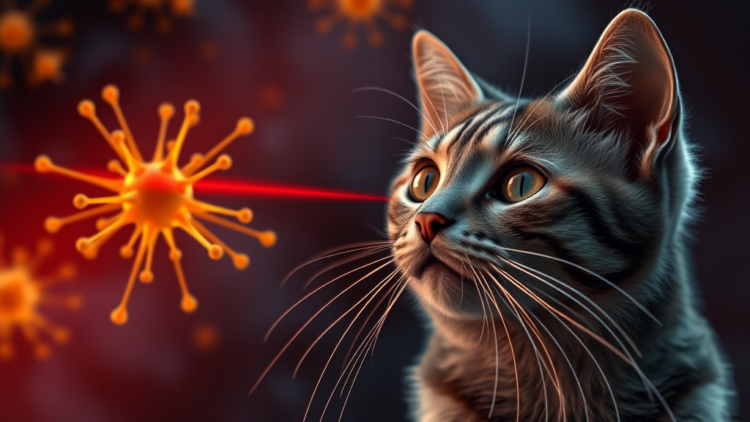
In a veterinary clinic in Cairo, ten cats with spontaneous mammary carcinoma became the unlikely protagonists of a study that could reshape how aggressive breast cancers are monitored and treated, in animals and possibly in humans. Researchers led by Rasha H. Elsabagh of the Animal Health Research Institute in Egypt applied a therapy built on one of nanotechnology’s most elegant tricks: tiny gold rods that convert near-infrared laser light into lethal local heat. Their results, published in the Springer journal Veterinary Oncology, show that this plasmonic photothermal therapy can drive circulating cancer stem cells down to near-normal levels in cats whose disease had not yet spread, while revealing a sobering limit of the approach in animals whose tumors had already seeded the lungs.
Feline mammary carcinoma is not a rare or gentle disease. It is the third most common cancer in domestic cats, and roughly ninety percent of these tumors are malignant, marked by rapid growth and an aggressive talent for metastasis. Cats also share many environmental and genetic risk factors with humans, which makes them a more faithful stand-in for human breast cancer than typical laboratory rodents. That translational relevance is precisely why the Egyptian team chose to work with client-owned queens rather than engineered mouse models, following the disease as it unfolded naturally over a follow-up period that stretched to twenty-nine months.
The therapy itself rests on the physics of surface plasmons. The gold nanorods used in the study measured roughly 27 by 6 nanometers and were coated with polyethylene glycol and RGD peptide ligands to keep them biocompatible. When an 808-nanometer diode laser illuminated the injected rods, the particles absorbed the light and released it as heat, raising the tumor to a carefully monitored 42 to 44 degrees Celsius, a range hot enough to kill malignant cells while sparing surrounding tissue. A 33-gauge thermocouple needle tracked the temperature throughout irradiation. Cats with tumors smaller than three centimeters received the nanorod therapy alone, repeated every two weeks until the tumor regressed, while those with larger masses underwent partial mastectomy followed by a single intraoperative dose of light-activated nanorods applied directly to the surgical bed.
What distinguishes this trial from earlier nanorod studies is its focus on cancer stem cells, the stubborn subpopulation of tumor cells that self-renew, drive invasion, and shrug off conventional chemotherapy and radiation. The researchers tracked these cells not in the tumor itself but in the bloodstream, using flow cytometry to count circulating mammary cancer stem cells bearing the CD133 marker or the CD44-positive/CD24-negative phenotype, signatures long associated with metastatic potential in human breast cancer. One milliliter of blood, drawn every two weeks for a year, was enough to follow the ebb and flow of these dangerous cells in real time, a liquid biopsy requiring no invasive tissue sampling.
The results in nonmetastatic cats were striking. Four queens treated with nanorod therapy alone achieved complete tumor remission within six to eight weeks, with no local recurrence or distant spread during the observation year. The two nonmetastatic cats treated with surgery plus photothermal therapy healed completely within a month and remained free of recurrence. Across both groups, circulating stem cell counts fell significantly compared with baseline, a decline the authors reported at a p-value of 0.00512, and the one-year survival rate for the whole cohort reached sixty percent. Nonmetastatic cats treated with the nanorod therapy alone showed a median overall survival of 17.5 months, while those receiving the combined surgical approach survived a median of 12.5 months.
The story was markedly different for the four cats that entered the study with lung metastases, or developed them along the way. In these animals, circulating cancer stem cell counts rose rather than fell, a statistically significant increase at p equal to 0.008, and lung metastases persisted despite treatment. The explanation, the authors argue, is geometric as much as biological: localized laser therapy can only reach cells within the illuminated tumor bed. Once stem cells have escaped into the circulation and colonized distant tissue, no amount of heat delivered to the primary tumor can touch them. Primary tumors, moreover, are known to prepare distant organs for settlement before the wandering cells even arrive, creating pre-metastatic niches that welcome and shelter them.
The study also delivered a diagnostic advance. Using receiver operating characteristic analysis, the team established cutoff values that cleanly separated metastatic from nonmetastatic cats: more than 996 CD44-positive/CD24-negative cells per milliliter of blood, or more than 110 CD133-positive cells. The area under the curve was excellent for both markers, with one hundred percent specificity, and the CD44-positive/CD24-negative count proved a powerful predictor, correlating with metastasis with a Spearman coefficient of 0.943. Notably, these feline thresholds are far higher than the few-cells-per-milliliter cutoffs used in human medicine, a difference the authors attribute to the sheer aggressiveness of feline mammary tumors, which shed neoplastic emboli and display molecular profiles that favor invasion and dissemination.
Why did the therapy work so well in cats whose cancer had not yet spread? The authors point to three converging mechanisms. Gold nanoparticles are known to block heparin-binding growth factors, starving tumors of new blood vessels. Local hyperthermia selectively destroys the tumor-associated vasculature. And the nanorods themselves appear to home in on and eliminate cancer stem cells, consistent with earlier work showing that gold nanorod hyperthermia reduces the mammosphere-forming capacity of breast cancer stem cells in vitro. On top of these local effects, the team proposes an immunological dimension: heat-induced tumor cell death can release damage-associated molecular patterns that activate dendritic cells, prime cytotoxic T lymphocytes, and potentially generate an abscopal effect in which the treated tumor’s destruction ripples outward to attack disseminated cells elsewhere in the body.
Yet the absence of any such systemic benefit in the metastatic cats tempers that hypothesis. The authors acknowledge that tumor burden in these animals may simply have exceeded the threshold needed for effective immune activation, and they cite evidence that locoregional treatment alone has never been shown to influence distant metastasis or survival. Their conclusion is pragmatic: cats with established metastatic disease will need systemic approaches, perhaps gold nanorods conjugated with antibodies that specifically hunt cancer stem cells throughout the bloodstream, rather than localized photothermal ablation. The flow cytometry monitoring, meanwhile, proved its worth as an early warning system, distinguishing treatment responders from nonresponders weeks before clinical signs might have done so.
The authors are candid about the study’s limits. Ten cats is a small cohort, the work was single-center, histopathologic tumor grades were not assessed, and antibody constraints prevented simultaneous staining for all three stem cell markers. Larger, multicenter trials with longer follow-up will be needed before the approach can be considered validated. Even so, the proof of concept is compelling: a light-activated nanoparticle therapy, tracked by a simple milliliter of blood, drove tumors into complete remission and cleared their circulating stem cells in cats otherwise facing a grim prognosis. Given how closely feline mammary carcinoma mirrors human breast cancer, the humble house cat may once again prove to be one of oncology’s most instructive teachers, this time demonstrating that the future of cancer therapy may be measured in nanometers and counted one cell at a time.
Subject of Research: Gold nanorod-mediated plasmonic photothermal therapy for feline mammary carcinoma, monitored through circulating cancer stem cells
Article Title: Gold Nano-Rod (AuNR)-mediated plasmonic photothermal therapy in feline mammary carcinoma: assessing metastatic and nonmetastatic outcomes
Article References: Gold Nano-Rod (AuNR)-mediated plasmonic photothermal therapy in feline mammary carcinoma: assessing metastatic and nonmetastatic outcomes. (n.d.). https://doi.org/10.1186/s44356-025-00035-2
Image Credits: AI Generated
DOI: 10.1186/s44356-025-00035-2
Keywords: gold nanorods, plasmonic photothermal therapy, feline mammary carcinoma, cancer stem cells, flow cytometry, liquid biopsy, metastasis, nanomedicine, veterinary oncology, breast cancer model, CD44, CD133
Cite Scienmag News
APA MLA Chicago
Nathaniel Bowman. (September 27, 2026). Gold Nanorods and Laser Light Strike at Cancer Stem Cells in Cats With Breast Tumors. Scienmag. https://scienmag.com/gold-nanorods-and-laser-light-strike-at-cancer-stem-cells-in-cats-with-breast-tumors/
Nathaniel Bowman. “Gold Nanorods and Laser Light Strike at Cancer Stem Cells in Cats With Breast Tumors.” Scienmag, 27 September 2026, https://scienmag.com/gold-nanorods-and-laser-light-strike-at-cancer-stem-cells-in-cats-with-breast-tumors/. Accessed 27 September 2026.
Nathaniel Bowman. “Gold Nanorods and Laser Light Strike at Cancer Stem Cells in Cats With Breast Tumors.” Scienmag. September 27, 2026. https://scienmag.com/gold-nanorods-and-laser-light-strike-at-cancer-stem-cells-in-cats-with-breast-tumors/
Copy citation Download RIS
Tags: breast cancer modelcancer stem cellsCD133CD44comparative oncology studies involving catsearly detection and treatment of feline mammary tumorsfeline mammary carcinomafeline mammary carcinoma researchflow cytometrygold nanorodsgold nanorods for cancer treatmentheat-based cancer therapies in catslaser photothermal therapy in veterinary oncologyliquid biopsymetastasismetastatic breast cancer in animals and humansNanomedicinenanomedicine applications in veterinary medicinenanotechnology-based cancer therapies in catsnear-infrared laser treatment for tumorsplasmonic photothermal therapytargeting cancer stem cells with nanomaterialstranslational cancer research using domestic catsveterinary oncology