Caffeine is the most widely consumed psychoactive substance on Earth, threaded through coffee, tea, energy drinks, and medications, yet detecting it quickly and accurately at trace levels has long frustrated analytical chemists. A research team at National Chung Hsing University in Taichung, Taiwan, has now unveiled a sensor platform that tackles this challenge by combining nanoscale metal fabrication with electrochemical control. Writing in the Journal of Nanoparticle Research, Huan-Yu Shi and Chu-Yu Huang describe an electrochemical surface-enhanced Raman spectroscopy (EC-SERS) platform built from gold-silver core-shell nanostructure arrays that can measure caffeine down to concentrations of roughly 0.05 milligrams per liter, a proof-of-concept sensitivity that could reshape how trace molecular detection is performed outside the traditional laboratory.
The problem the researchers set out to solve is one of trade-offs. Conventional electrochemical sensors, while fast and inexpensive, often lack the molecular specificity needed to distinguish caffeine from the chemical noise of a real sample. High-performance liquid chromatography, the gold standard for caffeine quantification, delivers precise results but demands bulky instrumentation, skilled operators, and extensive sample preparation. Standard surface-enhanced Raman spectroscopy substrates offer rich molecular fingerprints, but their signals frequently depend on random hotspots, the nanoscale gaps where electromagnetic fields are intensified, producing erratic and poorly reproducible readings from one spot to the next. Each technique, in isolation, leaves something essential on the table.
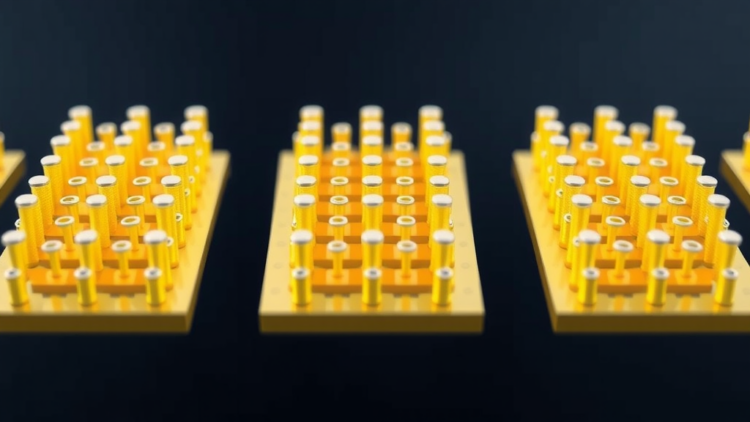
The Taiwanese team’s answer was to merge these approaches into a single, field-regulated platform. At its heart lies a bimetallic nanostructure array fabricated entirely by physical vapor deposition, specifically sequential sputtering of gold and silver onto moth-eye polycarbonate substrates. Moth-eye structures, named for the antireflective nanostructures on the eyes of moths, provide an ordered template of periodically arranged features. By sputtering metals onto these templates, the researchers grew arrays of nanostructures with an average diameter of approximately 120 nanometers and, crucially, interparticle gaps of just 10 to 20 nanometers, precisely the scale at which plasmonic hotspots form most intensely.
The fabrication protocol was optimized through systematic screening of deposition sequences. The winning recipe applied 175 seconds of gold sputtering followed by 75 seconds of silver, a 7:3 time ratio corresponding to estimated nominal thicknesses of approximately 126 and 43.5 nanometers respectively, yielding an Au:Ag ratio of roughly 2.9:1. This all-physical, lithography-free, and solvent-free route is one of the study’s two principal contributions, because it produces ordered Au@Ag nanostructure arrays with highly reproducible hotspot geometries without the chemical synthesis steps, templates, or cleanroom patterning that many SERS substrates require. The result is a scalable manufacturing approach in which the geometry that dictates enhancement is baked into the structure itself rather than left to chance.
The choice of a gold core beneath a silver-rich surface is not arbitrary. Silver is generally the strongest plasmonic metal for visible-light Raman enhancement, but it is chemically fragile, tarnishing and degrading under ambient and electrochemical conditions. Gold, by contrast, is robust and electrochemically stable but delivers somewhat weaker field enhancement. Core-shell architectures exploit both: the gold interior lends mechanical and chemical resilience while the silver exterior supplies intense plasmonic coupling. Previous work on Au@Ag cuboids, dumbbells, nanorods, and nanochains has demonstrated the benefits of this pairing, and the ordered arrays described here translate those benefits onto a reproducible, manufacturable surface.
The second principal contribution is a mechanism-guided EC-SERS protocol that synergistically integrates three elements: bimetallic plasmonic coupling from the gold-silver architecture, potential-dependent interfacial modulation through the electrochemical control of the electrode surface, and chloride-mediated activation of the silver-rich surface. Applying an electrical potential to the substrate changes how molecules adsorb at the interface and alters charge-transfer conditions, effectively tuning the molecule’s proximity and orientation to the enhanced electromagnetic fields. Chloride ions, meanwhile, are known to activate colloidal and structured silver surfaces by facilitating the rearrangement of surface atoms and adatoms, boosting SERS activity. By orchestrating all three effects together, the protocol maximizes the signal from molecules sitting in the hotspots.
Importantly, the authors were careful about their controls. Rhodamine 6G, a strongly adsorbing cationic dye and a classic SERS benchmark, was used only as a probe for initial substrate screening. Caffeine, by contrast, is a predominantly neutral molecule with a much weaker affinity for metal surfaces, and its potential-dependent response was rigorously and independently evaluated. This distinction matters: many SERS studies report spectacular limits of detection on molecules that readily stick to the substrate, but caffeine’s weak adsorption makes it a far more honest test of whether a platform genuinely works for real-world analytes.
For caffeine standards, the platform delivered a robust logarithmic calibration response across its measurement range. The lowest measured concentration was 0.05 milligrams per liter, while the blank-based theoretical limit of detection and limit of quantification were calculated at 0.049 and 0.058 milligrams per liter, respectively. Those numbers are strikingly close to one another, which indicates the calibration curve retains good precision right down to the detection threshold. For context, brewed coffee typically contains hundreds of milligrams of caffeine per liter, so the sensor operates far below the concentrations found in beverages, opening possibilities for monitoring caffeine in diluted biological fluids, environmental water, or quality-control applications where trace sensitivity is essential.
The work arrives amid a broader renaissance in SERS technology. Researchers have recently pursued enrichment strategies to concentrate analytes into hotspots, pyroelectric field modulation to add tunable enhancement to plasmonic substrates, and multivariate calibration methods for predicting caffeine content in tea. Prior EC-SERS studies have even detected caffeine intake through human saliva. What distinguishes the new platform is its combination of scalability and mechanistic clarity: rather than relying on randomly aggregated nanoparticle films whose hotspots vary unpredictably, it provides a lithography-free fabrication route with well-defined enhancement mechanisms, and it explicitly couples the optical substrate to electrochemical control. The authors also note that the ordered geometry, created on low-cost polycarbonate templates, avoids expensive nanofabrication such as electron-beam lithography, which has historically limited SERS substrates to specialist laboratories.
The researchers are candid about the limits of their proof-of-concept. All measurements to date were made on caffeine standards, and validation in real-world, complex matrices remains a priority. Coffee, tea, saliva, and wastewater contain a dense mixture of organic molecules that compete for adsorption sites on the metal surface, and matrix effects can distort the calibration relationships that hold in clean standards. Addressing competitive interference will likely require sample pretreatment, surface functionalization, or chemometric methods that separate caffeine’s spectral signature from overlapping signals. Still, the analytical foundation is now established: a scalable, physically fabricated, electrochemically tunable bimetallic substrate with reproducible hotspots and demonstrated caffeine sensitivity near 50 micrograms per liter. If the platform withstands the crucible of messy real samples, the days of bulky chromatographs for routine caffeine and trace-molecule testing may be numbered.
Subject of Research: An electrochemical surface-enhanced Raman spectroscopy platform using Au@Ag core-shell nanostructure arrays for ultrasensitive caffeine detection
Article Title: Electrochemical surface-enhanced Raman spectroscopy using Au@Ag core–shell nanostructure arrays for ultrasensitive caffeine detection
Article References: Electrochemical surface-enhanced Raman spectroscopy using Au@Ag core–shell nanostructure arrays for ultrasensitive caffeine detection. (n.d.). https://doi.org/10.1007/s11051-026-06776-x
Image Credits: AI Generated
DOI: 10.1007/s11051-026-06776-x
Keywords: EC-SERS, caffeine detection, Au@Ag core-shell nanostructures, surface-enhanced Raman spectroscopy, sputtering, nanostructure arrays, plasmonic hotspots, electrochemistry, chemical sensors, nanotechnology, molecular detection, analytical chemistry
Cite Scienmag News
APA MLA Chicago
Bethany Barker. (September 26, 2026). Gold-Silver Nanostructure Arrays Push Caffeine Sensing to New Sensitivity Limits. Scienmag. https://scienmag.com/gold-silver-nanostructure-arrays-push-caffeine-sensing-to-new-sensitivity-limits/
Bethany Barker. “Gold-Silver Nanostructure Arrays Push Caffeine Sensing to New Sensitivity Limits.” Scienmag, 26 September 2026, https://scienmag.com/gold-silver-nanostructure-arrays-push-caffeine-sensing-to-new-sensitivity-limits/. Accessed 26 September 2026.
Bethany Barker. “Gold-Silver Nanostructure Arrays Push Caffeine Sensing to New Sensitivity Limits.” Scienmag. September 26, 2026. https://scienmag.com/gold-silver-nanostructure-arrays-push-caffeine-sensing-to-new-sensitivity-limits/
Copy citation Download RIS
Tags: advanced spectroscopic techniques for psychoactive substancesanalytical chemistryAu@Ag core-shell nanostructurescaffeine detectioncaffeine detection sensitivitychemical sensorsEC-SERSelectrochemical control in sensingelectrochemical surface-enhanced Raman spectroscopyelectrochemistrygold-silver core-shell nanostructureshigh-performance liquid chromatography alternativesminiaturized analytical sensorsmolecular detectionnanoscale metal fabricationnanostructure arraysnanostructured sensor platformnanotechnologyplasmonic hotspotsreal-time caffeine analysissputteringsurface-enhanced Raman spectroscopytrace molecular detection