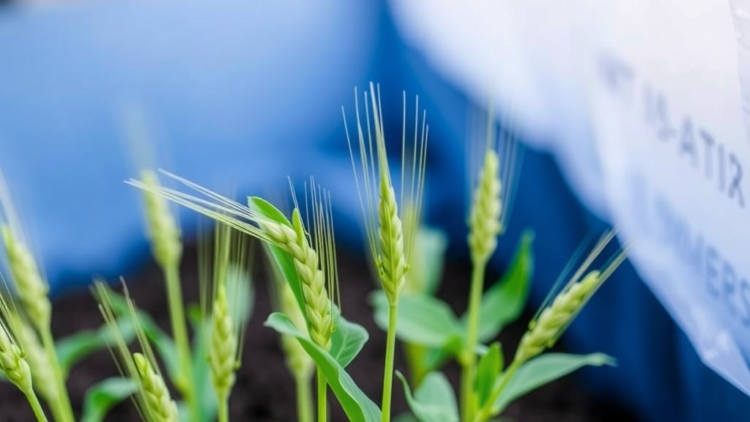
Cadmium is one of the most insidious contaminants in modern agriculture. The heavy metal, released into soils through industrial discharge, mining operations and other human activities, is toxic to plants even at concentrations as low as a few parts per million. It stunts germination, suppresses root and shoot growth, disrupts photosynthetic membranes and triggers an overproduction of reactive oxygen species that can ultimately kill plant cells. For wheat, the staple grain that feeds billions of people, cadmium contamination represents a direct threat to food security at a time when global demand is projected to double by mid-century. Now, a team of researchers in Pakistan has reported that a naturally occurring plant compound may offer a simple and elegant defense: lupeol, a pentacyclic triterpenoid, significantly reduces the damage that cadmium inflicts on wheat seedlings grown under controlled laboratory conditions.
The study, conducted by Joham Sarfraz Ali, Sania Naz, Amina Afzal and Muhammad Zia, examined wheat plants of the NARC 2009 variety grown in vitro on Murashige and Skoog medium supplemented with cadmium nitrate at concentrations of 25, 50 and 100 milligrams per liter. These cadmium treatments produced a clear, dose-dependent decline in nearly every measure of plant vigor. Root length, shoot length, the number of roots per plant, and both fresh and dry weights all fell as cadmium levels rose. At the highest cadmium concentration, shoot and root fresh weights dropped to roughly 0.184 and 0.195 grams respectively, while dry weights fell to just 0.026 grams in shoots and 0.009 grams in roots. Germination itself was not hindered, but the seedlings that did emerge were visibly compromised.
Lupeol, by contrast, tells a different story. This triterpenoid, which the researchers isolated from the plant Monotheca buxifolia using bioassay-guided methods, belongs to the largest class of plant secondary metabolites and has long been associated with stress tolerance and antioxidant activity in animal models. Previous work had shown that lupeol could protect plants against drought stress induced by polyethylene glycol, but its role in defending against heavy metal toxicity had never been directly tested in plants. In the new experiments, lupeol was added to the growth medium at 0.5, 1 and 2 milligrams per liter, both alone and in combination with the cadmium treatments, to assess whether the molecule could buffer the metal’s toxic effects.
The results were striking. When 2 milligrams per liter of lupeol was supplied alongside 100 milligrams per liter of cadmium, root length increased by 7 centimeters and shoot length by 10 centimeters compared with cadmium-treated plants lacking the compound. The number of roots per plant climbed to as many as nine under lupeol treatment, exceeding even the six roots observed in untreated control seedlings. Fresh and dry weights also improved substantially across the combined treatments. The researchers attribute this recovery to lupeol’s ability to activate signaling pathways that trigger the plant’s internal defense machinery, effectively preconditioning the seedlings against the oxidative onslaught that cadmium provokes.
Biochemical analyses revealed the mechanism in detail. Cadmium stress, as expected, drove a strong antioxidant response in the wheat seedlings. Total phenolic content in the shoots and roots of plants exposed to 100 milligrams per liter of cadmium reached 41.2 and 32.1 micrograms of gallic acid equivalents per milligram of dry weight respectively, while total flavonoid content rose to 25.3 and 19.8 micrograms of quercetin equivalents per milligram of dry weight. Free radical scavenging potential, measured with the DPPH assay, peaked at 49.3 percent in the roots of heavily stressed plants, while ABTS radical scavenging reached 41.5 percent in control shoots and 48.3 percent in stressed roots. Metal chelating ability, total antioxidant capacity and total reducing power all followed similar dose-dependent patterns, rising in lockstep with cadmium concentration.
The enzymatic arm of the antioxidant system responded just as vigorously. Superoxide dismutase, the enzyme that catalyzes the dismutation of superoxide radicals into less harmful species, reached its highest activity of 0.94 millimoles per minute per milligram in the roots of plants exposed to the highest cadmium dose. Peroxidase, which works alongside superoxide dismutase to neutralize hydrogen peroxide and other reactive intermediates, peaked at 0.53 millimoles per minute per milligram in the same roots. In shoots, the corresponding maxima were 0.82 and 0.44 millimoles per minute per milligram. Together, these enzymatic and non-enzymatic defenses represent the plant’s principal strategy for maintaining cellular redox homeostasis under heavy metal attack.
When lupeol entered the picture, however, the entire antioxidant profile shifted downward in a dose-dependent manner. Seedlings treated with lupeol alongside cadmium showed significantly lower levels of phenolics, flavonoids, radical scavenging activity, metal chelation and enzyme activity than their cadmium-only counterparts. At 2 milligrams per liter, lupeol reduced superoxide dismutase activity in roots to 0.65 millimoles per minute per milligram and peroxidase to 0.23 millimoles per minute per milligram. Counterintuitively, this decline in antioxidant output is precisely what makes the result so significant. The researchers interpret the lowered antioxidant burden as evidence that lupeol itself is absorbing much of the oxidative stress, sparing the plant from having to mount an expensive and energetically demanding defensive response. In effect, the triterpenoid acts as an external shield, quenching free radicals before they can inflict damage and thereby reducing the plant’s need to manufacture its own protective molecules.
To confirm these relationships statistically, the team employed a randomized complete block design with three replicate flasks per treatment and six seeds per flask, analyzed the data using analysis of variance and least significant difference testing at a significance threshold of 0.05, and applied principal component analysis to visualize correlations among morphological and biochemical parameters. The PCA biplots showed clear separation between control plants, lupeol-only treatments and cadmium-plus-lupeol combinations, with root parameters such as fresh weight, dry weight and root number clustering together along the first principal component. Radical scavenging activities from both shoots and roots formed distinct clusters, confirming that the treatments produced genuinely different patterns of oxidative stress rather than random variation.
The broader implications extend well beyond the laboratory. Abiotic stresses currently account for enormous yield losses worldwide, with salinity alone responsible for roughly 20 percent of crop losses, drought for 17 percent, and other factors, including heavy metal toxicity, for another 8 percent. A molecule that can be applied directly to growth media or potentially to soil, and that costs relatively little to produce from plant sources, could become a valuable tool for farmers and agronomists seeking to protect staple crops from contaminated land. The study’s authors emphasize that this is the first investigation to monitor lupeol’s protective potential within plants themselves, rather than in animal models, and they recommend that future work incorporate cellular imaging and transcriptional and translational profiling to uncover the precise molecular mechanisms through which lupeol mediates stress relief.
What makes the finding particularly compelling is its economy. Rather than engineering plants with new genes or treating soils with expensive chelating agents, the approach leverages a compound that plants already know how to use. Lupeol is found in many familiar species, from mango and olive to dandelion, and its triterpenoid relatives have been implicated in plant defense for millions of years. By demonstrating that a single exogenous molecule can modulate the delicate balance between oxidative damage and antioxidant defense in wheat, the Pakistani team has opened a promising avenue for crop protection research, one that may eventually help safeguard the world’s most important grain against the heavy metal legacy of industrial civilization.
Subject of Research: Lupeol-mediated mitigation of cadmium-induced oxidative stress in wheat plants through enhanced antioxidant defenses.
Article Title: Lupeol increases antioxidants in Triticum aestivum to mitigate cadmium stress under in vitro conditions
Article References: Ali, J. S., Naz, S., Afzal, A., & Zia, M. (2026). Lupeol increases antioxidants in Triticum aestivum to mitigate cadmium stress under in vitro conditions. Discover Plants, 3(1), Article 410. https://doi.org/10.1007/s44372-026-00890-9
Image Credits: AI Generated
DOI: 10.1007/s44372-026-00890-9
Keywords: lupeol, cadmium stress, Triticum aestivum, wheat, antioxidants, triterpenoid, oxidative stress, reactive oxygen species, superoxide dismutase, peroxidase, heavy metal toxicity, plant stress response
Cite Scienmag News
APA
MLA
Chicago
Alan Morgan. (September 26, 2026). Plant Triterpenoid Lupeol Shields Wheat Seedlings from Cadmium Toxicity by Boosting Antioxidant Defenses. Scienmag. https://scienmag.com/plant-triterpenoid-lupeol-shields-wheat-seedlings-from-cadmium-toxicity-by-boosting-antioxidant-defenses/
Alan Morgan. “Plant Triterpenoid Lupeol Shields Wheat Seedlings from Cadmium Toxicity by Boosting Antioxidant Defenses.” Scienmag, 26 September 2026, https://scienmag.com/plant-triterpenoid-lupeol-shields-wheat-seedlings-from-cadmium-toxicity-by-boosting-antioxidant-defenses/. Accessed 26 September 2026.
Alan Morgan. “Plant Triterpenoid Lupeol Shields Wheat Seedlings from Cadmium Toxicity by Boosting Antioxidant Defenses.” Scienmag. September 26, 2026. https://scienmag.com/plant-triterpenoid-lupeol-shields-wheat-seedlings-from-cadmium-toxicity-by-boosting-antioxidant-defenses/
Copy citation
Download RIS
Tags: Antioxidant defense mechanisms in plantsantioxidantsbiological strategies for food securitycadmium stresscadmium toxicity in wheateffects of cadmium on plant growthheavy metal contamination in agricultureheavy metal toxicityin vitro studies on cadmium stress in wheatlupeolmitigation of soil cadmium pollutionnatural plant compounds for stress toleranceOxidative stressperoxidasephytochemicals for crop protectionplant stress responsePlant triterpenoid lupeolplant-based detoxification of heavy metalsreactive oxygen speciessuperoxide dismutasetriterpenoidTriticum aestivumwheatwheat seedling resilience to heavy metals