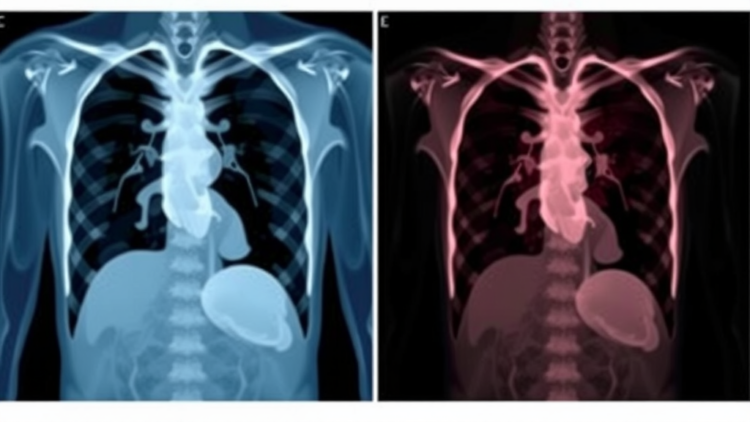
A routine chest scan taken before breast cancer surgery may hold a surprisingly powerful clue about how smoothly that operation will go. Researchers at Shinshu University School of Medicine in Japan report that the size of the pectoralis major muscle, the broad chest muscle laid bare during a mastectomy, can independently predict which patients are most likely to suffer post-surgical bleeding, one of the most troublesome early complications of breast cancer surgery. When combined with body mass index, the measurement identified a subgroup of patients whose bleeding risk reached roughly one in five, while others faced a risk of barely one in a hundred.
The study, published in Breast Cancer Research and Treatment, retrospectively analyzed 669 patients who underwent mastectomy at Shinshu University Hospital between January 2015 and December 2022. Because 20 of those patients had synchronous bilateral disease and were operated on both sides, the analysis covered a total of 709 breasts. Post-surgical bleeding, defined in the study as hemorrhage requiring manual compression or more than 100 milliliters of bloody discharge from a surgical drain by the morning of the first postoperative day, occurred in 42 cases, or 5.9 percent of the cohort. That figure may sound modest, but bleeding after mastectomy is clinically consequential: it can force blood transfusion or reoperation, prolong hospitalization, and delay adjuvant treatment.
What makes the new work distinctive is its focus on a regional rather than a systemic measure of body composition. Surgeons have long known that a high body mass index raises the odds of wound complications, infections, and bleeding after mastectomy, but BMI is a blunt instrument. It cannot distinguish a patient whose weight comes from abundant subcutaneous fat from one carrying substantial lean muscle. Meanwhile, surgical oncology research has increasingly implicated sarcopenia, the loss of skeletal muscle mass, in poor postoperative outcomes across many solid tumors. The standard tool for quantifying muscle in these studies is the skeletal muscle index, calculated from the cross-sectional muscle area at the third lumbar vertebral level on abdominal CT, normalized to height squared.
The Japanese team saw two problems with applying that abdominal measure to breast surgery. First, patients with early-stage breast cancer rarely undergo abdominal CT, so the necessary images often simply do not exist. Second, and more fundamentally, bleeding after mastectomy does not usually start in the abdomen. It originates from small vessels in the subcutaneous tissue or on the surface of the pectoralis major muscle, the very structures exposed during the operation. A global index of trunk musculature may therefore miss the local tissue characteristics that actually determine whether those fragile vessels hold or bleed. Chest CT, by contrast, is routinely obtained for staging in breast cancer, and the pectoralis major is clearly visualized on it.
To exploit that opportunity, the researchers measured the pectoralis major muscle area on axial CT slices at the level of the second thoracic vertebra, using semiautomated delineation within attenuation thresholds of minus 29 to 150 Hounsfield units. The area, expressed in square centimeters, was divided by the patient’s height squared to yield a pectoralis major muscle index, or PMI. Two investigators performed the image analysis while blinded to all postoperative outcomes, and cutoff values for BMI and PMI were derived from receiver operating characteristic curve analysis. The resulting thresholds were 23.7 for BMI and 2.90 for PMI.
The statistical signal was striking. Patients who bled had a significantly higher mean BMI than those who did not, 26.1 versus 22.8, and a significantly lower mean PMI, 2.76 versus 3.12. Yet BMI and PMI were only weakly correlated, with a Pearson coefficient of 0.16, and PMI also correlated only weakly with the conventional lumbar skeletal muscle index. In other words, the chest muscle measurement captures information about body composition that neither BMI nor the standard systemic muscle index reflects. On multivariate logistic regression, high BMI and low PMI each remained independently associated with bleeding, alongside the type of axillary procedure performed. Patients with a high BMI and low PMI had the highest incidence of bleeding at 20.1 percent, compared with 7.4 percent for high BMI with high PMI, 4.8 percent for low BMI with low PMI, and just 1.3 percent for low BMI with high PMI.
The authors offer a mechanistic explanation rooted in surgical anatomy. In patients with a high BMI, abundant subcutaneous fat can obscure small vessels and hinder meticulous hemostasis, raising the chance that a vessel is inadequately sealed and later bleeds. In patients with a low PMI, the pectoralis major itself tends to be atrophic, which may increase the fragility of the vessels running across its surface. Excess fat and diminished local muscle thus act synergistically: the fat makes vessels harder to secure, while the wasted muscle beneath makes them more vulnerable in the first place. Notably, the team’s earlier work found that the lumbar skeletal muscle index predicted bleeding only when normalized to BMI, a pattern consistent with sarcopenic obesity, whereas the regional PMI predicted bleeding on its own, without any adjustment.
One counterintuitive finding deserves mention. Faculty surgeons, defined as board-certified specialists, accounted for a significantly higher share of the bleeding cases than residents, 59.5 percent versus 42.2 percent. The authors argue this likely reflects case allocation rather than skill: faculty were more often assigned technically demanding or high-BMI patients, and at Shinshu every resident-performed mastectomy is directly supervised by a faculty surgeon acting as first assistant. Mastectomy is also a highly standardized procedure with routine drain placement and postoperative compression protocols, which may flatten differences attributable to individual technique. In routine practice, the study suggests, patient-related factors such as BMI and PMI matter more than operator-related ones.
The study has limitations the authors themselves acknowledge. It was retrospective and conducted at a single institution, the number of bleeding events was relatively small, and the bleeding definition captured early postoperative events rather than minor or late-onset ones. Bilateral cases were analyzed as independent observations, although sensitivity analyses excluding them produced essentially unchanged results. The BMI and PMI cutoffs were derived from the same cohort they were tested on, and the population was exclusively Japanese, so external validation in larger, more diverse cohorts will be needed before the thresholds can be generalized.
Even so, the practical implication is appealingly simple. Most breast cancer patients already have a preoperative chest CT, and measuring one muscle on an existing scan adds no cost, radiation, or delay. If validated prospectively, the pectoralis major muscle index could become a routine element of perioperative risk stratification, flagging patients, particularly those with both high BMI and low PMI, who warrant especially careful intraoperative hemostasis, closer drain monitoring, and a lower threshold for early intervention. In an era when body composition is increasingly recognized as a modifiable factor in cancer care, the study adds a new twist: for mastectomy outcomes, the muscle that matters most may be the one directly under the surgeon’s hands.
Subject of Research: Pectoralis major muscle mass as a predictor of post-surgical bleeding after mastectomy in breast cancer patients
Article Title: Low pectoralis major muscle mass predicts the risk of post-surgical bleeding after mastectomy in patients with breast cancer
Article References: Iji, R., Oba, T., Miyazawa, R., Kitazawa, A., Kiyosawa, N., Katsuyama, S., Morikawa, H., Amitani, M., Chino, T., Shimizu, T., Ono, M., Natori, K., Kanai, T., & Ito, K.-I. (2026). Low pectoralis major muscle mass predicts the risk of post-surgical bleeding after mastectomy in patients with breast cancer. Breast Cancer Research and Treatment, 219(1), Article 2. https://doi.org/10.1007/s10549-026-08063-8
Image Credits: AI Generated
DOI: 10.1007/s10549-026-08063-8
Keywords: breast cancer, mastectomy, pectoralis major muscle index, post-surgical bleeding, body mass index, body composition, sarcopenia, computed tomography, surgical complications, risk stratification, perioperative care, Shinshu University
Cite Scienmag News
APA
MLA
Chicago
Nathaniel Bowman. (September 26, 2026). Chest Muscle Size on Preoperative Scans Predicts Bleeding Risk After Mastectomy. Scienmag. https://scienmag.com/chest-muscle-size-on-preoperative-scans-predicts-bleeding-risk-after-mastectomy/
Nathaniel Bowman. “Chest Muscle Size on Preoperative Scans Predicts Bleeding Risk After Mastectomy.” Scienmag, 26 September 2026, https://scienmag.com/chest-muscle-size-on-preoperative-scans-predicts-bleeding-risk-after-mastectomy/. Accessed 26 September 2026.
Nathaniel Bowman. “Chest Muscle Size on Preoperative Scans Predicts Bleeding Risk After Mastectomy.” Scienmag. September 26, 2026. https://scienmag.com/chest-muscle-size-on-preoperative-scans-predicts-bleeding-risk-after-mastectomy/
Copy citation
Download RIS
Tags: bleeding risk predictionbody compositionbody mass indexbody mass index and surgerybreast cancerbreast cancer surgerybreast cancer surgery outcomescomputed tomographyearly complications in mastectomymastectomymastectomy complicationspectoralis major muscle indexpectoralis major muscle sizeperioperative carepost-surgical bleedingpostoperative hemorrhagepredictive markers for surgical bleedingpreoperative chest scansrisk stratificationsarcopeniaShinshu Universitysurgical bleeding factorssurgical complicationssurgical planning with imaging