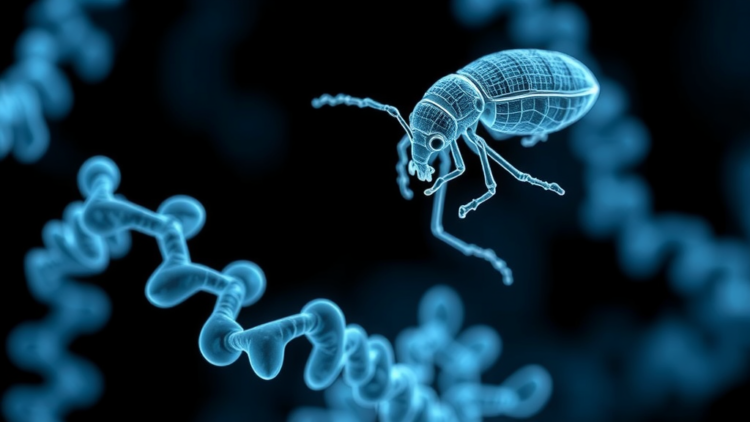
Aphids are among the most quietly destructive forces in agriculture, draining sap from crops and manipulating the very plants they feed on. But beneath their small size lies a molecular arsenal of remarkable sophistication. In a new study published in the Proceedings of the National Academy of Sciences, researchers at the Stowers Institute for Medical Research, working alongside structural biologists at the University of Pittsburgh, have revealed that thousands of rapidly evolving aphid proteins share a single hidden architectural blueprint. The discovery not only illuminates how these insects hijack plant biology, but also demonstrates a powerful new way to make artificial intelligence work on proteins that have long resisted every conventional tool in biology.
The proteins at the center of the study belong to a family first identified by Stowers Investigator and Howard Hughes Medical Institute Investigator David Stern, Ph.D., in 2021. He named them BICYCLE proteins because of a repeating cysteine motif that runs through their sequences. These molecules are secreted by aphids into the plants they attack, where they help reprogram plant tissue into galls: living structures made of plant cells but built to an insect’s specifications, providing both shelter and food for the aphid’s offspring. Hundreds of these proteins can be deployed in a single interaction, making them a defining weapon in the ongoing conflict between aphids and their hosts.
From the moment they were discovered, BICYCLE proteins posed a puzzle. Biologists typically identify an unknown protein by comparing its amino acid sequence against the millions catalogued in public databases, since a close match to a characterized protein offers strong clues about function. When BICYCLE proteins were run through those comparisons, the results came back empty. The family evolves so quickly, generation after generation, that their sequences have been rewritten past the point where computational tools can recognize any family resemblance. “We could tell immediately that they didn’t look like any other proteins that you might find in a database,” Stern said. That extraordinary rate of change is itself a signature of conflict, because proteins on the front line between a parasite and its host tend to evolve fastest, each side under relentless pressure to counter the other’s latest move.
To break through the wall of sequence divergence, the team turned to experimental structural biology. In collaboration with the lab of Angela Gronenborn at the University of Pittsburgh, researchers spent years crystallizing two BICYCLE proteins and solving their three-dimensional structures by X-ray diffraction. The structures matched nothing on record, but they revealed a version of a structural motif seen elsewhere in biology, known as a saposin-like fold. By an extraordinary coincidence, that same week a new deep learning system called AlphaFold2 was released, promising scientists highly accurate structure predictions from sequence alone. Stern immediately fed the BICYCLE sequences into the new tool, and it failed.
AlphaFold2 did not simply deliver low-confidence predictions; it returned the wrong answer. That failure became the study’s most productive result, because it exposed how the AI actually operates. AlphaFold2’s power does not come from machine learning alone. The program leans heavily on evolutionary data, drawing on multiple sequence alignments of related proteins to infer which parts of a structure are constrained and which are flexible. For BICYCLE proteins, that evolutionary record simply did not exist in the databases the program consults. “When it searched the database for similar proteins, it couldn’t find any,” Stern explained. “That part of the AlphaFold2 program was empty. It was actually an empty box.”
The fix, remarkably, required leaving the computer entirely. The team collected aphids across Virginia and West Virginia, traveled to Japan to obtain one critical species, and sequenced the genomes of closely related aphid species. By supplying AlphaFold2 with this missing evolutionary context, the researchers effectively reconstructed the input the AI needed. The result was dramatic: the program’s predictions now reproduced the crystal structures the team had solved experimentally. “Lo and behold, AlphaFold2 gave us back the crystal structure that we had solved,” Stern said. The lesson is a striking one for the era of AI-driven biology. Deep learning can achieve extraordinary things, but only when evolution itself provides the raw material. Without the information encoded in related sequences, even the most powerful model is working with an empty box.
With the method validated, the team scaled it up. They generated roughly 2,400 high-confidence structure predictions spanning seven aphid species, and a clear pattern emerged. The same saposin-like fold kept reappearing, duplicated, reoriented, and rearranged in different combinations from one protein to the next. In other words, across thousands of proteins whose sequences are too divergent to be recognized as related, a single shared architectural plan persists. Evolution has remodeled that plan so extensively that sequence-based tools fail, yet the underlying blueprint remains unmistakable once structures are compared.
What the researchers expected to find next, however, eluded them. They anticipated some shared surface feature among the BICYCLE proteins, some conserved patch of chemistry that would hint at a common job inside the plant cell. “We didn’t find anything,” Stern said. “No conserved patches of positive charge or negative charge, or regions that hated water, or regions that really liked water. Nothing.” The proteins clustered neatly by structural similarity but spread into a near-continuous spectrum when their surface chemistries were compared. “We used every method we could think of to force them into different clusters, and we just couldn’t,” Stern said. “That suggests that these proteins are really exploiting many different mechanisms in the plant to take over the plant cell.”
The authors propose that BICYCLE proteins are evolving on two fronts simultaneously: reaching new molecular targets inside the plant while remaining unrecognizable to the plant’s immune surveillance system. This dual pressure would explain both the conserved fold, which may be essential for the proteins’ basic structural integrity, and the astonishing surface diversity, which allows aphids to strike many different plant targets while evading detection. The result is a highly adaptive molecular arsenal, forged over evolutionary time by an arms race between insect and plant, in which each new plant defense selects for aphid effectors that are both functionally versatile and immunologically invisible.
Beyond aphids, the study delivers a methodology that other laboratories can immediately apply. Thousands of rapidly evolving proteins across biology, including many involved in immunity, host-parasite interactions, and agricultural traits, have remained largely inaccessible to structure prediction because their sequences lack recognizable relatives in public databases. The Stowers team’s approach, pairing close genomic sampling of related species with AlphaFold2, offers a general solution: generate the missing evolutionary context experimentally, then let the AI do the rest. For Stern, the work is only a beginning. “This is really the beginning of our work on the BICYCLE proteins, the beginning of our work on how insects control plants,” he said. “I’m very excited about the future and what we’re going to be able to do here to really understand how these molecules control plant biology.” What began as a failure of artificial intelligence has ended as a demonstration that evolution, properly supplied, can teach the machine what it could not learn alone.
Subject of Research: Structural evolution of rapidly evolving aphid BICYCLE effector proteins and AI-based structure prediction
Article Title: Stowers scientists uncover a hidden blueprint in aphids, providing a way to predict what AI couldn’t solve alone
Article References: Stowers scientists uncover a hidden blueprint in aphids, providing a way to predict what AI couldn’t solve alone. (n.d.). Original publication
Image Credits: AI Generated
DOI: Not provided
Keywords: aphids, BICYCLE proteins, AlphaFold2, protein structure prediction, saposin-like fold, evolutionary biology, plant-insect interactions, host-parasite conflict, X-ray crystallography, gall formation, agriculture, Stowers Institute
Cite Scienmag News
APA
MLA
Chicago
Gavin Prescott. (September 25, 2026). Hidden Blueprint in Aphid Proteins Shows How Evolution Can Rescue AI Structure Prediction. Scienmag. https://scienmag.com/hidden-blueprint-in-aphid-proteins-shows-how-evolution-can-rescue-ai-structure-prediction/
Gavin Prescott. “Hidden Blueprint in Aphid Proteins Shows How Evolution Can Rescue AI Structure Prediction.” Scienmag, 25 September 2026, https://scienmag.com/hidden-blueprint-in-aphid-proteins-shows-how-evolution-can-rescue-ai-structure-prediction/. Accessed 25 September 2026.
Gavin Prescott. “Hidden Blueprint in Aphid Proteins Shows How Evolution Can Rescue AI Structure Prediction.” Scienmag. September 25, 2026. https://scienmag.com/hidden-blueprint-in-aphid-proteins-shows-how-evolution-can-rescue-ai-structure-prediction/
Copy citation
Download RIS
Tags: advancements in AI for complex protein foldingagricultureAI prediction of protein structuresAlphaFold2Aphid protein structural analysisaphid-induced gall formationaphidsBICYCLE proteinsevolutionary biologyevolutionary conservation in insect proteinsgall formationhidden protein architectures in insectshost-parasite conflictmolecular blueprint in aphid proteinsplant manipulation by aphidsplant-insect interactionsplant-insect molecular interactionsprotein structure predictionprotein structure prediction challengesrapid evolution of aphid proteinssaposin-like foldStowers Institutestructural biology of aphid secreted proteinsX-ray crystallography