Deep in the mountains of Central Europe, a small, evergreen clubmoss known as Huperzia selago has become the unlikely star of a study that could change how biologists assess fertility in some of the planet’s most ancient land plants. A team of researchers at the University of South Bohemia in the Czech Republic has shown that a method as deceptively simple as looking at spores under a light microscope can reliably reveal whether those spores are alive and capable of reproduction. The finding, published in the journal Plant Biosystems, matters because the standard toolkit for testing spore viability, developed largely for ferns, breaks down almost completely when applied to lycophytes, a lineage of vascular plants that predates the dinosaurs.
Spore viability is far more than a technical curiosity. For plants that reproduce through spores rather than seeds, the proportion of viable spores produced by an individual shapes population dynamics, colonization ability, and ultimately evolutionary fate. In ferns, researchers typically judge spore abortion by examining morphology, running germination tests, or applying vital stains that color living cells differently from dead ones. Each of these approaches has proven unreliable in lycophytes. The spores of clubmosses and their relatives display high morphological variability that confounds visual classification, their germination requirements are so specialized that laboratory tests frequently fail even with healthy spores, and their walls are built from thick deposits of sporopollenin, one of the most chemically resistant biopolymers in nature, which blocks the dyes that stain-based methods depend on. The result has been a persistent blind spot: scientists studying lycophyte reproduction have lacked a dependable way to measure it.
The Czech team, led by Kateřina Vejvodová together with Libor Ekrt and Tomáš Hájek, attacked this problem by turning Huperzia selago into a natural laboratory. This species is not a single uniform entity but a complex of cytotypes, plant lineages that share a similar appearance yet carry different numbers of chromosome sets. The researchers gathered material from central European populations representing tetraploid, hexaploid, triploid, and pentaploid individuals, giving them a gradient of expected fertility, since plants with odd numbers of chromosome sets typically suffer chaotic cell division during meiosis, the process that produces spores. Against this biological backdrop, they tested whether a visually based metric called the spore abortion index, or SAI, calculated from ordinary optical microscopy, actually tracks the underlying biochemistry of life and death inside individual spores.
To validate the visual scoring, the team turned to Fourier-transform infrared spectroscopy, or FTIR, a technique that shines infrared light through a sample and reads back a molecular fingerprint. Different chemical bonds absorb infrared light at characteristic frequencies, so the resulting spectrum reveals how much protein, nucleic acid, and sporopollenin a bulk spore sample contains. The logic is straightforward: living spores should be packed with the molecular machinery of a functioning protoplast, including abundant proteins and the nucleic acids that encode them, while aborted spores should be hollow shells dominated by the wall material itself. As an independent measure, the researchers also quantified oil content gravimetrically, since lipid droplets are a hallmark of well-provisioned, metabolically competent spores.
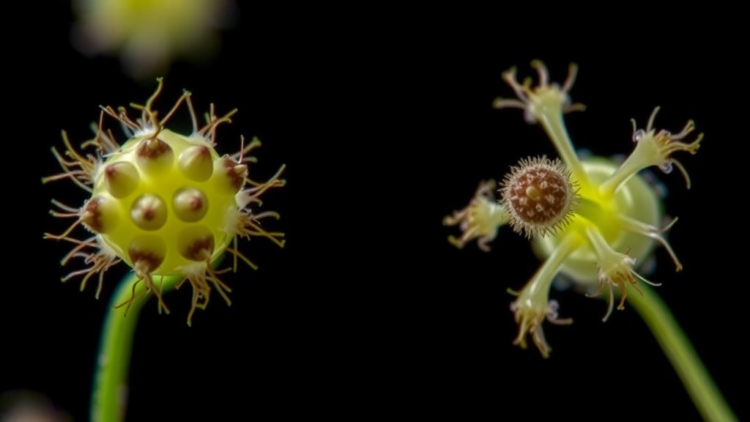
The results were strikingly clean. Every biochemical indicator they measured correlated significantly with the spore abortion index, confirming that what a trained eye sees through the microscope genuinely reflects the chemical reality inside the spore wall. Viable spores, classified visually as healthy, turned out to contain well-developed protoplasts studded with visible oil droplets, exactly the profile expected of cells primed for germination. Aborted spores told the opposite story: they lacked cytoplasmic content altogether, appeared irregular in shape and darker in color, and often contained air pockets where living material should have been. In other words, the morphological differences that botanists have long used to categorize spores are not superficial quirks but outward signs of profound internal differences in biochemical composition.
The correlations among the biochemical measures themselves painted a coherent picture of what makes a spore viable. Oil concentration rose in lockstep with relative protein and nucleic acid content, suggesting that successful spores accumulate a full complement of storage reserves and genetic and enzymatic machinery together, while the concentration of sporopollenin, the tough wall polymer, was negatively correlated with these internal contents. This inverse relationship makes intuitive sense: a spore filled with cytoplasm and oil has proportionally less wall material per unit mass, whereas an empty, aborted spore is essentially all wall and nothing else. The thick sporopollenin wall that makes lycophyte spores so resistant to staining and decay thus becomes, paradoxically, the very feature that makes aborted spores biochemically distinguishable once you look past it.
Beyond validating the method, the study delivered an evolutionary payoff. Spore viability tracked ploidy level in exactly the pattern that chromosome theory predicts. Plants with even numbers of chromosome sets, the tetraploids and hexaploids, showed moderate abortion rates ranging from one to thirty-eight percent, indicating that regular meiosis can proceed and yield mostly functional spores. Plants with odd ploidies, the triploids and pentaploids, told a very different story, with spore abortion values spanning twenty-seven to ninety-six percent. These elevated and highly variable abortion rates are consistent with irregular meiosis, in which unpaired chromosomes segregate haphazardly and produce unbalanced, nonviable spores. They also fit with the reticulate, web-like evolutionary relationships of the Huperzia selago complex, in which hybridization between lineages of different ploidy has repeatedly generated sterile or partially sterile offspring.
This pattern gives ecologists and evolutionary biologists a practical new instrument. Because the spore abortion index requires nothing more than a light microscope, a skilled observer, and a sample of spores, it can be applied in field stations, herbaria, and teaching laboratories anywhere in the world, without the expensive spectrometers or the finicky cultivation conditions that alternative methods demand. For a group of plants in which germination tests routinely fail and staining is defeated by chemistry, a validated visual proxy is arguably the most useful tool that could have been devised. The method also opens the door to large comparative studies: researchers can now quantify reproductive potential across populations, cytotypes, and species of lycophytes, and use those measurements to test hypotheses about hybridization, polyploid evolution, and the demographic health of rare populations.
The broader significance extends to how we understand the reproductive strategies of ancient lineages. Lycophytes were once towering trees of the Carboniferous coal forests, and their modern descendants, though small, retain reproductive biology that has puzzled botanists since the nineteenth century, when early researchers first described the slow, fungus-dependent development of clubmoss gametophytes. By connecting what spores look like to what spores contain, the new study closes a gap that has separated morphological botany from molecular and biochemical approaches for generations. It demonstrates that careful observation, the oldest tool in biology, can be rigorously calibrated against modern analytical chemistry, yielding a method that is both trustworthy and accessible.
For the humble firmosses of the European high mountains, the work also carries a conservation dimension. Understanding which cytotypes produce healthy spores and which are trapped in near-sterility helps clarify how these populations persist, spread, and respond to environmental change in their alpine refugia. The Czech team’s study, received in May 2026 and published in August of that year, was supported by the University of South Bohemia’s Faculty of Science. Its central message is elegant in its simplicity: to know whether a spore is alive, sometimes you really can just look, provided you have validated exactly what it is you are seeing. In the case of lycophytes, science can now see beyond the wall.
Subject of Research: Biochemical and morphological indicators of spore viability and reproductive potential in lycophytes
Article Title: Seeing beyond the wall: biochemical composition and morphology of spores as indicators of reproductive potential of lycophytes
Article References: Vejvodová, K., Ekrt, L., & Hájek, T. (2026). Seeing beyond the wall: biochemical composition and morphology of spores as indicators of reproductive potential of lycophytes. Plant Biosystems, 160(5), Article 241. https://doi.org/10.1007/s44473-026-00262-x
Image Credits: AI Generated
DOI: 10.1007/s44473-026-00262-x
Keywords: lycophytes, spore abortion, spore viability, Huperzia selago, FTIR spectroscopy, sporopollenin, ploidy, polyploidy, reproductive biology, plant fertility, optical microscopy, plant biosystems
Cite Scienmag News
APA
MLA
Chicago
Alan Morgan. (September 25, 2026). Simple Microscope Test Reveals Which Ancient Plant Spores Are Truly Alive. Scienmag. https://scienmag.com/simple-microscope-test-reveals-which-ancient-plant-spores-are-truly-alive/
Alan Morgan. “Simple Microscope Test Reveals Which Ancient Plant Spores Are Truly Alive.” Scienmag, 25 September 2026, https://scienmag.com/simple-microscope-test-reveals-which-ancient-plant-spores-are-truly-alive/. Accessed 25 September 2026.
Alan Morgan. “Simple Microscope Test Reveals Which Ancient Plant Spores Are Truly Alive.” Scienmag. September 25, 2026. https://scienmag.com/simple-microscope-test-reveals-which-ancient-plant-spores-are-truly-alive/
Copy citation
Download RIS
Tags: Ancient plant sporesfern versus lycophyte spore testingFTIR spectroscopyHuperzia selagoinnovative botanical researchlycophyte reproductionlycophytesmicroscopic analysis of sporesoptical microscopyPlant Biosystemsplant evolutionary historyplant fertilityplant fertility assessmentploidyPolyploidypopulation dynamics of spore-producing plantsReproductive biologyspore abortionspore germination methodsspore viabilityspore viability testingsporopolleninvital staining techniques in plants