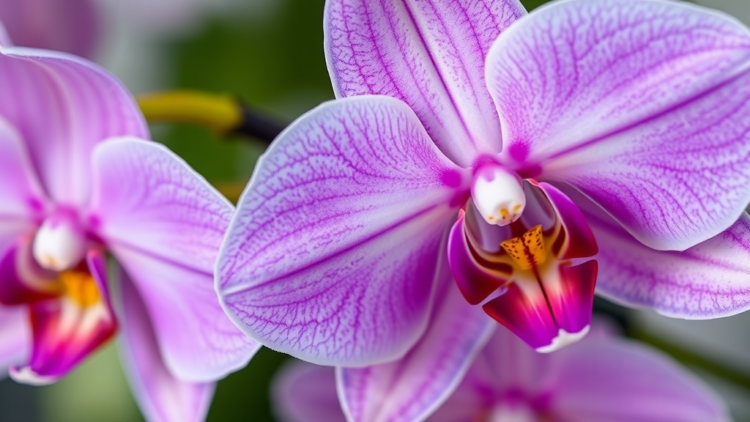
The deep purple blooms of Dendrobium nobile, one of the most prized ornamental orchids in traditional Chinese horticulture, owe their striking color to a surprisingly precise piece of metabolic bookkeeping. A new multi-omics study published in BMC Plant Biology shows that the difference between richly saturated purple petals and pale lavender ones comes down not to petal structure or sheer pigment quantity alone, but to how the plant’s flavonoid pathway partitions its metabolic traffic between two competing branches. By integrating morphology, pigment quantification, metabolomics and transcriptomics, researchers led by Yijun Fan and Aoxue Luo of Sichuan Agricultural University have traced the color variation of this orchid to a single candidate regulator, a gene known as G8H, whose expression level appears to decide whether precursor molecules flow into anthocyanin synthesis or are diverted toward flavonol production.
The team worked with two distinct petal types of D. nobile: one designated S, with deep purple coloration, and another designated Q, with light purple petals. Under the microscope, the two petal types showed no significant structural differences, ruling out anatomical explanations for the color gap. The real story emerged when the researchers quantified pigments chemically. The anthocyanin content of the deep purple S petals measured 0.38 milligrams per gram, more than double the 0.16 milligrams per gram found in the light purple Q petals. Anthocyanins are the water-soluble pigments responsible for most blue, purple and red hues in flowers, so this difference pointed directly at reduced anthocyanin accumulation as the immediate cause of the paler phenotype.
Yet the pigment measurements revealed a second, equally telling pattern. Total flavonoid levels in the Q petals were 57 percent higher than in the S petals. That inversion, less anthocyanin but more total flavonoid, suggested that the light purple petals were not simply failing to make pigments. Instead, their metabolic machinery appeared to be rerouting the same pool of precursor molecules into different end products. This kind of flux partitioning, in which a shared biochemical pathway splits into branches that compete for substrates, has become a central theme in plant pigment biology, and the D. nobile data offered an unusually clean natural experiment in it.
To identify exactly which compounds differed between the two petal types, the researchers performed untargeted metabolomics. The analysis identified 34 differential metabolites that were upregulated in the deep purple S petals. Among them were cyanidin-3-(6-O-p-coumaroyl)-glucoside, delphinidin-3-O-glucoside and naringenin-7-O-glucoside, a chemically diverse set of anthocyanins and flavonoid glycosides that together account for the saturated purple appearance. Cyanidin and delphinidin derivatives are classic contributors to violet and blue petal colors, and their coumaroylated and glucosylated forms are known to stabilize pigment molecules and shift their absorbance spectra. The enrichment of these compounds in S petals provided a molecular inventory of what deep purple actually means in this species.
The transcriptomic layer of the study was equally substantial. RNA sequencing of the two petal types revealed 15,460 differentially expressed genes, a remarkably large set that was significantly enriched in pathways related to secondary metabolism and flavonoid biosynthesis. Within this dataset, the integrated analysis of metabolite and gene expression profiles converged on G8H as a candidate key regulator of flavonoid flux partitioning. G8H encodes an enzyme acting early in the phenylpropanoid-flavonoid network, positioned at a point where its activity can influence how much of the naringenin pool is committed to the anthocyanin branch versus alternative flavonoid fates.
In the deep purple S petals, the researchers found that high G8H expression effectively opens the anthocyanin tap. Naringenin, a central flavonoid intermediate, is directed toward anthocyanin biosynthesis, and downstream genes follow suit. Two genes in particular stood out: DnUGT-like X1, a uridine diphosphate glycosyltransferase-like gene, and KFK09_007985, a glutathione S-transferase. Glycosyltransferases attach sugar molecules to anthocyanins, a modification that is essential for the pigments’ stability and solubility, while glutathione S-transferases are well established as facilitators of anthocyanin transport into the vacuole, the cellular compartment where flower pigments are stored. Coordinated upregulation of both gene families in S petals promotes anthocyanin glycosylation, transport and vacuolar sequestration, completing the pipeline that delivers pigment to where it can be seen and culminating in deep purple petals.
The light purple Q petals tell the opposite story. There, G8H expression is downregulated, and the anthocyanin branch of the pathway is effectively throttled. With naringenin no longer flowing efficiently into anthocyanin synthesis, the metabolic flow shifts toward the flavonol synthesis pathway. The transcriptomic data showed that a rhamnosyltransferase gene is significantly upregulated in Q petals, an enzymatic change that promotes the large-scale accumulation of flavonols, the pale yellow to colorless compounds that accumulated to levels 57 percent above those of the S petals. The result is a petal that still contains anthocyanin, but at concentrations too low to produce saturated color, diluted against a background of flavonols and rendered as light purple.
What makes this finding compelling beyond orchid biology is the elegance of the regulatory logic. Flower color in many species has been explained by mutations in structural genes or transcription factors that switch entire pathways on or off. The D. nobile case instead highlights flux control, a subtler mechanism in which a pathway’s output is determined by how intermediates are divided among competing branches rather than by whether the pathway operates at all. Both petal types possess the full anthocyanin machinery; the difference lies in how much substrate reaches it and how effectively the finished pigments are modified and stored. This kind of branch-point regulation is increasingly recognized as a major determinant of metabolic phenotypes across the plant kingdom, and having a named candidate gene for it in an orchid gives breeders a concrete molecular handle.
The practical implications reach into molecular breeding and the ornamental plant industry. Dendrobium nobile is both a horticulturally valuable orchid and a source of medicinal compounds, and flower color is one of its most commercially important traits. If G8H expression genuinely controls the anthocyanin-flavonol balance, then modulating that gene, through marker-assisted selection, transgenic approaches or gene editing, could allow breeders to dial petal color up or down with precision, producing either richer purples or softer pastel tones on demand. The study also provides a reference framework for pigment metabolism research across orchids, a family famous for its extraordinary floral diversity but genomically less explored than many crop plants. The work was funded by the Xichang Science and Technology Plan project and the Sichuan Science and Technology Program, and the plant material was collected with permission from Fengming Town, Hejiang County, in Sichuan Province.
For now, the authors frame G8H as a candidate regulator, and confirming its function will require the kind of validation experiments, overexpression, silencing and enzyme assays, that typically follow such integrated omics screens. But the convergence of evidence is striking: pigment chemistry, metabolite profiles and gene expression all point to the same branch point in the flavonoid network. The pale lavender petals of one D. nobile variety and the deep purple petals of another are, in effect, two outcomes of the same biochemical decision, made differently in each plant. As multi-omics approaches become standard tools in ornamental plant research, studies like this one are turning flower color from a trait described after the fact into a pathway that can be read, and potentially rewritten, gene by gene.
Subject of Research: Anthocyanin metabolic flux control of flower color variation in the orchid Dendrobium nobile
Article Title: Multi-omics analysis reveals that anthocyanin metabolic flux determines the flower color of Dendrobium nobile
Article References: Fan, Y., Liu, H., Liu, X., Yuan, M., Liu, J., Zhao, Y., Zhong, X., Jiang, Y., & Luo, A. (2026). Multi-omics analysis reveals that anthocyanin metabolic flux determines the flower color of Dendrobium nobile. BMC Plant Biology. https://doi.org/10.1186/s12870-026-10013-x
Image Credits: AI Generated
DOI: 10.1186/s12870-026-10013-x
Keywords: Dendrobium nobile, anthocyanins, flower color, flavonoid pathway, metabolic flux, metabolomics, RNA-Seq, G8H, flavonols, orchid pigmentation, molecular breeding, plant secondary metabolism
Cite Scienmag News
APA
MLA
Chicago
Juliet Wilcox. (September 22, 2026). A Single Metabolic Switch May Decide Whether Orchid Petals Turn Deep Purple or Pale Lavender. Scienmag. https://scienmag.com/a-single-metabolic-switch-may-decide-whether-orchid-petals-turn-deep-purple-or-pale-lavender/
Juliet Wilcox. “A Single Metabolic Switch May Decide Whether Orchid Petals Turn Deep Purple or Pale Lavender.” Scienmag, 22 September 2026, https://scienmag.com/a-single-metabolic-switch-may-decide-whether-orchid-petals-turn-deep-purple-or-pale-lavender/. Accessed 23 September 2026.
Juliet Wilcox. “A Single Metabolic Switch May Decide Whether Orchid Petals Turn Deep Purple or Pale Lavender.” Scienmag. September 22, 2026. https://scienmag.com/a-single-metabolic-switch-may-decide-whether-orchid-petals-turn-deep-purple-or-pale-lavender/
Copy citation
Download RIS
Tags: anthocyanin and flavonol biosynthesisanthocyaninsDendrobium nobileDendrobium nobile pigment pathwaysflavonoid biosynthesis regulationflavonoid pathwayflavonolsflower colorG8HG8H gene role in flower colorationgenetic basis of flower color differentiationinfluence of metabolic flux on flower pigmentationmetabolic fluxMetabolomicsmolecular breedingmolecular mechanisms of flower colormulti-omics plant biology studiesorchid horticulture and ornamental breedingorchid petal color variationorchid pigmentationpetal structural analysis in orchidsplant metabolomics and transcriptomicsplant secondary metabolismRNA-seq