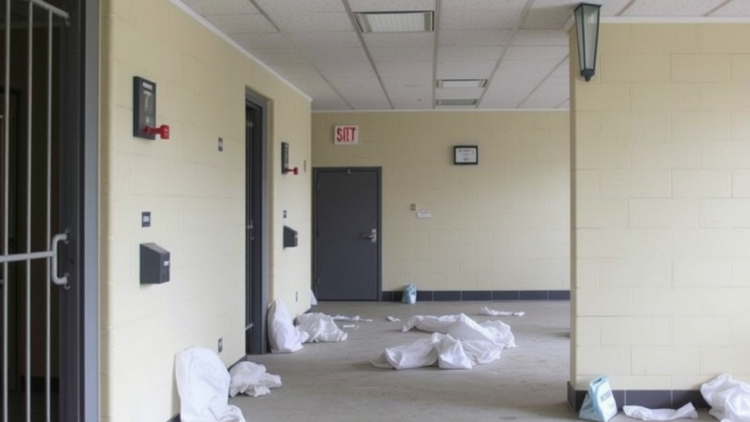
Extreme heat and extreme cold are not experienced equally across society, and few environments illustrate that inequality as starkly as prison. A new study published in Nature Communications examines what happens to mortality and healthcare use inside Pennsylvania’s state prisons in the days following episodes of extreme ambient temperature, and its findings add to a growing body of evidence that incarcerated people bear a disproportionate share of the health burden imposed by temperature extremes. Drawing on administrative records from the Pennsylvania Department of Corrections, the researchers link day-to-day temperature exposure to deaths and to healthcare contacts across the state prison system, providing one of the most detailed pictures to date of how hot and cold snaps translate into medical harm behind bars.
The central question the study addresses is deceptively simple: when temperatures outside a prison swing to dangerous extremes, does the risk of dying inside the facility rise, and do incarcerated people seek or receive more medical care in the aftermath? The answer matters because prisons are, in effect, closed institutional environments where individuals cannot choose their surroundings, cannot leave during a heat wave, and often cannot control ventilation, cooling, or heating. Unlike the general population, incarcerated people cannot relocate to air-conditioned spaces, cannot cool their homes, and cannot adjust their daily schedules to avoid the hottest or coldest hours of the day. That lack of agency makes prisons a sentinel setting for understanding temperature-related health risk.
Methodologically, the study follows a well-established tradition in environmental epidemiology known as time-series analysis. The researchers assembled daily counts of deaths and healthcare service encounters across Pennsylvania state correctional facilities and aligned them with daily ambient temperature data from the surrounding environment. Rather than comparing hot days with cold days in a simple way, the analysis estimates how the risk of death and the volume of healthcare use change in the days following an extreme temperature event, relative to what would be expected on comparable days without such an event. This distributed-lag framing matters because the health consequences of a hot or cold day are rarely confined to that day itself; physiological stress can accumulate, and deaths can be displaced over a window of several days.
Extreme ambient temperature is one of the most consistently documented environmental causes of excess mortality worldwide. Epidemiological work across many countries has identified a U-shaped or J-shaped relationship between temperature and death risk, with mortality climbing at both the cold and hot ends of the local temperature distribution. What has been far less documented is how this relationship operates inside correctional institutions, where building characteristics, population vulnerability, and restricted behavior can all modify exposure. Many state prison facilities in the United States were built decades ago, and a substantial fraction lack universal air conditioning, particularly in the northern states where cooling was historically considered unnecessary. Pennsylvania, with its cold winters and increasingly hot summers, offers a natural setting for studying both thermal extremes in the same institutional system.
The study’s findings on mortality indicate that episodes of extreme temperature are followed by elevated death risk among incarcerated people, a pattern consistent with the broader epidemiological literature but newly documented at this level of institutional detail. Because the analysis is conducted within a single, centralized prison system, it controls implicitly for many factors that complicate studies in the general population, such as differences in healthcare access, insurance status, and housing quality. Everyone in the system has access to the same institutional healthcare infrastructure, which means that observed differences in outcomes across temperature conditions are more plausibly attributable to the temperature exposure itself and to the constraints of the prison environment rather than to disparities in access.
The healthcare services dimension of the study adds an important layer to the mortality findings. Healthcare utilization data, including medical encounters within the prison system, can reveal whether extreme temperatures produce a broader burden of illness that never registers in mortality statistics. In the general population, heat waves and cold snaps are known to drive surges in emergency department visits, hospital admissions for cardiovascular and respiratory conditions, and complications of chronic diseases such as diabetes and kidney disease. By tracking healthcare contacts within the correctional system, the researchers can assess whether similar surges occur behind prison walls, and whether the medical system inside prisons absorbs a measurable increase in demand in the days after extreme temperature events.
This distinction between deaths and healthcare use is more than academic. Mortality statistics capture only the most extreme outcome of environmental stress; for every death attributable to heat or cold, many more people experience serious but nonfatal illness. In a prison setting, where medical staffing is often stretched and where access to outside hospitals requires security arrangements and transportation, even a modest rise in temperature-related illness can strain the system’s capacity. The study’s examination of healthcare services therefore speaks directly to operational questions faced by correctional administrators: how demand for medical care responds to weather, and whether facilities are equipped to anticipate and manage that demand.
The findings arrive at a moment when climate change is reshaping the temperature profile of the northeastern United States. Heat waves in Pennsylvania and neighboring states have become more frequent, more intense, and longer-lasting, while cold extremes, though less frequent in a warming climate, remain a serious hazard and may in some settings become more variable. For prison populations, this means that the exposure window is widening at the hot end. A facility that was designed for the climate of the mid-twentieth century may now face summer conditions for which it was never intended, with consequences for the people who live and work inside it. Correctional officers and other staff are also exposed to the same indoor conditions, meaning the implications extend beyond the incarcerated population.
The study also contributes to a broader conversation about environmental justice within the criminal justice system. Research on temperature and health has repeatedly shown that the people most at risk are those with the least capacity to protect themselves: the elderly, people with chronic physical or mental illness, people experiencing homelessness, and people in institutions. Incarcerated people overlap substantially with these vulnerable groups, and aging prison populations in the United States are growing rapidly, increasing the pool of individuals with chronic conditions that temperature extremes can destabilize. In this sense, prisons concentrate exactly the populations that climate-driven temperature change endangers most, while simultaneously removing the personal adaptive strategies—such as air conditioning at home, hydration on demand, or simply moving to a cooler location—that protect people elsewhere.
For policymakers, the study underscores a gap in how temperature risk is regulated and monitored. Occupational heat standards, cooling assistance programs, and heat-health warning systems are designed for free-moving populations and open workplaces; they rarely reach into correctional facilities, and there is no comprehensive national requirement that state prisons maintain specific temperature ranges. The evidence that deaths and healthcare demands rise in the aftermath of extreme temperature events inside Pennsylvania’s prisons suggests that institutional temperature standards, infrastructure investment in heating, ventilation, and cooling, and heat-health emergency plans tailored to correctional settings are not merely matters of comfort but of life and death. As climate change continues to intensify thermal extremes, the study’s central message is that the health consequences of a warming and climate-volatile world will be measured not only in open communities but also inside the closed institutions where millions of Americans live, and where the option to escape the heat or the cold simply does not exist.
Subject of Research: Effects of extreme ambient temperatures on mortality and healthcare services in Pennsylvania state prisons
Article Title: Mortality and healthcare services in Pennsylvania state prisons following extreme ambient temperatures
Article References: Jahn, J. L., Anderson, C. N., Simes, J. T., Schinasi, L. H., Leung, M., Kephart, J. L., & Western, B. (2026). Mortality and healthcare services in Pennsylvania state prisons following extreme ambient temperatures. Nature Communications. https://doi.org/10.1038/s41467-026-78012-y
Image Credits: AI Generated
DOI: 10.1038/s41467-026-78012-y
Keywords: extreme heat, extreme cold, prisons, mortality, healthcare utilization, incarcerated populations, Pennsylvania, climate change, environmental justice, temperature-related health risk, correctional facilities, healthcare
Cite Scienmag News
APA
MLA
Chicago
Sloane Callahan. (September 22, 2026). Extreme Temperatures Leave a Deadly Mark Inside Pennsylvania State Prisons. Scienmag. https://scienmag.com/extreme-temperatures-leave-a-deadly-mark-inside-pennsylvania-state-prisons/
Sloane Callahan. “Extreme Temperatures Leave a Deadly Mark Inside Pennsylvania State Prisons.” Scienmag, 22 September 2026, https://scienmag.com/extreme-temperatures-leave-a-deadly-mark-inside-pennsylvania-state-prisons/. Accessed 22 September 2026.
Sloane Callahan. “Extreme Temperatures Leave a Deadly Mark Inside Pennsylvania State Prisons.” Scienmag. September 22, 2026. https://scienmag.com/extreme-temperatures-leave-a-deadly-mark-inside-pennsylvania-state-prisons/
Copy citation
Download RIS
Tags: climate changeclimate change and prison mortalityclimate resilience in correctional infrastructurecorrectional facilitieseffects of extreme weather on vulnerable populationsenvironmental health risks in correctional facilitiesenvironmental justiceextreme coldextreme heathealth inequalities in incarceration settingsHealthcarehealthcare utilizationhealthcare utilization in prisons during heatwaves and cold spellsimpact of temperature extremes on incarcerated populationsincarcerated populationsindoor climate control challenges in prisonsmortalityPennsylvaniaprison health disparitiesprisonspublic health implications of prison environmental conditionsstudy of temperature and mortality in Pennsylvania prisonstemperature-related death rates in state prisonstemperature-related health risk