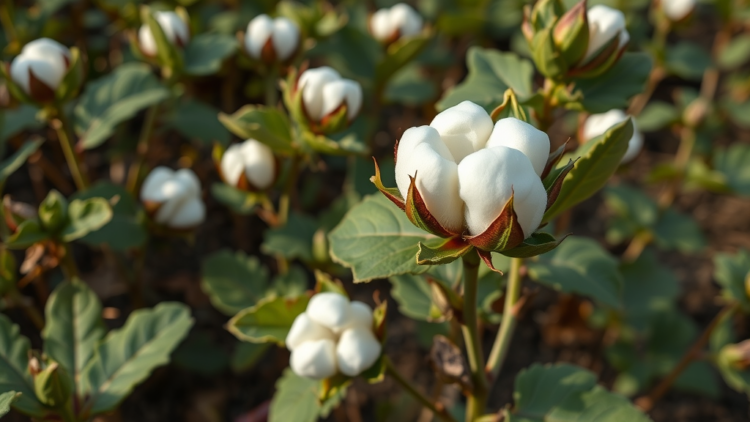
Cotton is one of the world’s most important fiber crops, yet its productivity is repeatedly undermined by drought, a stress that stunts growth, shrinks yields and leaves plants vulnerable to further damage. Now researchers at Xinjiang Normal University in Urumqi, China, have uncovered a molecular mechanism that explains how a naturally derived biopolymer helps cotton weather dry conditions. Their study, published in Plant Molecular Biology, identifies a gene called GhJAZ8 as a key positive regulator of drought tolerance and an important downstream component of the protective pathway triggered by gamma-polyglutamic acid, a fermentation product better known as gamma-PGA.
Gamma-PGA is a biodegradable polymer composed of glutamic acid residues, produced naturally by certain Bacillus bacteria. Earlier work by the same research group had shown that applying gamma-PGA to cotton enhances the plant’s ability to cope with water scarcity, but the underlying molecular machinery remained poorly defined. To probe deeper, the team performed transcriptome sequencing on gamma-PGA-treated cotton plants and found that multiple members of the TIFY gene family were markedly induced by the treatment. Among them, one gene stood out: GhJAZ8 showed the most pronounced upregulation of all, flagging it as a prime candidate for mediating the polymer’s drought-protective effects.
Sequence analysis placed GhJAZ8 firmly within the JAZ/TIFY5A subfamily, a group of proteins best known as repressors in jasmonate signaling, one of the central hormone pathways plants use to respond to stress and attack. The researchers also found that GhJAZ8 expression rises significantly under drought stress itself, independent of gamma-PGA treatment, suggesting the gene sits at a meaningful junction between the plant’s internal drought response and the externally applied biopolymer’s influence.
To test whether GhJAZ8 actually matters for drought survival, the team turned to virus-induced gene silencing, a technique that uses a modified viral vector to suppress a target gene’s activity in living plants. When GhJAZ8 was silenced, cotton plants became markedly more vulnerable to drought. The consequences were visible and measurable: leaves wilted more severely, relative water content in tissues dropped, malondialdehyde, a standard marker of oxidative damage to cell membranes, accumulated to higher levels, the activities of antioxidant enzymes weakened, and proline, an amino acid that helps cells retain water and stabilize proteins under stress, accumulated less abundantly. Together these results painted a clear picture: without GhJAZ8, cotton loses much of its capacity to defend itself against dehydration.
The complementary experiment reinforced the conclusion. When the researchers overexpressed GhJAZ8 in Arabidopsis thaliana, the widely used laboratory plant, the engineered plants displayed significantly enhanced drought tolerance. This cross-species gain of function indicates that GhJAZ8’s protective role is not an artifact of the cotton system alone but reflects a genuine capacity to strengthen drought defenses when present in sufficient quantity.
The study also clarified how GhJAZ8 relates to gamma-PGA’s benefits. When gamma-PGA was applied to both normal control plants and GhJAZ8-silenced plants, drought tolerance improved in both cases, but the improvement was substantially more pronounced in the control plants. That asymmetry indicates that GhJAZ8 is required for the full effect of the biopolymer: it functions as an important downstream component of the gamma-PGA-mediated drought tolerance pathway rather than being irrelevant to it. In other words, part of the polymer’s protective power flows through this gene.
Adding a further layer of nuance, the researchers tested whether methyl jasmonate, the active form of the jasmonate hormone, could rescue the drought-sensitive phenotype of GhJAZ8-silenced plants. It could, but only partially. Exogenous MeJA treatment alleviated some of the damage in the silenced plants, yet did not restore them to full resilience. This partial rescue suggests that GhJAZ8’s role in drought tolerance extends beyond simply acting as a repressor within the jasmonate pathway, hinting at broader functions in coordinating multiple stress responses.
Transcriptome analysis of the silenced plants provided strong support for that broader role. Differentially expressed genes were predominantly enriched in the signaling pathways of three major plant hormones: abscisic acid, the classic drought-response hormone that closes stomata and activates protective genes; jasmonic acid, central to wound and stress signaling; and salicylic acid, traditionally associated with pathogen defense but increasingly implicated in abiotic stress responses. Hormone quantification experiments then confirmed the transcriptomic picture at the biochemical level, showing that silencing GhJAZ8 significantly altered the endogenous levels of ABA, JA and SA in the plants.
Taken together, the findings establish GhJAZ8 as a positive regulator of the cotton drought response and as a critical downstream element in the gamma-PGA pathway, acting by modulating multiple phytohormone signaling networks simultaneously. The discovery carries practical weight. Drought is a growing threat to cotton cultivation, particularly in arid regions such as Xinjiang where the research was conducted, and breeding programs constantly seek candidate genes that can be deployed to develop more resilient varieties. GhJAZ8 now joins the toolkit as such a candidate, and the study suggests that combining genetic approaches with gamma-PGA application could offer a two-pronged strategy for protecting crops in water-limited environments.
The work also illustrates how a biopolymer once considered mainly as a soil conditioner or drug-delivery material can act as a genuine elicitor of plant stress responses, rewiring hormone signaling at the transcriptional level. As climate change intensifies drought pressure on agriculture worldwide, understanding these molecular levers, and the inexpensive, biodegradable compounds that pull them, may prove essential for keeping staple crops productive on a drying planet.
Subject of Research: The role of the GhJAZ8 gene in gamma-polyglutamic acid-induced drought tolerance and phytohormone signaling in cotton.
Article Title: γ‑polyglutamic acid‑induced GhJAZ8 positively regulates drought tolerance in cotton associated with phytohormone signaling
Article References: Wang, X., Kudelaiti, K., Fu, W., Han, A., Zhong, X., Bao, Z., Shan, D., Lou, Y., Chen, H., Jiang, M., Liusui, Y., & Zhang, J. (2026). γ‑polyglutamic acid‑induced GhJAZ8 positively regulates drought tolerance in cotton associated with phytohormone signaling. Plant Molecular Biology, 116(5), Article 97. https://doi.org/10.1007/s11103-026-01763-1
Image Credits: AI Generated
DOI: 10.1007/s11103-026-01763-1
Keywords: GhJAZ8, gamma-polyglutamic acid, cotton, drought tolerance, phytohormone signaling, abscisic acid, jasmonic acid, salicylic acid, TIFY gene family, gene silencing, plant molecular biology, crop breeding
Cite Scienmag News
APA MLA Chicago
Juliet Wilcox. (September 20, 2026). Bacterial Polymer-Boosted Gene Helps Cotton Survive Drought Through Hormone Signaling. Scienmag. https://scienmag.com/bacterial-polymer-boosted-gene-helps-cotton-survive-drought-through-hormone-signaling/
Juliet Wilcox. “Bacterial Polymer-Boosted Gene Helps Cotton Survive Drought Through Hormone Signaling.” Scienmag, 20 September 2026, https://scienmag.com/bacterial-polymer-boosted-gene-helps-cotton-survive-drought-through-hormone-signaling/. Accessed 20 September 2026.
Juliet Wilcox. “Bacterial Polymer-Boosted Gene Helps Cotton Survive Drought Through Hormone Signaling.” Scienmag. September 20, 2026. https://scienmag.com/bacterial-polymer-boosted-gene-helps-cotton-survive-drought-through-hormone-signaling/
Copy citation Download RIS
Tags: abscisic acidbacterial biopolymers in agriculturebiopolymer in plant stress responsecottoncotton water scarcity adaptation mechanismscrop breedingdrought toleranceDrought tolerance in cottongamma-PGA effect on plant hormone signalinggamma-polyglutamic acidgene regulation for drought stress in cottongene silencingGhJAZ8GhJAZ8 gene in drought resistancejasmonic acidmicrobial fermentation products in crop protectionmolecular pathways of drought resiliencephytohormone signalingplant molecular biologysalicylic acidTIFY gene familyTIFY gene family in stress regulationtranscriptome analysis in drought studies