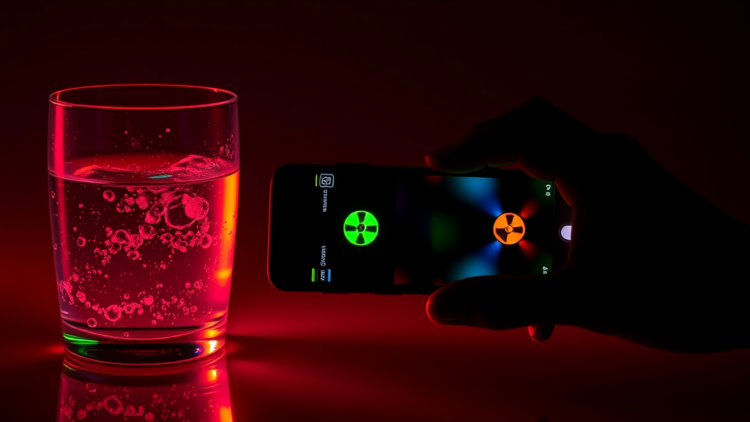
Uranium is one of the most consequential contaminants that can enter a water supply, and its presence is difficult to detect without specialized equipment. In many aquatic environments, uranium persists in its most stable chemical form, the uranyl ion, a species that combines chemical toxicity with radioactivity and unusually high mobility in water. Once released into lakes, rivers, or groundwater, uranyl ions can travel far from their original source, making rapid, on-site detection a pressing goal for environmental protection and public health. A research team now reports a fluorescent sensing platform that addresses this challenge by converting the presence of uranyl ions into a striking, visible color change that can be quantified with nothing more sophisticated than a smartphone camera.
The new material, described in the journal Sustainable Carbon Materials, is called EuZn-PMA. It belongs to a class of substances known as metal-organic coordination polymers, in which metal ions are linked by organic ligands into extended structures. What distinguishes EuZn-PMA is its deliberate combination of two different metals, europium and zinc, each assigned a distinct and complementary job. Europium serves as the fluorescence signaling center, emitting the characteristic red light that lanthanide elements are known for. Zinc, by contrast, does not produce the signal itself but helps regulate the architecture of the polymer and strengthens its overall luminescence. The organic ligand, pyromellitic acid, abbreviated PMA, ties the structure together and simultaneously provides the chemical recognition sites that capture uranyl ions from solution.
Corresponding author Suhua Wang of Guangdong University of Petrochemical Technology explained the motivation behind the design. The goal, according to Wang, was to create a sensing system that is not only highly sensitive but also produces an intuitive optical signal that can be interpreted without relying on sophisticated laboratory instruments. The red-to-green fluorescence transition, Wang noted, provides a straightforward way to visualize changes in uranyl concentration and creates opportunities for portable environmental monitoring. That emphasis on visual simplicity is central to the design philosophy: a sensor that requires a trained technician and expensive spectrometers may perform well in a laboratory, but it offers little help at the lakeshore or the wellhead where contamination decisions must be made quickly.
The underlying chemistry of the sensor is an elegant example of energy transfer being redirected on demand. In its resting state, when the probe is illuminated with ultraviolet light, the pyromellitic acid ligand absorbs the excitation energy and passes it along to the europium ions, which respond with a sharp red fluorescence centered at 616 nanometers. This is the color the sensor displays when the water is clean. When uranyl ions are introduced, however, the situation changes dramatically. The uranyl ions preferentially bind to the carboxylate groups on the PMA ligand, and this binding event disrupts the efficient transfer of energy to europium. Deprived of its energy supply, the europium red emission weakens and fades.
At the same time, a second optical process comes into play. The formation of the uranyl-ligand complex opens a ligand-to-metal charge transfer pathway associated with the uranyl moiety itself, which generates a new green fluorescence signal at 513 nanometers. As the concentration of uranyl ions rises, more ligand sites are occupied, the red emission continues to decline, and the green emission continues to grow. The net result is a smooth, clearly visible shift in the perceived color of the sample, from red toward green, that tracks the amount of uranium present. An observer can, in principle, watch the contamination level change color before their eyes.
The value of this dual-signal approach goes beyond aesthetics. Because the method measures the relationship between two fluorescence signals rather than relying on the absolute intensity of a single one, it constitutes what is known as ratiometric detection. Ratiometric measurements carry a built-in form of self-calibration: since both signals come from the same sample and are read under the same conditions, many common sources of error are cancelled out. Variations in probe concentration, fluctuations in the intensity of the excitation light, or drift in environmental conditions that would distort a single-channel measurement largely cancel in the ratio between the green and red channels. This robustness is one of the key advantages the dual-metal design confers over conventional single-emission fluorescent probes.
The analytical performance reported in laboratory measurements is impressive by any standard. EuZn-PMA achieved a detection limit of 51 nanomolar, a concentration low enough to flag uranium contamination well before it reaches levels of practical concern. The sensor also maintained a linear response across a detection range extending from zero to 60 micromolar, meaning that the fluorescence ratio changed predictably and proportionally over a wide span of uranyl concentrations. Such a broad linear range allows the same probe to be used for both trace-level screening and higher-concentration measurements without dilution or recalibration, a practical benefit for real-world deployment.
Selectivity is a perennial challenge for any ion sensor, because natural waters contain a crowded mixture of dissolved salts and metals that can mimic or mask the target analyte. The researchers therefore tested a panel of common ions that could potentially interfere with uranium sensing. The probe maintained favorable selectivity for uranyl ions and demonstrated strong anti-interference performance, indicating that its carboxylate-based recognition sites bind uranyl with sufficient preference to remain reliable in chemically busy environments. This selectivity, combined with the sensitivity, positions the material as a serious candidate for routine screening applications.
Perhaps most importantly, the team did not confine their evaluation to idealized laboratory solutions. They tested the sensor using lake water and seawater samples spiked with known concentrations of uranyl ions, a standard practice for assessing whether a sensor can survive contact with genuine environmental matrices. The measured recoveries ranged from 94.5 percent to 102.5 percent, with relative standard deviations between 1.9 percent and 3.9 percent, figures that indicate promising accuracy and precision in these tested samples. The study is candid, however, about the limits of this validation: more complex mixtures of interfering substances were not fully simulated, and the authors note that such conditions should be investigated in future practical applications before the platform can be trusted in the most demanding field scenarios.
To complete the pathway toward genuinely portable use, the researchers incorporated a smartphone into the readout. Fluorescent samples were photographed under ultraviolet excitation, and the red, green, and blue values of the resulting images were analyzed using a smartphone-based platform. The ratio of green to red intensity extracted from the photographs showed a strong relationship with uranyl concentration, which means the color change captured by an ordinary camera can serve as a quantitative readout rather than a merely qualitative impression. In effect, the sensor converts a chemical measurement into a photograph, and a photograph into a number. The researchers suggest that this dual-metal strategy, in which one metal handles signaling while the other tunes structure and luminescence, could provide a broader framework for designing lanthanide-based fluorescent sensors for environmental contaminants of many kinds. If that promise holds, the sight of a water sample glowing red, or shifting to green, could become one of the simplest and most accessible early-warning tools in environmental chemistry.
Subject of Research: A dual-metal fluorescent coordination polymer for ratiometric detection of uranyl ions in water.
Article Title: Dual-metal fluorescent probe enables ultrasensitive, color-changing uranium detection with a smartphone
Article References: Dual-metal fluorescent probe enables ultrasensitive, color-changing uranium detection with a smartphone. (n.d.). Original publication
Image Credits: AI Generated
DOI: Not provided
Keywords: uranium detection, uranyl ions, fluorescent probe, water contamination, ratiometric sensing, metal-organic coordination polymer, europium, zinc, smartphone sensing, environmental monitoring, lanthanide luminescence, pyromellitic acid
Cite Scienmag News
APA MLA Chicago
Bethany Barker. (September 20, 2026). Color-shifting fluorescent sensor spots uranium in water using just a smartphone. Scienmag. https://scienmag.com/color-shifting-fluorescent-sensor-spots-uranium-in-water-using-just-a-smartphone/
Bethany Barker. “Color-shifting fluorescent sensor spots uranium in water using just a smartphone.” Scienmag, 20 September 2026, https://scienmag.com/color-shifting-fluorescent-sensor-spots-uranium-in-water-using-just-a-smartphone/. Accessed 20 September 2026.
Bethany Barker. “Color-shifting fluorescent sensor spots uranium in water using just a smartphone.” Scienmag. September 20, 2026. https://scienmag.com/color-shifting-fluorescent-sensor-spots-uranium-in-water-using-just-a-smartphone/
Copy citation Download RIS
Tags: color-changing fluorescent sensors for water testingEnvironmental Monitoringenvironmental protection through portable water testing deviceseuropiumeuropium-based fluorescence indicatorsfluorescent probelanthanide luminescencemetal-organic coordination polymermetal-organic coordination polymers for pollutant sensingpublic health monitoring of radioactive pollutantspyromellitic acidrapid on-site uranium detection technologyratiometric sensingsmartphone sensingsmartphone-based environmental monitoringsustainable carbon materials for water safetyuranium detectionUranium water contamination detectionuranyl ion detection in aquatic environmentsuranyl ionsvisual colorimetric sensors for radioactive contaminantswater contaminationzinczinc-enhanced water contamination sensors