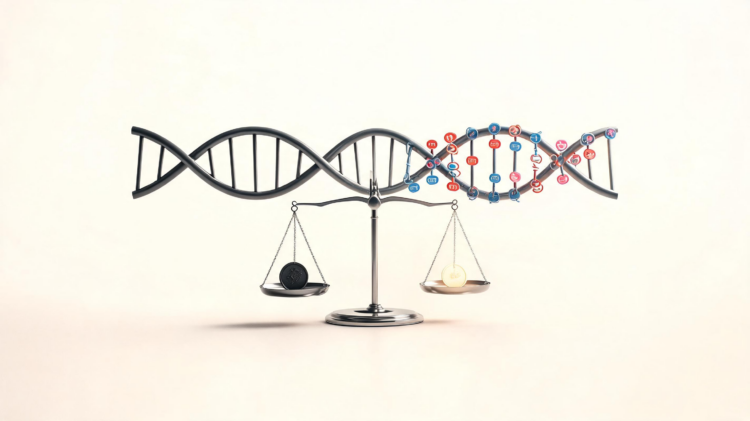
A concept as old as moral philosophy itself is being shaken by one of modern biology’s most transformative fields. In a new analysis published in Epigenetics Communications, philosopher Agnes E. Kandlbinder of the University of Lausanne and the University of Zurich argues that advances in epigenetics—cheap, cumulative, and often invisible changes in gene expression triggered by the environment—are creating deep conceptual problems for the three dominant philosophical accounts of what it means to harm or benefit someone. The paper suggests that the entire framework philosophers, bioethicists, and even lawmakers use to decide when an event makes a person worse off may rest on an outdated picture of biological identity.
For centuries, moral philosophy has wrestled with the definition of harm. The idea that one person’s actions can damage another’s well-being underpins applied ethics, moral theory, and most systems of law, yet the fine details remain hotly disputed. Kandlbinder’s starting point is the observation that three well-established accounts dominate the debate. The counterfactual comparative account, championed by Derek Parfit and Joel Feinberg, holds that an event harms someone if they end up worse off than they would have been had the event not occurred. The temporal comparative account defines harm as being worse off after an event than before it. The non-comparative, or causal, account—defended by philosophers such as Elizabeth Harman and Seana Shiffrin—says an event is harmful simply if it causes a person to be in an objectively bad state. None of these is canonically accepted, and each has attracted serious criticism, but all continue to shape moral reasoning in bioethics, law, and policy.
To see how these accounts work, Kandlbinder offers a simple illustration. A man hit on the head with a beer bottle in a bar fight is straightforwardly harmed. On the counterfactual account, he is worse off than he would have been had he stayed home that evening. On the temporal account, he is worse off after the fight than he was at work beforehand. On the non-comparative account, concussion and a painful laceration are objectively bad states, and the bottle caused them. The example seems airtight—but epigenetics, she argues, reveals cracks that run far deeper than this apparently clean case of cause and effect.
The trouble begins with identity. Person-affecting views of harm assume that for an event to count as a harm, it must be harmful to a specific someone with a distinct numerical identity. For much of the twentieth century, that identity was assumed to be fixed by genetics: the unique set of nuclear DNA in each cell, established at conception, defined the biological individual. This genetic essentialism still lingers in legislation and regulation of reproductive technologies. Yet developmental biology has rendered it untenable. Epigenetic mechanisms—chemical modifications that regulate which genes are switched on or off—respond to environmental circumstances, shape phenotypical traits such as appearance, behavior, stress response, and disease susceptibility, and begin operating as early as the embryonic stage. As scholars such as Daniela Cutas and Andrea Smajdor have noted, the new science blurs the boundary between genetics and environment, dissolving the old dichotomies of nature versus nurture and biological versus social.
This shift has consequences for the notorious non-identity problem, introduced by Parfit in 1984. The problem holds that existence-constituting events cannot make a person worse off, because without those events the person would not have existed at all to be harmed. Traditionally confined to reproductive and population ethics, the problem now leaks into the lives of existing people. If even modest environmental shifts alter gene expression, and if such changes are taken to alter identity, then arguably ‘new’ people are being produced all the time—which would make it impossible to classify everyday events as person-affecting harms or benefits on either comparative account. Smajdor has warned that numerical genetic identity can no longer sustain the weight the non-identity problem expects it to bear.
The non-comparative account escapes this identity trap, since it measures harm absolutely—being caused to be in a bad state—rather than by comparison. But it stumbles over two other requirements: a fixed categorization of ‘good’ and ‘bad’ states, and a strict criterion of causation. Both falter under epigenetic scrutiny. Critics including Elisabeth Carlson, Johan Johansson, and Olle Risberg have questioned whether intrinsic harms exist at all, and disability scholarship has shown that lived experience of biological traits is far more ambiguous than generalized intuitions suggest—a caution against embedding anti-disability bias into philosophical definitions of the ‘bad’ state. Epigenetics compounds the ambiguity: as Carlo Dupras and Vardit Ravitsky have observed, an epigenetic change may be adaptive in one context yet harmful in another. Metabolic shifts toward insulin sensitivity triggered by prenatal malnutrition, for instance, can help a fetus survive early life while raising the risk of type 2 diabetes decades later. Moreover, Erla Moormann has argued that epigenetic changes rarely trace back to a single causal event, undermining causation-based accounts that presume the neat linearity of a beer bottle to the skull.
The paper’s most provocative claim goes further still. Drawing on feminist phenomenology—from Iris Marion Young’s account of embodied spatiality to Judith Butler’s argument that identity is co-constituted through relationality—Kandlbinder contends that lived experience, embodiment, and gene expression form a circular system that collectively constitutes identity itself. Environment shapes gene expression; gene expression shapes phenotype; phenotype shapes how a person is perceived and how they move through the world; those experiences in turn reshape biology and identity. On this view, there is no ‘original’ identity that exists prior to and apart from the events that befall a person, which means any account of harm that separates who someone is from what happens to them is conceptually doomed to chase its own tail.
To make the stakes vivid, Kandlbinder constructs a hypothetical figure named Mona, a woman in her thirties who carries epigenetic changes triggered by her mother’s malnutrition during pregnancy. Living in a higher-weight body, she faces chronic weight-based discrimination rooted in social norms; the resulting stress elevates her risk of anxiety, hypertension, and cardiovascular disease; those conditions limit her employment options, deepening financial precarity, which further raises stress levels—all well-studied ‘social determinants of health’ largely outside her control. Where, Kandlbinder asks, in this cascade of entwined circumstances stretching from the prenatal period onward, could one pinpoint a discrete harmful event that made Mona worse off, on any of the three accounts? Her harms are, at the same time, inseparable from who she is.
The proposed way out is methodological rather than destructive. Kandlbinder endorses multi-dimensional accounts of harm, such as Moormann’s, which incorporate lived experience and relationality, and urges that they be merged with relational conceptions of identity like Françoise Baylis’s, in which the self is co-constructed through iterative cycles of private and public interaction—now understood to operate at the molecular as well as the social level. Such a framework would treat benefit and harm as more than additions or subtractions to a person’s well-being, recognizing instead that events constantly reshape identity without thereby dissolving the person altogether. Even the humble bar fight looks different through this lens: rather than a unilateral cause acting on a pre-existing victim, it becomes one strand in a web of sociocultural and embodied conditions. As debates over germline genome editing and epigenetic editing intensify—framed by bodies such as the World Health Organization around imperatives to maximize benefits and minimize harms—philosophy may need to abandon the comfortable fiction of a fixed biological self. What epigenetics ultimately teaches, Kandlbinder concludes, is that harming and benefiting someone cannot be understood apart from understanding who they are becoming.
The timing of Kandlbinder’s analysis is notable. Bioethical attention since the advent of CRISPR/Cas9 gene editing has concentrated overwhelmingly on alterations to the nuclear DNA sequence itself, even though germline alterations can also arise through changes to molecular structures other than DNA. Epigenetic editing, which modifies gene expression rather than genes, can influence phenotypic outcomes without touching the underlying sequence, and the article argues that debates about the ‘potential benefits of human genome editing research’ must therefore expand to cover these non-sequence-based mechanisms of biological change.
The epigenetic paradigm also carries implications beyond philosophy seminars. Epigenetic mechanisms influence phenotypic markers including appearance, behavior, stress response, and disease susceptibility, and these processes begin acting as early as the embryonic stage. Because some epigenetic states can be shaped by nutrition, stress, and other environmental conditions, the boundaries between individual responsibility, parental influence, and societal obligation become harder to draw. A trait that diminishes well-being in one sociocultural setting may be neutral or adaptive in another, which complicates any regulatory framework that assumes harms can be identified and attributed in a straightforward manner.
Kandlbinder’s intervention also situates epigenetics within a longer philosophical tradition. The margins of life—its beginning and its end—have long been recognized as especially troublesome for theories of benefit and harm, and questions about whether a person can be harmed before existing or after dying remain unresolved. What the epigenetic paradigm adds is the recognition that such puzzles are no longer confined to the edges of a lifespan. If embodied experience, epigenetic change, and identity are co-constitutive throughout life, then the conceptual work of defining harm must become multi-dimensional and relational, integrating biological, embodied, and sociocultural dimensions rather than treating them as separate spheres.
Subject of Research: The philosophical implications of epigenetic mechanisms for conceptualizing benefit and harm to individuals.
Article Title: Philosophical complications of epigenetic benefit and harm
Article References: Kandlbinder, A. E. (2026). Philosophical complications of epigenetic benefit and harm. Epigenetics Communications, 6(1), Article 8. https://doi.org/10.1186/s43682-026-00049-3
Image Credits: AI Generated
DOI: 10.1186/s43682-026-00049-3
Keywords: epigenetics, harm, benefit, identity, non-identity problem, bioethics, gene expression, well-being, feminist philosophy, genetic essentialism, social determinants of health, philosophy of biology
Cite Scienmag News
APA
MLA
Chicago
Juliet Wilcox. (September 10, 2026). How Epigenetics Is Rewriting the Philosophy of Harm and Benefit. Scienmag. https://scienmag.com/how-epigenetics-is-rewriting-the-philosophy-of-harm-and-benefit/
Juliet Wilcox. “How Epigenetics Is Rewriting the Philosophy of Harm and Benefit.” Scienmag, 10 September 2026, https://scienmag.com/how-epigenetics-is-rewriting-the-philosophy-of-harm-and-benefit/. Accessed 10 September 2026.
Juliet Wilcox. “How Epigenetics Is Rewriting the Philosophy of Harm and Benefit.” Scienmag. September 10, 2026. https://scienmag.com/how-epigenetics-is-rewriting-the-philosophy-of-harm-and-benefit/
Copy citation
Download RIS
Tags: benefitbioethicsbiological basis of harm and benefitconceptual challenges in ethicscumulative and invisible biological changesepigeneticsEpigenetics and moral philosophyethical theories in light of epigenetic researchfeminist philosophygene expressiongene expression and environmental influencegenetic essentialismharmhistoric versus modern biological perspectivesidentityimpact of epigenetics on legal frameworksimplications for bioethics and lawnon-identity problemphilosophical reevaluation of biological identityphilosophy of biologyredefining well-being and harm in biological contextreinterpretation of harm and benefitsocial determinants of healthwell-being