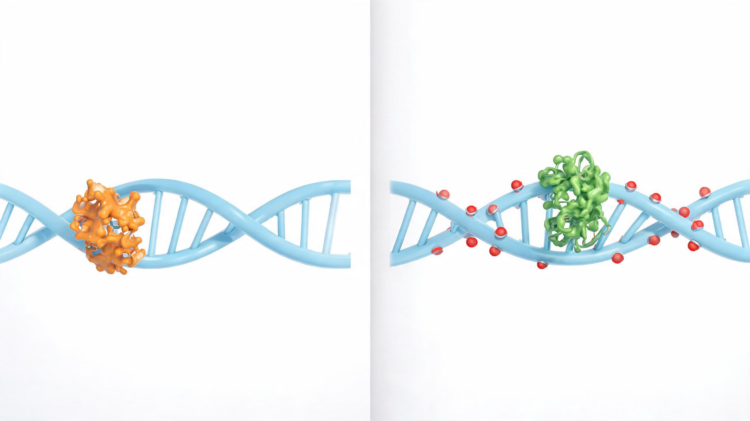
Transcription factors are the master regulators of the genome, the proteins that decide which genes are switched on, which are silenced, and ultimately what a cell becomes. Because they govern cell identity, development, and the progression of many diseases, researchers have long sought reliable ways to measure their activity. A new study published in Molecular Systems Biology by Max Trauernicht, Vinícius H. Franceschini-Santos, Hatice Yücel, Teodora Filipovska, and Bas van Steensel of the Netherlands Cancer Institute now delivers one of the most systematic head-to-head comparisons to date of the two dominant approaches for gauging transcription factor activity, and the results carry important implications for how thousands of published and future gene regulation studies should be interpreted.
The first approach, which has become a workhorse of modern genomics, infers transcription factor activity computationally from ATAC-seq data. ATAC-seq maps regions of open, accessible chromatin across the genome, and the logic behind the inference is elegant: many transcription factors bind DNA and displace nucleosomes, prying open the chromatin around their binding sites. By scoring the genome-wide correlation between a factor’s binding motif and the presence of accessible chromatin, tools such as chromVAR can assign an activity score to every transcription factor in a single experiment. The method is simple, requires little input material, works even on single cells, and has been applied across fields ranging from neuroscience to cancer biology to reconstruct gene regulatory networks and dissect cis-regulatory logic.
But the approach is fundamentally indirect. ATAC-seq captures a factor’s ability to bind DNA and remodel chromatin, not necessarily its transcriptional output. This introduces systematic biases. Pioneer factors, which can invade closed chromatin and open it up, leave strong accessibility signatures that ATAC-seq readily detects. Factors that require pre-existing open chromatin, or that bind regions opened by other proteins, may be underrepresented or falsely flagged as active simply because they occupy constitutively accessible housekeeping promoters. The central question motivating the new work was blunt: what does ATAC-seq actually measure about transcription factor function?
To answer it, the team turned to a direct alternative they had previously developed: the prime TF reporter system, a multiplexed assay in which a library of one hundred barcoded synthetic reporters, each designed to probe the regulatory activity of a single transcription factor, is transfected into cells. Transcription from each reporter is quantified by sequencing the barcodes in messenger RNA, and a computational pipeline called primetime converts barcode counts into differential activity scores. Because the reporters were engineered with optimized motif spacing and flanking sequences to minimize crosstalk, some can even distinguish between closely related family members, a feat that motif-based analysis of genomic ATAC-seq data often cannot achieve.
The experimental design was deliberately rigorous. The researchers transfected the reporter library into mouse embryonic stem cells and then applied nine distinct perturbations known to alter specific transcription factor activities: degradation of the core pluripotency pioneers SOX2 and POU5F1 using degron-tagged cell lines, knockdown of TFCP2L1, overexpression of FOXA1, withdrawal of LIF to dampen STAT3 signaling, depletion of the WNT pathway activator Chiron to reduce TCF7 activity, and stimulation of SRF, CREB1, and HSF1 through serum exposure, forskolin treatment, and heat shock respectively. Crucially, both assays were performed in the same cellular background after transfection, and the same binding motifs were used for the ATAC-seq analysis as those embedded in the reporters, enabling a genuinely direct comparison. Quality controls confirmed the robustness of both readouts, with replicate correlations for chromVAR deviation scores reaching 0.92 to 0.97 and strong agreement with previously published SOX2 degradation data.
The headline finding was a striking asymmetry. The primeTF reporter assay detected significant, directionally correct activity changes for all nine perturbed factors, with fold-changes ranging from 2.6-fold for SRF upon serum stimulation to a dramatic 63-fold for HSF1 upon heat shock. ATAC-seq, analyzed with chromVAR, captured seven of the nine, but completely missed the activation of SRF by serum and CREB1 by forskolin. When all one hundred factors were ranked by their perturbation response, both methods placed the correct target at or near the top in six conditions, but under heat shock, forskolin, and serum stimulation, ATAC-seq ranked the expected targets only fourth, fourteenth, and eighty-fifth respectively. Repeating the analysis with TOBIAS, an independent footprinting-based method, produced the same overall trends, demonstrating that the discrepancies reflect intrinsic limitations of accessibility-based inference rather than the quirks of any single algorithm.
The pattern that emerged was mechanistically coherent. Signal-responsive transcription factors such as CREB1, STAT3, HSF1, SRF, EGR1, NFKB1, and TP53, whose activities are typically controlled by post-translational modifications like phosphorylation rather than by changes in protein abundance or chromatin remodeling, were far more sensitively detected by the reporters. These factors often bind chromatin that is already accessible, so their activation leaves little or no footprint in accessibility data. Conversely, ATAC-seq preferentially captured chromatin-modifying and pioneer factors. Degradation of SOX2 and POU5F1 produced pronounced accessibility changes that chromVAR detected robustly, and ATAC-seq additionally revealed biologically meaningful secondary responses, such as reduced TCF7L2 and increased TEAD1 accessibility after SOX2 loss, consistent with SOX2’s known roles in promoting WNT signaling and antagonizing the Hippo pathway. Upon LIF withdrawal, ATAC-seq captured reduced accessibility of the pluripotency effectors TFCP2L1, KLF4, and ESRRB downstream of STAT3, changes the reporters did not register.
Time added a further dimension to the story. In a time-course following LIF withdrawal, ATAC-seq detected a measurable decrease in accessibility around STAT3 binding sites within one hour, reaching maximum downregulation by three hours, while the reporter assay showed no change at one hour, a delayed response at three hours, and a progressive decline through twenty-four hours. ATAC-seq therefore provides a near-instantaneous snapshot of chromatin state, whereas the reporters yield a time-integrated readout shaped by both transcriptional induction and mRNA degradation. Yet temporal resolution alone could not explain the sensitivity gap: at both six and twenty-four hours, primeTF identified STAT3 as the single most significantly downregulated factor with a large effect size, while ATAC-seq reported comparable effect sizes for several other factors without clearly prioritizing STAT3.
To test the methods in a less controlled but biologically richer setting, the team differentiated mouse embryonic stem cells into neural precursor cells and profiled both cell types with both assays. The two methods correlated moderately, and primeTF correctly identified the downregulation of all key pluripotency factors upon differentiation, whereas ATAC-seq missed STAT3 and POU5F1. The clearest divergence involved NFIA, a factor central to neural and glial differentiation: ATAC-seq detected a massive increase in NFIA-associated accessibility, consistent with pioneer activity and extensive chromatin remodeling, while the reporter registered only a modest two-fold activation, suggesting NFIA remodels chromatin powerfully but acts as a weak transcriptional activator in isolation. In additional perturbations of the differentiated cells, ATAC-seq also struggled to distinguish CREB1 from the related bZIP factors FOS::JUN and NFE2L2, whose motifs are highly similar, whereas the optimized reporters resolved these cases specifically and correctly identified NR4A1, a well-established CREB1 target.
The authors are careful to note the limitations of their benchmark. The perturbations were deliberately chosen to target factors with previously validated reporters, making the comparison somewhat favorable to primeTF, and the reporter system is designed to measure transcriptional activation rather than repression, while ATAC-seq alone cannot discriminate activating from repressive effects. Both approaches also require orthogonal follow-up experiments to deconvolve cases where multiple factors bind the same motif. Nevertheless, the overarching conclusion is clear and actionable: the two methods offer distinct and complementary perspectives on transcription factor function. ATAC-seq excels at identifying factors that reshape chromatin, especially pioneer factors, while reporter assays reveal the transcriptional potency of factors, particularly those activated through signaling pathways. For researchers seeking a comprehensive picture of gene regulation, neither assay alone suffices, and integrating both is emerging as the standard that rigorous studies of transcriptional control should aspire to meet.
The study’s findings arrive at a moment when accessibility-based inference has become near-ubiquitous in the literature, often without explicit validation against orthogonal measurements. Because ATAC-seq profiles can be generated from tiny amounts of material and even single cells, activity scores derived from them are frequently reported as ground truth, yet the new comparison shows that such scores are best understood as measures of chromatin engagement rather than of transcriptional drive. This distinction matters particularly for interpreting signaling pathways, where factors like CREB1 and HSF1 are activated by phosphorylation and trimerization respectively, leaving protein abundance untouched and chromatin largely unremodeled.
The work also builds on a longer arc of reporter technology development. Early massively parallel reporter assays demonstrated that hundreds of regulatory sequences could be assayed simultaneously using barcodes and sequencing, but applying this logic to transcription factors themselves required carefully engineered synthetic elements that isolate each factor’s contribution from the combinatorial context of endogenous enhancers. The prime reporter library represents that refinement, and its ability to resolve closely related family members addresses a persistent weakness of motif-based analyses, where similar DNA-binding specificities confound attribution.
For the field, the practical message is one of calibration rather than replacement. Accessibility data remain invaluable for mapping pioneer activity and secondary network effects, while reporters quantify transcriptional potency directly. Studies that rely on a single method should now acknowledge its blind spots explicitly, and combined designs are likely to become the benchmark for claims about transcription factor function.
Subject of Research: Systematic comparison of transcription factor activity measurements by ATAC-seq chromatin accessibility inference and multiplexed prime TF reporter assays in mouse stem cells
Article Title: Systematic comparison of estimates of transcription factor activity by ATAC-seq and multiplexed reporter assays
Article References: Trauernicht, M., Franceschini-Santos, V. H., Yücel, H., Filipovska, T., & van Steensel, B. (2026). Systematic comparison of estimates of transcription factor activity by ATAC-seq and multiplexed reporter assays. Molecular Systems Biology. https://doi.org/10.1038/s44320-026-00240-7
Image Credits: AI Generated
DOI: 10.1038/s44320-026-00240-7
Keywords: transcription factors, ATAC-seq, chromVAR, primeTF reporter assay, chromatin accessibility, gene regulation, pioneer factors, SOX2, POU5F1, STAT3, mouse embryonic stem cells, signal-responsive TFs
Cite Scienmag News
APA MLA Chicago
Juliet Wilcox. (September 3, 2026). Two Ways to Read a Cell’s Master Switches Reveal Hidden Biases in Gene Regulation Studies. Scienmag. https://scienmag.com/two-ways-to-read-a-cells-master-switches-reveal-hidden-biases-in-gene-regulation-studies/
Juliet Wilcox. “Two Ways to Read a Cell’s Master Switches Reveal Hidden Biases in Gene Regulation Studies.” Scienmag, 3 September 2026, https://scienmag.com/two-ways-to-read-a-cells-master-switches-reveal-hidden-biases-in-gene-regulation-studies/. Accessed 3 September 2026.
Juliet Wilcox. “Two Ways to Read a Cell’s Master Switches Reveal Hidden Biases in Gene Regulation Studies.” Scienmag. September 3, 2026. https://scienmag.com/two-ways-to-read-a-cells-master-switches-reveal-hidden-biases-in-gene-regulation-studies/
Copy citation Download RIS
Tags: ATAC-seqATAC-seq analysisBiases in gene regulation studiesCell identity and developmentChromatin AccessibilityChromatin accessibility tools like chromVARchromVARComputational inference of gene regulationDisease progression and gene regulationGene regulationGenome-wide chromatin mappingmouse embryonic stem cellsNucleosome displacementpioneer factorsPOU5F1primeTF reporter assaysignal-responsive TFsSOX2STAT3Systematic comparison of gene regulation methodsTranscription factor activity measurementtranscription factors