A team of researchers in Cameroon, Belgium and South Africa has shown that two humble additives—a natural gum harvested from acacia trees and a common clay called bentonite—can dramatically transform the properties of biodegradable plastics made from cassava starch and cellulose. The study, published in the journal Discover Industrial Chemistry and Materials, reports that adding acacia gum to a starch-cellulose film nearly quadruples its stiffness, while combining the gum with bentonite slashes the material’s water uptake and slows its breakdown in soil. The findings offer a low-cost, plant-based route to tougher and more moisture-resistant bioplastics at a time when the world is drowning in persistent plastic waste.
The motivation behind the work is stark. Global plastic consumption was estimated at 700 million tonnes in 2021, yet only about six percent of that material is recycled. Projections cited by the authors suggest that by 2050 worldwide plastic use could climb to between 753.5 and 832.4 million tonnes, with global recycling of plastic waste still languishing at roughly 13 percent. Because conventional petrochemical plastics do not biodegrade, they fragment into microparticles that contaminate ecosystems and can even enter the human food chain. Bioplastics made from renewable agricultural resources such as starch are an attractive alternative, but they suffer from two chronic weaknesses: they absorb water readily and they lack mechanical strength.
Starch is one of the cheapest and most abundant biopolymers available. Cassava, in particular, is a major crop in Cameroon, which produces more than five million tonnes of roots every year—about 40 percent of the world’s production. Yet most of that cassava is consumed as food, and the industrial starch market remains underdeveloped. The researchers, led by Herman Assonfack Lekane of the University of Yaoundé I, set out to upgrade cassava starch into a viable plastic by reinforcing it with acid-hydrolyzed cellulose derived from Ceiba pentandra, a tropical tree known locally as Eteng, and then modifying the resulting composite with acacia gum and bentonite.
The cellulose was extracted from Eteng wood and then treated with 60 percent sulfuric acid to produce acid-hydrolyzed cellulose, abbreviated NCE in the study. The acid dissolves the amorphous regions of cellulose, leaving behind highly crystalline nanoscale fibrils. Characterization by scanning electron microscopy revealed fibers only a few nanometers thick after treatment, while X-ray diffraction confirmed a higher crystallinity index for the hydrolyzed material than for the raw cellulose. Infrared spectroscopy detected new bands at 1264 and 804 per centimeter, signatures of sulfate ester groups grafted onto the cellulose surface during the acid reaction. These charged groups, measured at a density of 8 times ten to the minus six moles per gram by conductimetry, help the particles disperse and can enhance thermal stability.
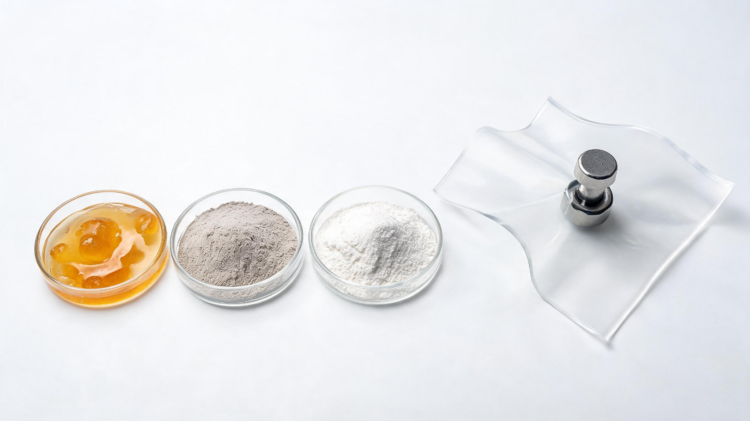
Three film formulations were prepared and compared. The reference composite, labeled AN, combined five percent cassava starch suspension with glycerol as a plasticizer, sodium carbonate, and ten percent NCE relative to starch mass. A second formulation, ANG, added 12.5 percent acacia gum—an exudate from African Vachellia nilotica trees supplied by a traditional production unit in northern Cameroon. The third, ANBG, further incorporated 30 percent bentonite clay relative to starch mass. Each suspension was gelatinized at 70 degrees Celsius for 30 minutes, cast into molds, and dried at 50 degrees Celsius for three days.
The most striking result concerned water. When films were exposed to a humid atmosphere of 87 percent relative humidity, the reference starch-cellulose film absorbed water rapidly, reaching a maximum uptake of about 30 percent after 300 minutes. Adding acacia gum cut that figure to roughly 20 percent, and the gum-bentonite combination reduced it to about 10 percent—a reduction of 18 percent relative to the gum-only film and a dramatic improvement over the pristine composite. Infrared analysis explained why: the gum and clay form hydrogen bonds with the starch and cellulose chains, occupying the molecular sites that water molecules would otherwise bind to. The intensity of the hydroxyl stretching band and the free-water deformation band both dropped in the modified films, confirming tighter internal bonding and less adsorbed water.
Mechanical testing delivered equally impressive numbers. The reference film had a Young’s modulus of 39.9 megapascals and a tensile strength of 1.46 megapascals. With acacia gum added, the modulus soared to 150.7 megapascals and the tensile strength climbed to 7.14 megapascals—nearly a fivefold increase in stiffness. The researchers attribute this hardening effect to the gum’s chemical functionality, which improves adhesion between the starch matrix and the cellulose reinforcement. Small molecules from the gum appear to intercalate between polymer chains, facilitating chain sliding while simultaneously building a denser network of bonds. Interestingly, adding bentonite on top of the gum partially reversed the gains: the gum-clay film reached a modulus of 133.3 megapascals and a strength of 4.13 megapascals, still well above the reference but below the gum-only material. The clay particles appear to interfere with polymer-gum networking and to aggregate into fragile domains that limit elongation.
Thermal analysis added further nuance. Differential scanning calorimetry showed that the melting of the starch component, recorded at 133 degrees Celsius in the reference film, shifted to 171 degrees Celsius with gum and rose a further 24 degrees with the gum-bentonite combination. The gum retards melting by increasing hydrogen bonding within the film, while the mineral clay acts as a barrier to heat diffusion through the matrix. Thermogravimetric analysis, evaluated with the Broido model between 300 and 350 degrees Celsius, revealed that activation energies decreased from 76.9 kilojoules per mole for the reference film to 69.9 with gum and 66.7 with gum plus bentonite, indicating progressively weaker internal interactions as additives were introduced. The authors propose an ordering of interaction energies: starch-cellulose bonding is strongest, followed by the gum-modified and then the gum-clay systems. Bentonite’s contribution is therefore physical rather than chemical—a heat shield rather than a bonding agent.
Perhaps the most consequential finding relates to biodegradation. Films were buried in soil from Mbalmayo in central Cameroon, with a pH of 5.1 and a composition of 65 percent sand, 29 percent clay and 21 percent silt, at 80 percent relative humidity and 25 degrees Celsius. Mass loss increased with burial time in all films, but the gum-containing formulations degraded noticeably more slowly. Because the microorganisms that decompose these materials depend on moisture, the reduced water uptake of the modified films starves them of the conditions they need to thrive. Bentonite further slows the process by drawing migrating water into the clay phase, leaving less available in the carbohydrate region where microbes operate. The authors suggest this controlled degradation could be a feature rather than a flaw: films that persist long enough to be useful but still break down naturally at end of life.
The study positions acacia gum as a genuine bio-hardener for starch-based plastics, echoing earlier work showing that African tree exudates can harden tannin-based wood adhesives. Because the gum is a natural, locally available material, it preserves the biodegradability of the composite while delivering performance that synthetic additives struggle to match. The gum-bentonite pairing, though less effective mechanically, offers a distinct advantage in moisture control and degradation management, pointing toward applications in food packaging, where limiting water uptake also limits bacterial growth. The authors note that the gum-bentonite films could serve for more than 200 minutes in highly humid conditions with less than 10 percent water uptake. For a field searching for sustainable materials that balance strength, cost and environmental fate, the message is clear: sometimes the answers are literally dripping from the trees.
Beyond the headline results, the study offers a useful reminder of how locally sourced materials can shape materials science outcomes. The acacia exudate used in the films came from a traditional production unit in northern Cameroon, meaning the hardening additive required no synthetic chemistry to obtain. Similarly, the bentonite and glycerol were standard commercial reagents, while the starch itself was extracted from cassava tubers softened in water for five days, washed, filtered, and air-dried at ambient temperature. The entire production chain relies on low-energy processing, with gelatinization carried out at just 70 degrees Celsius and drying at 50 degrees Celsius over three days.
The choice of Ceiba pentandra as the cellulose source is also notable. The tree, identified with assistance from the National Herbarium in Yaoundé, was collected in Mbalmayo, the same region whose soil later served as the biodegradation medium. Acid hydrolysis of the extracted cellulose followed established protocols, using repeated hot-water washing cycles, neutralization with dilute sodium hydroxide, ultrasonic dispersion, and freeze-drying to yield the final NCE powder. This level of procedural detail matters for reproducibility, since the surface chemistry of hydrolyzed cellulose, including its sulfate ester content, strongly influences how well the particles bond with a starch matrix.
Methodologically, the team combined a broad characterization toolkit: Fourier transform infrared spectroscopy and X-ray diffraction confirmed the presence and interactions of the additives, while coupled thermal analysis probed melting behavior and decomposition kinetics. Moisture uptake was tracked over 700 minutes in a controlled 87 percent relative humidity chamber, and mechanical response was quantified through stress-strain testing. The convergence of evidence from these independent techniques strengthens the authors’ interpretation that acacia gum acts primarily as a bonding agent between polymer chains, whereas bentonite functions as a physical barrier to both heat and water transport within the composite films.
Subject of Research: Effects of acacia gum and bentonite additives on the mechanical, thermal, moisture and biodegradation properties of cassava starch and acid-hydrolyzed cellulose composite bioplastics
Article Title: Effects of acacia gum and bentonite on the properties of composite bioplastics made of starch and acid hydrolyzed cellulose
Article References: Assonfack Lekane, H., Cheumani Yona, A. M., Tsague, F. L., Abo, T. M., Kuete, M. A., Ndinteh, D. T., Mbey, J. A., & Ndikontar, M. K. (2026). Effects of acacia gum and bentonite on the properties of composite bioplastics made of starch and acid hydrolyzed cellulose. Discover Industrial Chemistry and Materials, 1(1), Article 15. https://doi.org/10.1007/s44508-026-00014-x
Image Credits: AI Generated
DOI: 10.1007/s44508-026-00014-x
Keywords: bioplastics, cassava starch, acid-hydrolyzed cellulose, acacia gum, bentonite, biodegradation, moisture absorption, Young’s modulus, hydrogen bonding, thermal stability, nanocellulose, sustainable materials
Cite Scienmag News
APA
MLA
Chicago
Bethany Barker. (September 3, 2026). Acacia Gum and Bentonite Give Starch Bioplastics a Major Strength Boost. Scienmag. https://scienmag.com/acacia-gum-and-bentonite-give-starch-bioplastics-a-major-strength-boost/
Bethany Barker. “Acacia Gum and Bentonite Give Starch Bioplastics a Major Strength Boost.” Scienmag, 3 September 2026, https://scienmag.com/acacia-gum-and-bentonite-give-starch-bioplastics-a-major-strength-boost/. Accessed 3 September 2026.
Bethany Barker. “Acacia Gum and Bentonite Give Starch Bioplastics a Major Strength Boost.” Scienmag. September 3, 2026. https://scienmag.com/acacia-gum-and-bentonite-give-starch-bioplastics-a-major-strength-boost/
Copy citation
Download RIS
Tags: acacia gumacacia gum as bioplastic additiveacid-hydrolyzed cellulosebentonitebentonite clay in bioplasticsbiodegradable plastic degradation controlbiodegradable plasticsbiodegradationbioplastic mechanical property enhancementbioplasticscassava starchcassava starch bioplasticseco-friendly plastic alternativeshydrogen bondinglow-cost bioplastic production methodsmoisture absorptionmoisture-resistant biodegradable plasticsnanocelluloseplant-based bioplastic strengtheningplastic waste reduction strategiessustainable materialssustainable materials for packagingthermal stabilityYoung’s modulus