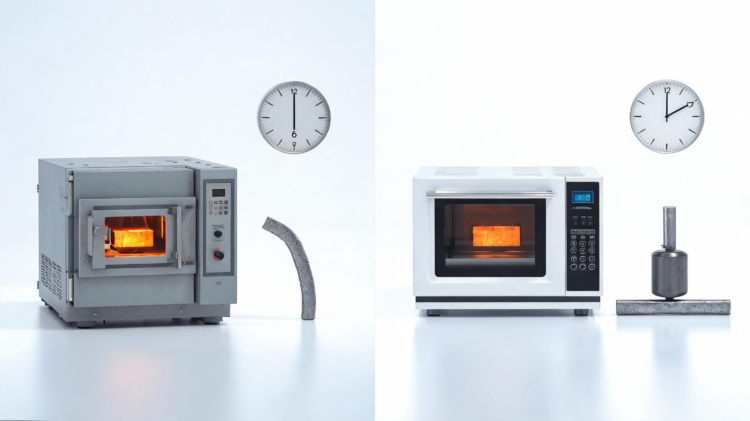
For decades, the prevailing assumption in materials science held that metals and microwaves were natural enemies. Bulk metal, after all, is an excellent reflector of electromagnetic radiation, a property that engineers have long exploited to build the walls of microwave ovens and shield electronic devices from interference. That assumption, however, breaks down at the scale of powdered metals and at elevated temperatures, where the physics of electromagnetic coupling changes dramatically. A comprehensive new review published in the journal Advanced Materials Joining by Qingyang Qiu, Yuntao Sun, Shuai Zhang, Peng He, and their colleagues at the Harbin Institute of Technology and the Zhengzhou Research Institute of Mechanical Engineering in China now provides the most detailed roadmap to date for exploiting this overlooked regime. The work traces microwave sintering of metals from the quantum-level interaction between electromagnetic waves and individual atoms all the way to the industrial production of dense, defect-minimized alloy components, revealing a technology that could reshape how the world manufactures everything from jet engine parts to biomedical implants.
The fundamental distinction between microwave and conventional heating lies in where heat is generated. Traditional sintering furnaces rely on thermal conduction, radiation, and convection to transfer energy from an external source to the surface of a material, from which it slowly diffuses inward. This creates a persistent temperature gradient between the hot exterior and the cooler core, prolonging processing times and often producing uneven microstructures, thermal stresses, and inconsistent mechanical properties. Microwave heating inverts this paradigm entirely. Rather than heating from the outside in, microwaves interact directly with the internal structure of the material, converting electromagnetic energy into thermal energy within the bulk. The result is rapid, volumetric heating that can shorten processing cycles by up to 75 percent, reduce energy consumption substantially, and yield finer, more homogeneous microstructures. The review explains that for non-magnetic materials, heating arises primarily from two mechanisms: dipole loss, in which permanent or induced molecular dipoles continuously reorient in response to the oscillating electric field, generating frictional heat; and conduction loss, in which free electrons are driven by the field to produce induced currents and associated Joule heating.
For magnetic metals such as iron, nickel, and cobalt, the picture becomes considerably richer because both the electric and magnetic field components of the microwave contribute to heating. The review identifies four distinct magnetic loss mechanisms: hysteresis loss, arising from the realignment of magnetic domains under the external field; eddy current loss, generated by circulating currents induced within the material; domain wall resonance, caused by the movement and friction of domain walls; and electron spin resonance, in which the precession of electron spins under the magnetic field absorbs microwave energy and converts it to heat. This multiplicity of pathways means that ferromagnetic metal powders can couple efficiently with microwaves directly from room temperature, self-heating without any external assistance. Non-magnetic conductive metals such as copper and aluminum, by contrast, present a formidable barrier because their exceptionally high electrical conductivity induces intense microwave reflection, establishing what the authors describe as a heating stagnation effect that persists until the material is raised above a critical temperature threshold.
That threshold is governed by a parameter the review discusses at length: skin depth. At room temperature, microwaves penetrate bulk metals only to a negligible depth, typically between 1 and 100 micrometers, where the electromagnetic field decays rapidly and generates strong surface currents that shield the interior. As the temperature rises, however, the electrical conductivity of metals decreases, and the skin depth correspondingly increases. The review shows that once bulk metals reach approximately 400 to 600 degrees Celsius, microwave coupling efficiency improves markedly, enabling more uniform heating. This insight has driven the development of microwave hybrid heating, a technique that surrounds the target material with microwave-absorbing susceptors such as graphite, charcoal, or silicon carbide. These high-dielectric-loss materials absorb microwave energy first, preheating the metal until its own absorption becomes sufficient, at which point a synergistic transition occurs and the material begins to heat itself directly. The two-stage process ensures efficient energy distribution and uniform heating across the workpiece.
The particle size of the metal powder emerges from the review as perhaps the single most consequential variable in determining microwave sintering outcomes. Because microwave energy absorption in conductive particles depends critically on the ratio of particle radius to skin depth, there exists an optimal particle size for each metal and frequency. The review synthesizes extensive experimental evidence confirming this relationship. Studies of copper powders with average particle sizes ranging from 6 to 383 micrometers showed that heating rates decreased monotonically with increasing particle size, with the smallest powders reaching maximum heating rates of 25.6 degrees Celsius per minute while the largest managed only 8.8. Similarly, copper powders in the 6 to 8 micrometer range exhibited peak heating rates under 400-watt microwave exposure, a finding attributed to the optimal match between particle dimensions and the penetration characteristics of the electromagnetic field at the operating frequency. For ferromagnetic powders, the interplay between electrical conductivity and magnetic permeability shifts the optimal absorption toward even smaller particle dimensions, providing an additional design lever for process engineers.
Beyond particle geometry, the review examines how microwave power and heating rate jointly shape the thermal evolution of the sintering body. An appropriately rapid heating rate accelerates diffusion between powder particles, suppresses abnormal grain growth, and produces fine-grained microstructures with superior mechanical properties. Too slow a rate wastes energy and allows undesirable coarsening, while excessive speed can generate thermal gradients that cause cracking or deformation. Experimental results from tungsten-nickel-iron heavy alloys illustrate the sensitivity involved: heating rates between 20 and 105 degrees Celsius per minute all achieved densities exceeding 99 percent, but the optimum mechanical performance, with a tensile strength of 1020 megapascals and elongation of 21 percent, was obtained at 80 degrees Celsius per minute. Similarly, studies of 17-4PH stainless steel demonstrated that heating at 30 degrees Celsius per minute produced the smallest porosity and highest hardness, while pushing to 50 degrees Celsius per minute caused sample damage due to non-uniform internal temperature distribution and thermal stress concentration.
Sintering temperature and holding time complete the multivariable coupled system that determines final material quality. The review documents how these parameters interact synergistically to control diffusion kinetics, densification, and microstructural evolution across a broad spectrum of metal systems. Copper powders sintered at increasing temperatures showed enhanced grain growth and reduced porosity, with the highest temperature of 1020 degrees Celsius producing the most significant densification. For tungsten carbide reinforced with high-entropy alloy binders, sintering at 1400 degrees Celsius for just 10 minutes yielded a grain size of 273 nanometers, Vickers hardness of 17.6 gigapascals, and fracture toughness of 8.7 megapascal-root-meters, while extending the hold time beyond 10 minutes triggered abnormal grain growth that degraded properties. In aluminum-silicon carbide composites, the temperature of 770 degrees Celsius maximized relative density and hardness because the SiC particles absorbed microwave energy and promoted localized melting of the aluminum matrix, while temperatures above that threshold caused particle aggregation and structural inhomogeneity. These case studies collectively demonstrate that the optimal combination of temperature and time is highly material-specific and requires careful experimental calibration.
The breadth of applications surveyed in the review underscores the transformative potential of this technology across virtually every major alloy family. In ferrous systems, microwave sintering of 316L stainless steel achieved tensile strengths of 457 megapascals with elongations of 23 percent, along with dramatically improved corrosion resistance due to finer, more uniform microstructures and reduced pore connectivity. Copper-based composites reinforced with carbon nanotubes or graphite flakes showed enhanced electrical and thermal conductivity alongside superior mechanical properties. Titanium alloys, prized for their high specific strength and biocompatibility, benefited from microwave sintering’s ability to achieve good densification at lower temperatures and shorter holding times compared to the 10 to 18 hours required in conventional vacuum furnaces. Porous titanium-niobium-hydroxyapatite composites produced by rapid microwave sintering exhibited compressive strengths of 383 megapascals and elastic moduli of 25 gigapascals, closely matching human bone properties for biomedical implant applications. In the field of flexible electronics, microwave sintering of silver nanoparticle films achieved 30 percent bulk conductivity in just 1.5 minutes, seven times higher than conventional furnace annealing, enabling the rapid production of highly conductive circuits on temperature-sensitive polymer substrates.
The review also highlights remarkable advances in high-entropy alloys, a class of multi-principal-element materials whose complex chemistry makes conventional processing particularly challenging. Microwave sintering enabled the synthesis of FeCoNi1.5CuB0.5Y0.2 with a boron addition that transformed the microstructure from a loose oxide-containing network to a dense boride-containing structure, achieving 93.8 percent density and boosting compressive strength by 150 percent to 1546 megapascals. For tungsten-based refractory materials destined for nuclear fusion reactor plasma-facing components, microwave sintering at 1400 to 1500 degrees Celsius in 30 minutes produced high-density samples with sub-micrometer grains and thermal conductivity reaching 140 watts per meter-kelvin, performance levels that would require far longer conventional processing. These achievements demonstrate that microwave sintering is not merely a faster alternative but a genuinely enabling technology that unlocks microstructural regimes inaccessible through traditional heating routes.
Despite these advances, the review candidly identifies persistent challenges that must be overcome before microwave sintering achieves widespread industrial adoption. Large or complex-shaped components remain prone to uneven heating because the electromagnetic field decays before penetrating the full cross-section, leaving the core to depend on slow passive thermal conduction. The equipment itself carries high manufacturing and maintenance costs, and operational complexity currently limits scalability. The interdependent nature of process parameters, where power, frequency, heating rate, temperature, and time form a coupled system whose effects cannot be optimized in isolation, demands sophisticated multiphysics simulation and control strategies. Looking forward, the authors point to variable-frequency microwave systems and multi-mode stirred-field furnaces as promising pathways to overcome the inherent penetration-depth limitations of large-scale components. They also foresee powerful synergies between microwave sintering and additive manufacturing, where binder-jet printed green parts could be rapidly densified in microwave furnaces, a combination already demonstrated for magnesium alloys that achieved equivalent densification three times faster than conventional sintering. As the technology matures, its combination of speed, energy efficiency, and microstructural control positions microwave sintering to play an increasingly central role in the sustainable manufacture of high-performance metals across aerospace, biomedical, energy, and semiconductor industries.
Subject of Research: A review of microwave sintering mechanisms, process parameters, and defect-minimized densification applications in metal powders
Article Title: A review of heating mechanisms, process parameters, and defect-minimized densification applications of microwave sintering in metals
Article References: Qiu, Q., Sun, Y., Zhang, S., He, P., Ding, T., Long, W., Zhong, S., & Zhang, S. (2026). A review of heating mechanisms, process parameters, and defect-minimized densification applications of microwave sintering in metals. Advanced Materials Joining, 1(1), Article 11. https://doi.org/10.1007/s44500-026-00011-2
Image Credits: AI Generated
DOI: 10.1007/s44500-026-00011-2
Keywords: microwave sintering, metal powders, heating mechanisms, skin depth, hybrid heating, powder metallurgy, densification, high-entropy alloys, process parameters, tungsten alloys, titanium alloys, microstructure
Cite Scienmag News
APA MLA Chicago
Denise Maddox. (September 3, 2026). Microwave Sintering Rewrites the Rules for Making Stronger Metals Faster. Scienmag. https://scienmag.com/microwave-sintering-rewrites-the-rules-for-making-stronger-metals-faster/
Denise Maddox. “Microwave Sintering Rewrites the Rules for Making Stronger Metals Faster.” Scienmag, 3 September 2026, https://scienmag.com/microwave-sintering-rewrites-the-rules-for-making-stronger-metals-faster/. Accessed 3 September 2026.
Denise Maddox. “Microwave Sintering Rewrites the Rules for Making Stronger Metals Faster.” Scienmag. September 3, 2026. https://scienmag.com/microwave-sintering-rewrites-the-rules-for-making-stronger-metals-faster/
Copy citation Download RIS
Tags: advanced materials joining technologiesdefect-minimized alloy productiondensificationdevelopment of stronger and faster metal fabricationelectromagnetic coupling in powdered metalsheating mechanismshigh entropy alloyshigh-temperature microwave processinghybrid heatingindustrial applications of microwave sinteringinnovative metal sintering methodsmetal powdersmicrostructuremicrowave sinteringmicrowave sintering of metalsmicrowave versus conventional heating in metallurgymicrowave-assisted metal manufacturingpowder metallurgyprocess parametersquantum-level electromagnetic interactions in metalsrapid metal strengthening techniquesskin depthtitanium alloystungsten alloys