
StackRSS Canonical Source Context
Original Article Title: Graded membranes point to a sustainable route for refining complex petroleum
Journal or Source Feed: Eurekalert | Chemistry
Original Publication Date: Not provided
Canonical Source URL:
Canonical DOI: Not provided
Context Rule: These fields identify the source article. DOIs inside the bibliography identify cited works and must not replace the canonical DOI above.
Original Abstract or Feed Summary: Researchers have developed a membrane-based strategy that separates complex light naphtha into valuable chemical streams at the molecular level. By mildly etching a metal–organic framework membrane with tannic acid, the team created complementary membranes that sort hydrocarbons by size and chemical affinity. The membrane cascade separated a 15-component petroleum mixture into three product streams while potentially reducing energy consumption by about 91% compared with conventional distillation.
News Release
27-Aug-2026
Graded membranes point to a sustainable route for refining complex petroleum
Peer-Reviewed Publication
Science China Press
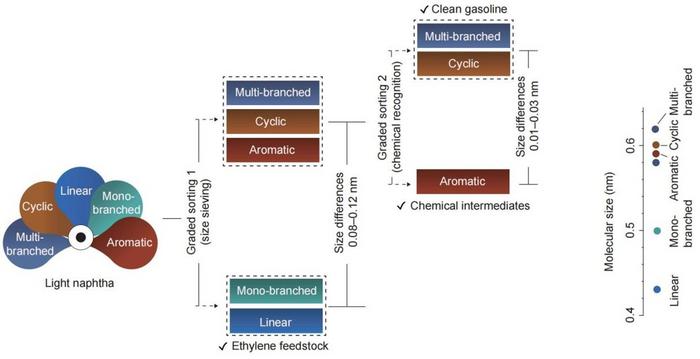
image: Conceptual illustration of the graded membrane strategy for molecular-level separation of light naphtha.
view more
Credit: ©Science China Press
Petroleum refining depends heavily on the separation of complex hydrocarbons mixtures into a variety of valuable products. This process is particular challenging when the constituent molecules exhibit nearly identical physical properties. Researchers from the Dalian Institute of Chemical Physics, Chinese Academy of Sciences, and Sun Yat-sen University have developed a membrane-based strategy that offers a new approach to address this challenge. Rather than utilizing a single membrane, the researchers engineered membranes with distinct molecular sorting capabilities and integrated them into a sequential separation process. Their study, published in National Science Review, demonstrates molecular-level fractionation of light naphtha, an important petroleum fraction containing a complex mixture of hydrocarbons.
Light naphtha typically comprises hydrocarbons containing five to seven carbon atoms, including linear alkanes, branched alkanes, cyclic alkanes and aromatics. Although these molecules share chemically similarities, their industrial applications vary significantly. Linear and mono-branched alkanes commonly serve as feedstocks for ethylene production. Aromatics are utilized as essential chemical intermediates, whereas highly branched and cyclic alkanes are valuable constitutes of high-octane gasoline. However, the separation of these molecules presents considerable challenges. Conventional refining processes predominantly rely on distillation, which separates molecules through repeated vaporization and condensation, requiring substantial energy consumption.
Membranes provide an alternative approach by allowing selective passage of specific molecules through nanoscale channels. However, a single membrane is seldom capable of efficiently fractionating complex petroleum mixtures at the molecular level. To overcome this limitation, the research team developed a graded sorting strategy. They employed a porous material known as a metal–organic framework (MOF) as the membrane platform. Specifically, the material CuBTC, which posseses ordered nanopores, was utilized to regulate molecular transport.
The CuBTC membranes were treated with tannic acid, a naturally derived polyphenolic compound. This mild treatment progressively altered both the effective pore size and the chemical functionality of membranes. By adjusting the treatment conditions, the researchers developed membranes exhibiting distinct separation capabilities. One membrane type primarily separated hydrocarbons based on their molecular dimensions, preferentially permitting the passage of linear and mono-branched molecules. Another membrane exhibited modified chemical functionality that enhanced interactions with aromatics, facilitating their separation from structurally similar aliphatic hydrocarbons.
The researchers subsequently integrated two membranes with distinct functions into a cascade separation process. In the first stage, linear and mono-branched hydrocarbons were selectively extracted from a complex mixture, producing a stream suitable as an ethylene feedstock. In the second stage, aromatic hydrocarbons were preferentially separated, resulting in a stream enriched with chemical intermediates. The residual components, predominantly multi-branched and cyclic hydrocarbons, constituted a third stream suitable for gasoline blending. Using this approach, the team successfully separated a simulated light naphtha mixture containing 15 different hydrocarbons into three value-specific product streams. The recovery rate for each stream was approximately 85–90%.
The researchers also evaluated the energy consumption of the membrane process through chemical process simulations. For a representative five-component mixture, the membrane cascade was estimated to reduce energy consumption by approximately 91% compared to conventional distillation, while achieving the same target recovery.
The graded membrane strategy assigns distinct molecular sorting tasks to membranes engineered with tailored pore structures and chemical functionalities. This concept provide a foundation for the development of more energy-efficient separation processes applicable to complex petroleum fractions and other multicomponent chemical mixtures.
The study, “Molecular-Level Petroleum Refining by Graded Membranes,” was published in National Science Review. The corresponding authors are Weishen Yang and Yujie Ban of the Dalian Institute of Chemical Physics, Chinese Academy of Sciences, and Dongdong Zhou of Sun Yat-sen University. The first authors are Yuecheng Wang of the Dalian Institute of Chemical Physics and Fangdi Dong of Sun Yat-sen University.
Journal
National Science Review
DOI
10.1093/nsr/nwag488
Method of Research
Experimental study
Disclaimer: AAAS and EurekAlert! are not responsible for the accuracy of news releases posted to EurekAlert! by contributing institutions or for the use of any information through the EurekAlert system.
Subject of Research: Chemistry
Subject of Research: Chemistry
Article Title: Graded membranes point to a sustainable route for refining complex petroleum
Article References: Original research article
Image Credits: AI Generated
DOI: Not provided
Keywords: cascade membrane systems, chemical affinity-based membrane technology, complex naphtha separation, energy-efficient distillation alternatives, environmentally friendly refining processes, light petroleum component separation, Membrane-based hydrocarbon separation, metal-organic framework membranes, molecular-level hydrocarbon sorting, reduction of energy consumption in petroleum processing, sustainable petroleum refining, tannic acid etching
Cite Scienmag News
APA
MLA
Chicago
Bethany Barker. (August 31, 2026). Graded membranes point to a sustainable route for refining complex petroleum. Scienmag. https://scienmag.com/graded-membranes-point-to-a-sustainable-route-for-refining-complex-petroleum/
Bethany Barker. “Graded membranes point to a sustainable route for refining complex petroleum.” Scienmag, 31 August 2026, https://scienmag.com/graded-membranes-point-to-a-sustainable-route-for-refining-complex-petroleum/. Accessed 31 August 2026.
Bethany Barker. “Graded membranes point to a sustainable route for refining complex petroleum.” Scienmag. August 31, 2026. https://scienmag.com/graded-membranes-point-to-a-sustainable-route-for-refining-complex-petroleum/
Copy citation
Download RIS
Tags: advanced membrane materials for petrochemical industrycascade membrane systemschemical affinity-based hydrocarbon separationchemical affinity-based membrane technologycomplex light naphtha separationcomplex naphtha separationenergy-efficient distillation alternativesenergy-efficient petroleum processingenvironmentally friendly petroleum refining strategiesenvironmentally friendly refining processeslight petroleum component separationmembrane cascade technologyMembrane-based hydrocarbon separationmetal-organic framework membranesmolecular-level hydrocarbon sortingreduction of energy consumption in oil refiningreduction of energy consumption in petroleum processingsustainable petroleum refiningsustainable petroleum refining methodstannic acid etchingtannic acid etching in membrane fabrication