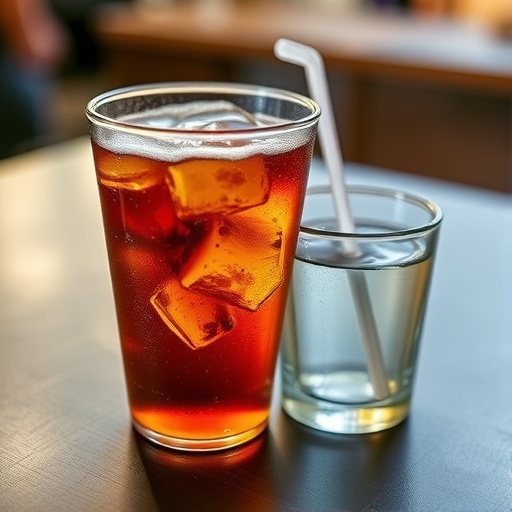
Tea and coffee are among the most beloved beverages on the planet, poured into billions of cups every single day. But what if those cups are quietly adding something unwanted to the drink? A new open-access study from Romanian researchers, published in the Journal of Agriculture and Food Research, has systematically measured how much arsenic, cadmium, lead and chromium leach from four common types of drinking vessels—stainless steel, ceramic, cardboard and recycled cardboard—into three everyday beverages: green tea, green tea with lemon, and coffee. The results reveal a complex and sometimes surprising picture, in which the identity of the drink, the chemistry of the cup and the passage of time all conspire to determine how many potentially toxic elements (PTEs) end up in what we swallow.
The team, led by Adriana Dehelean and colleagues at the National Institute for Research and Development of Isotopic and Molecular Technologies in Cluj-Napoca, designed an experiment that closely mimicked real-world consumption. They prepared green tea with water heated to 80 °C, steeping one tea bag per 250 millilitres for five minutes, and brewed 100% Arabica coffee at a ratio of 7 grams per 100 millilitres of water. A third beverage combined green tea with 5% freshly squeezed lemon juice, deliberately creating a strongly acidic drink with a pH of 3.1—compared with pH 5.0 for coffee and pH 6.3 for plain green tea. Each hot beverage was poured into cups of four different materials and left in contact for 30 minutes, 2 hours and 24 hours, producing 36 experimental conditions that were each analysed in duplicate, for a total of 72 samples.
The analytical workhorse of the study was inductively coupled plasma mass spectrometry, or ICP-MS, a technique capable of detecting metals and metalloids at concentrations down to fractions of a microgram per litre. Before measurement, each beverage sample was mineralised in a microwave digestion system using concentrated nitric acid and hydrogen peroxide, breaking down the complex organic matrices of tea and coffee into a clean solution suitable for analysis. The method was rigorously validated: calibration curves showed correlation coefficients above 0.999, limits of detection were as low as 0.001 micrograms per litre for cadmium, relative standard deviations stayed below 10%, and recovery tests returned values between 87% and 113%. Control samples prepared in borosilicate glass—never touching the test cups—allowed the researchers to separate what came from the beverages themselves and what leached from the vessel.
The starkest findings concerned lead. In ceramic cups filled with green tea with lemon, lead concentrations peaked at 29.34 micrograms per litre after two hours of contact, while stainless steel cups yielded 23.80 micrograms per litre under the same conditions. Controls contained at most 0.57 micrograms per litre, making it clear that the vast majority of the lead originated from the cup material rather than the beverage ingredients. The researchers attribute the ceramic result to lead-containing glazes or impurities in the clay body, and the stainless steel finding to trace contamination or damage to the alloy’s protective chromium oxide layer under acidic conditions. Plain green tea, being the least acidic of the three drinks, consistently produced the lowest metal release, while coffee—with its chlorogenic acids and moderate acidity—fell in between.
The behaviour of lead over time was especially revealing and somewhat counterintuitive. Concentrations rose sharply during the first two hours and then declined after 24 hours, a pattern the authors explain through two possible mechanisms: lead may react with components of the beverage to form insoluble compounds that precipitate out of solution, or it may be adsorbed onto the vessel walls and onto suspended solid particles. Interactions between citric acid and the tannins and polyphenols abundant in tea may also enhance metal solubilisation, temporarily boosting the dissolved lead concentration before removal processes catch up. This dynamic interplay between dissolution and re-capture means that migration is anything but a simple linear function of time.
Cadmium and arsenic, by contrast, largely stayed put. Cadmium concentrations across stainless steel and ceramic cups ranged from roughly 0.11 to 0.66 micrograms per litre, with green tea with lemon again producing the highest values, a statistically significant effect of beverage type confirmed by analysis of variance (p = 0.021). Arsenic remained below 0.1 micrograms per litre in all beverages served in glass and ceramic vessels, essentially indistinguishable from control levels, suggesting that these elements are either absent from the cup materials or locked in stable, non-migrating chemical forms. Statistical analysis confirmed that beverage type significantly influenced arsenic concentrations as well (p = 0.008), but the absolute differences were so tiny that the researchers judged them practically irrelevant.
The paper-based cups told a different and, in one respect, surprising story. Conventional cardboard cups released less lead than stainless steel or ceramic, peaking at 8.81 micrograms per litre in lemon green tea after two hours and reaching 5.38 micrograms per litre in coffee after 24 hours—demonstrating a clear time-dependent migration, likely driven by gradual degradation of the inner polyethylene barrier layer. Recycled cardboard cups performed even better, with peak lead values of 7.45 micrograms per litre, challenging the assumption that recycled materials necessarily carry more contaminants into food. The authors suggest that recycling processes involving washing, filtering and chemical treatment may strip out heavy metals and that recycled products may face stricter food-safety scrutiny, resulting in a more stable barrier layer. Arsenic, however, showed slightly elevated migration from recycled cardboard, particularly in acidic beverages, plausibly tracing back to residual inks, adhesives and metallised layers from previous lives of the recovered paper.
Chromium displayed the most complex behaviour of all, and it was the only element whose migration depended significantly on the cup material itself (p = 0.004). Stainless steel released the most chromium, but with a striking twist: concentrations peaked within the first 30 minutes—especially in coffee—and then fell over the following hours. The researchers interpret this as the signature of the passive chromium oxide layer that gives stainless steel its corrosion resistance. Hot, acidic liquids initially destabilise this film, releasing a burst of chromium, after which the layer re-passivates and migration slows. In conventional cardboard cups, by contrast, chromium concentrations tended to climb over time, with lemon tea fluctuating between 13.38 and 14.27 micrograms per litre as the protective inner coating degraded unevenly. In recycled cardboard, chromium declined over time in teas but rose progressively in coffee, hinting that the beverage’s chemistry can extract the element from deeper layers of the material.
Why does acidity matter so much? The study explains that acidic beverages can chemically attack the superficial layers of cup materials, dissolving metallic species into the liquid, while elevated temperature accelerates the process by increasing molecular motion and the frequency of energetic collisions at the surface. Lemon juice’s citric acid is a particularly potent driver of metal dissolution, and the organic compounds in tea and coffee—tannins, polyphenols and caffeine—can act as complexing agents, binding metals and holding them in solution. These findings align with earlier work showing heavy metals leaching from plastic cups into tea and carbonated drinks, and from disposable paper cup liners into hot water within just 15 minutes of contact.
The health context gives the numbers weight. Arsenic, cadmium and chromium(VI) are classified by the International Agency for Research on Cancer as Group 1 human carcinogens. Lead exposure has no established safe threshold and is linked to neurodevelopmental disorders and cardiovascular disease; even low blood-lead levels in children are associated with measurable IQ deficits. Against this backdrop, the lead levels measured in ceramic and stainless steel cups with lemon tea—approaching 30 micrograms per litre, three times the World Health Organization guideline of 10 micrograms per litre for drinking water—warrant attention, even though the study’s authors caution against over-generalisation. They analysed only two cups per material from a single production batch, so the results represent the specific products tested rather than an entire category of tableware.
The study’s conclusion is not a call to abandon your favourite mug but a reminder that food contact materials are active chemical participants in every meal. Metal release is a dynamic process shaped by material composition, surface coatings, beverage chemistry and exposure time. Finishing your tea promptly rather than letting it sit for hours, and thinking twice about pairing very acidic drinks with certain cups—particularly ceramics with suspect glazes—are practical takeaways. The researchers call for further work on the roles of individual coating layers, manufacturing additives and long-term use conditions. As disposable cup consumption approaches an estimated 300 billion units annually worldwide, understanding precisely what our cups give back to us has never been more relevant.
Subject of Research: Migration of potentially toxic elements (As, Cd, Pb, Cr) from stainless steel, ceramic, cardboard and recycled cardboard drinking cups into green tea, green tea with lemon and coffee under realistic conditions
Subject of Research: Agriculture
Article Title: Migration of potentially toxic elements from drinking cups: Influence of vessel material and beverage type
Article References: Dehelean, A., Magdas, D.-A., Tomoiagă, M., Mirel, V., & Cristea, G. (2026). Migration of potentially toxic elements from drinking cups: Influence of vessel material and beverage type. Journal of Agriculture and Food Research, 31, Article 103237. https://doi.org/10.1016/j.jafr.2026.103237
Image Credits: AI Generated
DOI: 10.1016/j.jafr.2026.103237
Keywords: food contact materials, heavy metal migration, lead leaching, drinking cups, ICP-MS, beverage acidity, ceramic glaze, recycled cardboard, stainless steel, green tea, coffee, food safety
Cite Scienmag News
APA MLA Chicago
Alan Morgan. (August 30, 2026). Toxic elements leach from drinking cups depending on material and beverage type. Scienmag. https://scienmag.com/toxic-elements-leach-from-drinking-cups-depending-on-material-and-beverage-type/
Alan Morgan. “Toxic elements leach from drinking cups depending on material and beverage type.” Scienmag, 30 August 2026, https://scienmag.com/toxic-elements-leach-from-drinking-cups-depending-on-material-and-beverage-type/. Accessed 30 August 2026.
Alan Morgan. “Toxic elements leach from drinking cups depending on material and beverage type.” Scienmag. August 30, 2026. https://scienmag.com/toxic-elements-leach-from-drinking-cups-depending-on-material-and-beverage-type/
Copy citation Download RIS
Tags: arsenicarsenic cadmium lead chromium in drinking vesselsbeverage type influence on metal leachingcadmiumcontamination risk in common drinkeffect of beverage type on toxic element transfereffect of cup material on beverage safetyenvironmental and health risks of contaminated drinkwareenvironmental implications of recycled cardboard cupshealth risks of toxic elements from cupsimpact of cup material on heavy metal contaminationimpact of drink chemistry on toxic element releaseinfluence of beverage chemistry and temperature on toxic element releaseinfluence of beverage temperature and steeping timeleaching of heavy metals into hot beveragesleaching of heavy metals into tea and coffeelead and chromium in beveragesreal-world simulation of toxic element leaching in beveragesreal-world simulation of toxic element transfersafety assessmentstainless steel vs ceramic vs cardboard cups toxicitysystematic study of toxic element migration in drinking vesselsToxic element leaching from drinking cupstoxic elements leaching from drinking cups