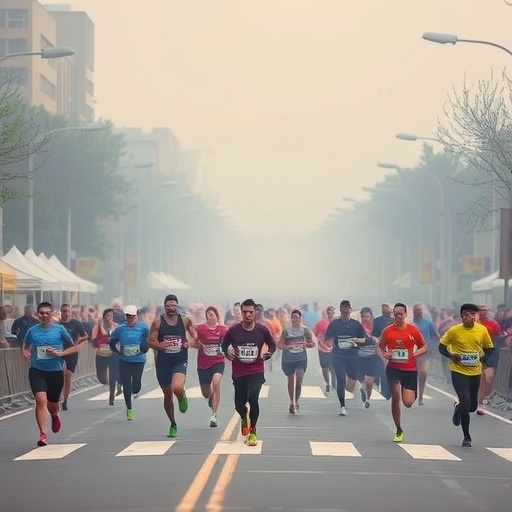
Dirty Air Is Quietly Costing Marathon Runners Minutes — and Amateur Athletes Pay the Highest Price
For the hundreds of thousands of amateur runners who spend months pounding city pavements in pursuit of a personal best, a new study delivers an uncomfortable truth: the air on race day may be quietly stealing minutes from their finishing times. In the largest investigation of its kind ever conducted, researchers at the University of Leicester analysed 2,756,553 marathon finishing times from the six World Marathon Majors — Berlin, Boston, Chicago, London, New York City and Tokyo — spanning 75 race editions held between 2010 and 2024. Published in Sports Medicine – Open, the analysis found that every additional microgram of nitrogen dioxide per cubic metre of race-day air was associated with finishing times roughly 1.4 to 1.6 minutes slower, once the effects of heat, humidity and wind were rigorously disentangled. Moving from a relatively clean race day to a polluted one — a jump across the middle half of observed NO₂ concentrations — cost male runners about 7.3 minutes and female runners 7.9 minutes on average.
The sheer scale of the dataset separates the work from earlier attempts to connect pollution with endurance performance. The researchers wrote custom Python web-scraping scripts to harvest individual chip-timed results from the official results platforms of each major, then validated the haul with manual spot-checks against published finisher lists and automated consistency checks on finisher counts and the ordering of times by finishing place. Implausible values were excluded by restricting finishing times to a window of 120 to 480 minutes, a lower bound approximating the men’s world record and an upper bound reflecting typical course time limits. Some events were lost to history: the 2020 editions were cancelled or run virtually during the COVID-19 pandemic, the 2012 New York City Marathon was abandoned after Hurricane Sandy, and comparable Tokyo data begin only in 2015. The final sample contained 1,713,151 male performances (62.1 per cent of the total) and 1,043,402 female performances (37.9 per cent) across three continents.
Crucially, the team did not lean on a sparse handful of roadside monitors. Race-day pollutant concentrations came from the Copernicus Atmosphere Monitoring Service (CAMS) global reanalysis, a satellite-constrained atmospheric model that yields three-hourly estimates of atmospheric composition on a global 0.75-degree grid. For each race, the researchers extracted nitrogen dioxide and fine particulate matter (PM₂.₅) concentrations at the coordinates of the start line, averaged over the six-hour daytime race window from 6 a.m. to 6 p.m. local time, and assigned the same exposure to every participant in that edition. Because reanalysis products can drift from ground truth, the estimates were benchmarked against street-level monitoring networks in five of the six cities, including the US Environmental Protection Agency’s Air Quality System, the UK’s Automatic Urban and Rural Network and Berlin’s Luftgütemessnetz. Across 68 matched race-years, CAMS showed moderate-to-strong rank-order agreement with the monitors for NO₂, with Pearson correlations between 0.52 and 0.82.
The statistical machinery had to accommodate the awkward fact that pollution was measured once per event rather than per runner. The team fitted linear mixed-effects models carrying a random intercept for each of the 75 marathon–year events, allowing baseline finishing times to vary between races because of course profiles, field composition and other unmeasured idiosyncrasies. Fixed effects included a linear year trend capturing the gradual evolution of marathon fields, race-day wind speed, and a heat index — a single measure of apparent temperature combining air temperature and relative humidity through the NOAA Rothfusz regression — entered as a natural cubic spline with five degrees of freedom to capture the curvilinear relationship between heat stress and endurance performance. Fitted by restricted maximum likelihood, the models identified pollution effects from between-event contrasts in environmental conditions. The random intercept was highly significant across all models, with an intraclass correlation of 6.9 to 11.3 per cent, confirming that conditions unique to each race leave a substantial imprint on results.
The headline result was stark. Each 1 µg/m³ increase in race-day NO₂ was associated with a 1.43-minute slower finish among men (95 per cent confidence interval 0.66 to 2.21) and 1.56 minutes slower among women (0.63 to 2.48). The apparent sex difference dissolved under scrutiny: expressed as a percentage of mean finishing time, the effects were near-identical at 0.56 per cent for men and 0.55 per cent for women, indicating that women’s longer average times — not greater susceptibility — explain the larger absolute estimate. PM₂.₅ told a different story, showing no statistically significant association with finishing time in single-pollutant models, with point estimates close to zero and confidence intervals straddling the null in both sexes. Strikingly, these measurable effects emerged at modest concentrations: the median race-day NO₂ level was just 7.3 µg/m³, ranging from roughly 2.8 to 32.3 µg/m³ across events, because the majors are typically run on weekend mornings with roads closed to traffic.
When both pollutants were modelled simultaneously, the NO₂ coefficient grew by about a third, to 1.91 minutes per µg/m³ in men and 2.06 in women, while PM₂.₅ inexplicably flipped negative and appeared to improve performance. The authors firmly decline to read it that way. When two error-prone, positively correlated exposures sharing an emission source are forced into the same regression, the more accurately measured pollutant can absorb the shared signal and impose a spurious negative coefficient on the noisier one — a long-recognised trap in exposure epidemiology. The interpretation fits the data: CAMS agreed far less well with ground monitors for PM₂.₅ in Boston and Chicago than in Berlin, London and New York, and the negative coefficient disappeared when Boston’s 14 editions were removed from the analysis. The NO₂ association, meanwhile, survived every stress test thrown at it, including alternative heat-index specifications, trimming of extreme pollution days, alternative exposure windows, and exclusion of the 2013 Boston Marathon, which was halted before all participants could finish.
Perhaps the study’s most provocative finding concerns who pays the price. Classifying runners into six ability bands by within-race percentile rank, the researchers found that elite finishers — the fastest decile of each field — lost only 0.34 minutes per µg/m³ of NO₂ (95 per cent CI 0.03 to 0.65), while back-of-pack runners lost 2.12 minutes (0.91 to 3.54), a roughly six-fold difference that persisted even when expressed as a share of mean finishing time, at 0.18 versus 0.67 per cent. Complementary Kolmogorov–Smirnov tests confirmed that high-pollution days shifted the entire distribution of weather-adjusted finishing times to the right rather than merely tugging at the average, with weather-residualised median differences of 9.5 minutes in men and 10.1 minutes in women (both p < 0.001). The pattern echoes half-marathon research from the UK’s Great North Run suggesting amateurs are more environmentally sensitive than elites, but here the gradient is mapped across the full ability spectrum for the first time.
Why would a gas most runners barely notice leave a measurable dent in a 42-kilometre effort? During endurance exercise, minute ventilation can climb from about six litres of air at rest to well over 100 litres per minute, and the switch from nasal to dominant oral breathing bypasses much of the respiratory tract’s filtration capacity, delivering pollutants deeper into the lungs. Nitrogen dioxide is a potent oxidant that provokes airway inflammation, raises airway resistance and impairs gas exchange, while experimental studies link acute exposure to systemic oxidative stress, vasoconstriction and endothelial dysfunction — the very machinery of oxygen delivery on which endurance performance depends. Animal and human work further shows that NO₂ inhalation disrupts cardiac mitochondrial function and promotes coronary endothelial dysfunction. Slower runners compound the problem by spending more time on course and accumulating a larger inhaled dose, and the burden is not confined to race day: one study of collegiate athletes found that 21 days of elevated PM₂.₅ exposure during training slowed 5,000-metre times by nearly 13 seconds.
The age pattern upended expectations in the opposite direction. Runners aged 18 to 29 lost 2.17 minutes per µg/m³ of NO₂, versus 1.32 minutes among those aged 60 and over, and the gap survived normalisation to mean finishing time at 0.87 versus 0.45 per cent. The authors suspect a healthy-selectee effect: sixty-something marathon finishers are a rigorously screened subset of their cohort with exceptional cardiovascular reserve, whereas the youngest field spans everyone from seasoned competitors to untrained first-timers. The findings also extend a growing literature. An earlier study of 1.79 million finishers across the same six majors between 2001 and 2010 flagged NO₂ as a key environmental predictor alongside temperature; a 2025 analysis of 2.56 million performances at nine US marathons tied each µg/m³ of PM₂.₅ to roughly 32 seconds slower finishing in men; and in China, where race-day PM₂.₅ often exceeded 100 µg/m³, average runners needed about 12 extra minutes. What makes the new results sobering is that they emerged at concentrations generally at or below the World Health Organization’s 24-hour guideline of 25 µg/m³ for NO₂ — hinting that everyday urban training conditions could carry even larger costs.
For race organisers and public-health authorities, the implications are concrete. Air-quality forecasts deserve a seat at the planning table alongside temperature and humidity, the authors argue, with traffic restrictions in the wider vicinity of courses, earlier start times to dodge the morning pollution ramp-up, and real-time advisories during races all worth considering. Coaches and recreational runners, who most closely resemble the general exercising public, may benefit from adjusting pacing strategies or training locations when pollution peaks. Limitations remain: exposure was assigned at a single point per event on a model grid too coarse to capture mile-by-mile variation along a 42-kilometre route, ground-level ozone was not measured, and repeat runners could not be tracked across races because results carry no persistent identifiers. Yet the study’s multinational scale, rigorous weather adjustment and distributional analysis make a strong case that its central message — that even modest, traffic-derived NO₂ measurably slows endurance performance in a dose-dependent manner — is one the running world will find difficult to outrun. The complete code and processed datasets have been released publicly for independent scrutiny.
Subject of Research: The association between race-day ambient air pollution — particularly nitrogen dioxide (NO₂) and fine particulate matter (PM₂.₅) — and marathon finishing times among more than 2.7 million finishers across the six World Marathon Majors.
Subject of Research: Medicine
Article Title: Air Pollution Impairs Marathon Performance: A Cross-Sectional Analysis of 2.7 Million Finishers Across Six World Marathon Majors
Article References: Donaldson, J. A., Cai, S., Vande Hey, J., Hansell, A. L., Yates, T., Ng, G. A., & O’Driscoll, J. (2026). Air pollution impairs marathon performance: A cross-sectional analysis of 2.7 million finishers across six World Marathon Majors. Sports Medicine – Open, 12, Article 128. https://doi.org/10.1186/s40798-026-01099-6 Original publication
Image Credits: AI Generated
DOI: 10.1186/s40798-026-01099-6
Keywords: Air pollution, Nitrogen dioxide (NO₂), Fine particulate matter (PM₂.₅), Marathon running, Endurance performance, Athletic performance, Environmental exposure, Exercise, World Marathon Majors, Public health
Cite Scienmag News
APA MLA Chicago
Miles G. (August 29, 2026). Air Pollution Slows Marathon Runners, Study of 2.7 Million Finishers Shows. Scienmag. https://scienmag.com/air-pollution-slows-marathon-runners-study-of-2-7-million-finishers-shows/
Miles G. “Air Pollution Slows Marathon Runners, Study of 2.7 Million Finishers Shows.” Scienmag, 29 August 2026, https://scienmag.com/air-pollution-slows-marathon-runners-study-of-2-7-million-finishers-shows/. Accessed 29 August 2026.
Miles G. “Air Pollution Slows Marathon Runners, Study of 2.7 Million Finishers Shows.” Scienmag. August 29, 2026. https://scienmag.com/air-pollution-slows-marathon-runners-study-of-2-7-million-finishers-shows/
Copy citation Download RIS
Tags: air pollution and marathon race outcomesair pollution impact on marathon runnersamateur athletes and pollution-related time lossamateur runners and pollution-related performance declinecity marathon pollution and athlete performanceeffects of city air pollution on athletic performanceeffects of nitrogen dioxide on running performanceeffects of urban air quality on marathon timesenvironmental factors affecting endurance runningenvironmental factors affecting marathon resultshealth risks of air pollution for long-distance runnershealth risks of air pollution for runnersimpact of microgram-level air contaminants on athleteslarge-scale study of marathon finishing timeslargest study on marathon finish times and pollutionlong-term effects of air pollution on athletic performancemarathon air pollution impactnitrogen dioxide and running performancepollution levels and gender differences in marathon performancepollution-related time delays in major marathonspublic health implications for urban marathonspublic health implications of air pollution for runnersrace day air pollution effects on endurance sportsurban air quality and marathon finishing times