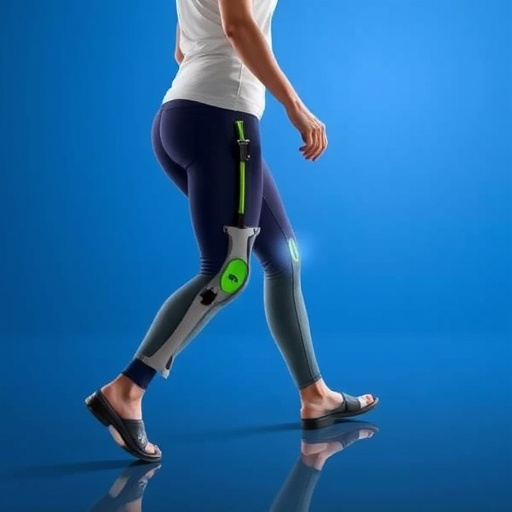
A slim robotic brace that straps around the hips and nudges each thigh forward with every step helped patients recover their walking speed faster after total knee replacement surgery, according to a pilot clinical trial conducted in Japan and published in the Journal of Artificial Organs on 16 June 2026. Patients who received just two to three weeks of early gait training with the lightweight hip-assist device, layered on top of standard rehabilitation, experienced a markedly gentler dip in both self-selected and maximum walking speed during the most fragile days of recovery than patients who received rehabilitation alone. By four weeks after surgery, significantly more of the device-trained patients had crossed a walking-speed threshold that orthopedic researchers consider acceptable to patients themselves. Perhaps most striking, the gains appeared with a remarkably modest dose—eight to ten sessions of no more than twenty minutes each—delivered within the first weeks after surgery, and the intervention proved safe and well tolerated in a group of older adults healing from major joint replacement.
Total knee arthroplasty, or TKA, is among the most frequently performed orthopedic operations in the world, and demand keeps climbing as populations age and obesity deepens the burden of knee osteoarthritis. The operation resurfaces worn cartilage and bone with prosthetic components and reliably extinguishes the grinding pain of end-stage arthritis. Yet it creates a biological paradox: for all its long-term benefits, the first weeks after a knee replacement are typically marked by a sharp decline in walking ability. Patients move cautiously around swelling, surgical pain, and quadriceps muscles that fire weakly or not at all, and meta-analyses have shown that walking speed after knee arthroplasty can remain below preoperative levels for months. That slowdown is no trivial inconvenience. Gait speed is increasingly described as a sixth vital sign—a single number that integrates strength, balance, coordination, and motivation, and that predicts independence, hospitalization, and even survival in older adults. Standard rehabilitation—early mobilization, range-of-motion work, progressive strengthening—delivers results but remains largely uniform, and researchers have long suspected that the earliest postoperative window, when the nervous system is most primed to relearn movement, is being underused.
The device at the heart of the trial, known as the HWA-01, belongs to a new generation of rehabilitation robots that trades the bulk of hospital-scale exoskeletons for minimalism. Instead of enclosing the legs in rigid frames or suspending patients over a treadmill, the system is worn at the waist, with compact actuators seated at each hip joint. Sensors continuously track the angle of the thighs, detect the phase of the gait cycle, and time brief pulses of assistive torque to help flex the hips and swing each leg forward. The approach descends from the Walking Assist Device engineered by Honda, which the same research group and collaborators have previously evaluated in patients recovering from hip replacement and in people with incomplete spinal cord injury. Because the robot assists the hips rather than immobilizing the knees, patients walk overground along hospital corridors at their own cadence, rehearsing the natural rhythm of walking rather than practicing it strapped to a machine. Each session was capped at twenty minutes of actual walking, excluding rest breaks, to keep the workload gentle on healing tissue.
Whether such light-touch assistance could meaningfully alter early recovery was the question Kenichi Yoshikawa of the University of Tsukuba, Hirotaka Mutsuzaki of Ibaraki Prefectural University of Health Sciences, and their colleagues set out to probe. Their team had reported promising single-subject and case-controlled experiences with hip-wearable exoskeletons after hip and knee replacement, but controlled pilot data on the optimal dose and timing were lacking. Patients scheduled for total knee arthroplasty were allocated before surgery to one of two paths. Thirteen patients, contributing thirteen operated knees, received hip-assist gait training integrated into standard rehabilitation during postoperative weeks one through three, completing eight to ten sessions of at most twenty minutes. Twenty-nine patients, contributing thirty-nine knees—some participants had both knees replaced—served as controls and received standard rehabilitation alone. Outcomes were measured before surgery and at two, four, and eight weeks afterward: self-selected walking speed, maximum walking speed, knee range of motion, knee extension torque, and the Western Ontario and McMaster Universities Osteoarthritis Index, or WOMAC, a questionnaire capturing pain, stiffness, and physical function. With unequal groups and repeated measurements, including bilateral knees, the researchers turned to generalized linear mixed models, a statistical framework built for unbalanced, correlated data. The trial was prospectively registered as UMIN000054889 and approved by the ethics committee of Ibaraki Prefectural University of Health Sciences.
The pivotal results turned on a statistic called the time-by-group interaction—an estimate of whether the two groups’ recovery curves diverged over time beyond measurement noise. At the two-week mark, those interactions were statistically significant for self-selected walking speed (p = 0.045) and maximum walking speed (p = 0.044), indicating that the early postoperative decline in walking speed was attenuated in the device-trained group. Self-selected speed reflects the pace people instinctively adopt for daily living, while maximum speed probes the ceiling of the neuromuscular system; both were cushioned by the training. The two-week time point matters because it coincides with the close of the training block, the hardest moment to separate groups that otherwise share an identical standard of care. The clearest clinical signal arrived at four weeks, when significantly more patients in the training group achieved the Patient Acceptable Symptom State, or PASS, for self-selected walking speed, defined as at least 1.2 meters per second—roughly a brisk 4.3 kilometers, or 2.7 miles, per hour (p = 0.013). The PASS framework, borrowed from outcomes research, captures something a p-value alone cannot: whether patients would judge their current state satisfying enough to accept living with it.
Just as revealing was what refused to change. No significant group differences or interactions emerged for knee range of motion, knee extension torque, or WOMAC scores—the joint’s mobility, the raw strength of its quadriceps, and patients’ self-reported pain and function. That dissociation is scientifically telling. It suggests the device did not accelerate tissue healing, dissolve swelling, or rebuild muscle faster than conventional care. Instead, the authors conclude, hip assistance appears to have acted on walking itself, helping patients organize a faster, more confident gait pattern even while the knee beneath them was still healing. Gait is a whole-body skill, and speed can improve through better timing, longer strides, and more symmetrical loading rather than strength alone. Repetitive, task-specific practice with precisely timed assistive torque may operate as a form of high-intensity motor learning delivered inside a low-fatigue envelope, letting patients bank more quality steps per session than they could manage unassisted—precisely the kind of intensive stepping practice that early postoperative fatigue usually forbids.
The physiology of early recovery helps explain why the hips make such a promising target. After a knee replacement, surgical trauma and swelling suppress the quadriceps through a spinal reflex phenomenon called arthrogenic muscle inhibition, forcing patients into compensations—shorter strides, reduced time on the operated limb, and a characteristic stiff-kneed shuffle that offloads the new joint. Those strategies are protective at first but can calcify into habits that limit long-term recovery. Kinesiophobia, the protective fear of movement that often follows joint surgery, further shortens strides, and guided, confident stepping may help override it. The hip flexors drive the swing phase of gait, and assistive torque delivered at exactly the right phase can substitute for some of the propulsion a healing knee cannot yet generate, encouraging longer strides and more even loading across the prosthesis. Because the device is light and sessions brief, this gait re-education could begin in the first postoperative weeks—when movement is most cautious and high-intensity training would be unsafe—without overloading delicate tissue. Perceived exertion was monitored session by session, and the program’s safety and tolerability were rated favorably throughout.
Caution is nonetheless warranted. This was a pilot study: forty patients, groups of markedly unequal size, and no blinding of participants or therapists—features that make it a proof of concept rather than a definitive trial. Follow-up ended at eight weeks, leaving unresolved whether the early speed gains persist, fade, or translate into better long-term function, community mobility, or quality of life. The null results for strength and symptom scores suggest the intervention refines gait rather than transforming the healing joint, and it remains unknown which patients—by age, sex, body mass index, or preoperative fitness—stand to gain the most. Participants were treated at a single Japanese hospital, and devices of this kind are not yet widely available outside research settings. Larger, adequately powered randomized controlled trials with longer follow-up are the logical next step, alongside cost-effectiveness analyses to establish whether a few weeks of robot-assisted walking can justify the hardware, therapist time, and clinical workflow it requires.
The trial nonetheless lands at a telling moment, as rehabilitation robotics shrinks from room-sized treadmill systems toward wearables light enough to wheel onto a hospital ward, and as health systems confront the rising tide of joint replacement in aging populations. Walking speed is not a cosmetic metric: slower gait in older adults foreshadows frailty, falls, and lost independence, and every week spent moving slowly is a week of deconditioning that must later be undone. With hospital stays shrinking and more rehabilitation migrating to outpatient and home settings, tools that make the earliest days of training more productive could carry disproportionate weight. If a two- to three-week burst of hip-assisted walking can cushion that early slide and carry more patients past a self-accepted speed milestone within a month of surgery, the finding hints at a future in which recovery from joint replacement is actively engineered rather than passively endured. For now, the message from the Ibaraki team is a measured one: a small robot at the hips, worn for minutes a day in the first fragile weeks, may help patients find their stride again sooner—and do it safely.
Subject of Research: Early postoperative gait training with a lightweight hip-wearable assistive robot (HWA-01) to improve walking-speed recovery after total knee arthroplasty
Subject of Research: Medicine
Article Title: Effect of short-term early postoperative gait-training using a lightweight hip-assist device on walking-speed recovery after total knee arthroplasty: a pilot study
Article References: Yoshikawa, K., Mutsuzaki, H., Koseki, K., Iwai, K., & Kohno, Y. (2026). Effect of short-term early postoperative gait-training using a lightweight hip-assist device on walking-speed recovery after total knee arthroplasty: a pilot study. Journal of Artificial Organs, 29(3), Article 34. https://doi.org/10.1007/s10047-026-01560-z
Image Credits: AI Generated
DOI: 10.1007/s10047-026-01560-z
Keywords: Total knee arthroplasty, Robot-assisted gait training, Wearable exoskeleton, Walking speed, Early postoperative rehabilitation, Patient acceptable symptom state (PASS)
Cite Scienmag News
APA MLA Chicago
Arden W. (August 29, 2026). Lightweight hip-assist device speeds early walking recovery after knee replacement. Scienmag. https://scienmag.com/lightweight-hip-assist-device-speeds-early-walking-recovery-after-knee-replacement/
Arden W. “Lightweight hip-assist device speeds early walking recovery after knee replacement.” Scienmag, 29 August 2026, https://scienmag.com/lightweight-hip-assist-device-speeds-early-walking-recovery-after-knee-replacement/. Accessed 29 August 2026.
Arden W. “Lightweight hip-assist device speeds early walking recovery after knee replacement.” Scienmag. August 29, 2026. https://scienmag.com/lightweight-hip-assist-device-speeds-early-walking-recovery-after-knee-replacement/
Copy citation Download RIS
Tags: accelerated mobility recovery after TKAearly gait training after knee surgeryearly gait training post-arthroplastyearly intervention in knee surgeryelderly orthopedic rehabilitationenhancing walking speed after knee replacementimpact of robotic assistance on walking thresholdsimproving mobility after total knee arthroplastyinnovative post-surgical mobility solutionsknee replacement recoverylightweight robotic hip-assist deviceminimally invasive gait recoveryminimally invasive rehabilitation technologyorthopedic robotic assistive devicespost-arthroplasty rehabilitationpostoperative walking speed improvementrobotic brace for walking speedrobotic braces for knee surgerysafety and tolerability of hip-assist devicessafety and tolerability of robotic rehabilitationshort-duration gait therapyshort-duration gait training for knee recovery