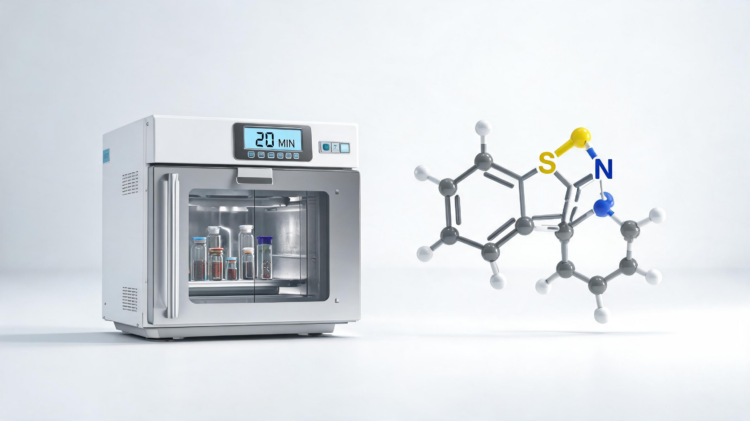
A simple mineral catalyst and microwave energy have helped researchers produce a collection of complex drug-like molecules in minutes, while reducing the time required for a conventional synthesis from hours to a fraction of one hour. The compounds, known as spiro-benzothiazoles, showed distinct anticancer, antioxidant and antibacterial activities in laboratory tests, with different chemical substitutions determining which biological effect was strongest. In the study, a team led by researchers in India used potash alum, a low-cost hydrated aluminium potassium sulfate, to catalyze a three-component reaction under microwave irradiation. The optimized process produced eleven derivatives, designated 3a–k, in yields ranging from 86% to 96% within 20 minutes. The strongest result came from compound 3k, which inhibited the growth of MCF-7 breast cancer cells with a reported half-maximal inhibitory concentration, or IC50, of 0.58 micromolar. Compound 3a, meanwhile, showed the most powerful activity in a chemical antioxidant test, while compound 3d produced the largest inhibition zones against the Gram-positive bacteria Staphylococcus aureus and Bacillus subtilis. The findings do not establish a treatment, but they identify a versatile chemical framework for further medicinal chemistry research.
The work addresses a persistent challenge in drug discovery: finding molecules that combine biological activity with practical, efficient and comparatively sustainable synthesis. Spiro compounds contain two ring systems joined through a single shared atom, creating a three-dimensional structure that can help molecules occupy biological binding sites in ways that flatter, more flexible compounds may not. Benzothiazoles, which contain fused benzene and thiazole rings, are also widely studied because their nitrogen and sulfur atoms can participate in interactions with proteins and other biomolecules. Combining these features creates a rigid, information-rich scaffold, but assembling such molecules can require multiple steps, long heating periods and substantial solvent use. The researchers therefore designed a multicomponent reaction that brings three starting materials together in a single vessel: 11H-indeno[1,2-b]quinoxalin-11-one, a substituted 2-aminobenzothiazole and isatoic anhydride. Potash alum was added as the catalyst, ethanol served as the solvent, and the mixture was irradiated at 600 watts in a microwave reactor while being stirred.
Optimization experiments showed why the final protocol performed better than the initial conditions. Without a catalyst, ethanol gave a 56% yield after 10 hours of conventional heating and a 59% yield after 40 minutes of microwave irradiation. Adding 20 mol% potash alum under conventional heating raised the yield to 67% and shortened the reaction time to six hours. Under microwave conditions, increasing the catalyst loading from 5 to 20 mol% progressively improved the yield, reaching 77% during the optimization sequence. At the selected catalyst loading, increasing microwave power from 400 to 600 watts improved conversion, while raising it further to 800 watts produced no meaningful gain. Extending irradiation from 10 to 20 minutes increased the model reaction yield from 80% to 95%. The researchers attributed the performance of ethanol partly to its polarity, microwave absorption and ability to solvate the reactants. Potash alum is proposed to activate the ketone and assist the sequence of bond-forming events that links the three components into the spirocyclic products. The resulting process uses a readily available catalyst and avoids the prolonged heating associated with the comparison method.
The chemical identity of the products was checked using several complementary analytical techniques rather than relying on yield alone. Fourier-transform infrared spectroscopy detected characteristic nitrogen–hydrogen, carbonyl, carbon–nitrogen and aromatic signals. Proton and carbon nuclear magnetic resonance spectroscopy provided evidence for the expected hydrogen and carbon environments, including resonances associated with the spiro carbon. Electrospray ionization mass spectrometry produced molecular-ion signals consistent with the proposed formulas. High-performance liquid chromatography was used to assess purity, which ranged from 92% to 99% across the reported compounds. The library incorporated a range of substituents on the benzothiazole ring, including nitro, methoxy, methyl, fluoro, bromo and chloro groups, as well as combinations of halogens. This systematic variation allowed the researchers to compare how changes in electronic character, size and lipophilicity affected the biological assays. The products were isolated as powders after cooling the reaction mixture, precipitation into ice-cold water and extraction with diethyl ether, followed by washing and drying.
The most striking biological result came from the MTT assay of cytotoxicity against MCF-7 breast cancer cells. The unsubstituted compound 3a provided a moderate baseline response, with an IC50 of 43.66 micromolar. Several substitutions performed poorly, including the methoxy derivative 3e and the methyl derivative 3f, both of which had IC50 values above 100 micromolar. A nitro group produced sharply different outcomes depending on its position: compound 3c showed an IC50 of 2.07 micromolar, whereas related compounds 3b and 3d were much weaker, with reported values of 92.15 and 24.66 micromolar, respectively. The standout was 3k, bearing both fluorine and bromine substituents, which reached 0.58 micromolar. For comparison, doxorubicin and cisplatin produced IC50 values of 1.03 and 4.61 micromolar, respectively, under the study’s conditions. The authors suggest that the paired electron-withdrawing halogens may improve activity partly by increasing lipophilicity. However, the test used a single cancer cell line and did not determine selectivity for cancer cells over healthy cells, mechanism of action or activity in animals. Those limitations mean that 3k should be viewed as a lead for investigation, not as a validated anticancer drug.
The antioxidant results revealed a contrasting structure–activity pattern. In the DPPH radical-scavenging assay, the unsubstituted compound 3a was the strongest performer, with a reported IC50 of 0.52 micromolar. The result suggests that preserving the parent aromatic and electronic arrangement favored the reaction with the stable radical used in the test. Most substitutions reduced activity substantially: compounds carrying nitro, methoxy, methyl or halogen groups generally had IC50 values above 100 micromolar. Compound 3d retained measurable activity at 35.47 micromolar, while the fluoro derivative 3g showed an IC50 of 83.45 micromolar. Ascorbic acid was included as the reference compound and had a reported IC50 of 17.56 micrograms per milliliter. Because the assay measures a chemical radical-scavenging reaction rather than antioxidant effects in a living organism, the result cannot by itself demonstrate therapeutic benefit. Still, the sharp difference between 3a and its substituted analogues gives the researchers a useful structure–activity clue: the modifications that enhanced the anticancer profile of 3k did not enhance its antioxidant performance.
The compounds also displayed activity against two Gram-positive bacteria in a Kirby–Bauer disk-diffusion assay. Compound 3d, containing a nitro group at the reported R4 position, produced the largest inhibition zone, measuring 18 millimeters against both S. aureus and B. subtilis. Compound 3e generated an 18-millimeter zone against B. subtilis, while 3f produced an 11.66-millimeter zone against the same organism. The dichloro derivative 3j showed a notable 11-millimeter zone against S. aureus, and several fluoro-, bromo- and chloro-substituted compounds showed moderate effects. The reference antibiotic ciprofloxacin produced inhibition zones of 21 to 24 millimeters in the reported comparisons. These results suggest that antibacterial activity depended on a different balance of electronic effects and lipophilicity from the one associated with cytotoxicity. In particular, a nitro group at one position was more favorable for bacterial inhibition than the same functional group at other positions. Since disk diffusion depends on both antimicrobial action and a compound’s ability to move through the assay medium, further tests would be needed to determine minimum inhibitory concentrations, activity against additional organisms and the underlying molecular targets.
Computational analysis provided a molecular explanation for why 3k, 3c and 3d emerged as leading candidates. The researchers docked the compounds into the breast cancer-associated protein structure identified by PDB code 3EQM using the Glide XP protocol. Compound 3k produced the most favorable reported docking score, −8.41957, together with a Glide energy of −53.911 kilocalories per mole. Compounds 3c and 3d also scored strongly, at −8.36215 and −8.21235, respectively, compared with −6.88115 for the protein’s co-crystallized ligand in the redocking comparison. The predicted interactions for 3k included a hydrogen bond involving a nitrogen atom in its quinoxalinone region, pi–pi stacking with tryptophan 224, hydrophobic contacts with valine, methionine and isoleucine residues, and a halogen bond involving bromine and arginine 375. A 100-nanosecond molecular-dynamics simulation suggested that the 3k–3EQM complex remained stable, with limited ligand fluctuation and persistent contacts, including a pi–pi interaction with tryptophan 224. QikProp calculations further indicated that the compounds met Lipinski’s rule of five, while 3k and 3j showed high predicted permeability and potential central nervous system exposure. These computational findings are useful for prioritizing experiments, but docking scores and in silico pharmacokinetics do not substitute for biochemical, cellular, toxicological or animal studies. The study’s central advance is therefore a practical synthesis and a set of testable leads whose activities can now be examined with more demanding models.
The study also illustrates why multifunctional screening can reveal trade-offs within one chemical series. The derivatives were not uniformly active across assays: structural changes that favored interaction with the breast cancer-associated protein did not necessarily improve radical scavenging or bacterial inhibition. This divergence is scientifically useful because it indicates that the scaffold can be tuned toward different biological objectives rather than treated as a single-purpose template. The reported antioxidant mechanism should nevertheless be interpreted cautiously. DPPH measures reaction with a stable laboratory radical and does not establish how a compound behaves in cells, where uptake, metabolism, redox cycling and toxicity can alter the outcome.
Further validation would need to connect the computational predictions with direct experiments. The proposed contacts between 3k and 3EQM could be tested through biochemical binding or inhibition studies, while broader cell panels could assess whether its effect is selective for MCF-7 cells. Additional antibacterial measurements, including minimum inhibitory concentrations, would distinguish growth inhibition from differences in diffusion through agar. The favorable ADME-Tox predictions are similarly prioritization tools rather than evidence of safe exposure in an organism. Even so, combining rapid synthesis, analytical confirmation, phenotypic assays and modeling gives the series a rational starting point for refining potency, selectivity and pharmacological behavior.
Subject of Research: Microwave-assisted synthesis and biological evaluation of spiro-benzothiazole derivatives
Article Title: Boosting microwave-assisted synthesis via potash alum for bioactive spiro-benzothiazoles with its computational profile
Article References: Gamit, A. S., Humal, T. R., Desai, P. S., Shaikh, F. M., Patel, N. B., Shah, A. B., Limbachiya, N. G., Prajapati, A., Patel, H. D., & Patel, V. M. (2026). Boosting microwave-assisted synthesis via potash alum for bioactive spiro-benzothiazoles with its computational profile. Discover Green Chemistry, 1(1), Article 25. https://doi.org/10.1007/s44509-026-00027-x
Image Credits: AI Generated
DOI: 10.1007/s44509-026-00027-x
Keywords: spiro-benzothiazoles, microwave chemistry, potash alum, green synthesis, anticancer compounds, antioxidant activity, antibacterial activity, molecular docking, Boosting, microwave-assisted, synthesis, potash
Cite Scienmag News
APA MLA Chicago
Scienmag. (August 29, 2026). Microwave Chemistry Yields Promising Spiro-Benzothiazole Drug Leads in 20 Minutes. https://scienmag.com/microwave-chemistry-yields-promising-spiro-benzothiazole-drug-leads-in-20-minutes/
Scienmag. “Microwave Chemistry Yields Promising Spiro-Benzothiazole Drug Leads in 20 Minutes.” Scienmag, 29 August 2026, https://scienmag.com/microwave-chemistry-yields-promising-spiro-benzothiazole-drug-leads-in-20-minutes/. Accessed 29 August 2026.
Scienmag. “Microwave Chemistry Yields Promising Spiro-Benzothiazole Drug Leads in 20 Minutes.” Scienmag. August 29, 2026. https://scienmag.com/microwave-chemistry-yields-promising-spiro-benzothiazole-drug-leads-in-20-minutes/
Copy citation Download RIS
Tags: antibacterial activityantibacterial effects of spiro-benzothiazolesanticancer activity of spiro compoundsanticancer compoundsantioxidant activityantioxidant properties of benzothiazolesBoostinggreen synthesisinnovative approaches in medicinal chemistrylow-cost catalysis in pharmaceutical researchmicrowave chemistrymicrowave chemistry for accelerated drug discoverymicrowave-assistedMicrowave-assisted drug synthesismineral catalysts in drug developmentmolecular dockingpotashpotash alumrapid medicinal chemistryspiro-benzothiazole derivativesspiro-benzothiazolesstructure-activity relationship in spiro-benzothiazolessustainable chemical synthesisSynthesis