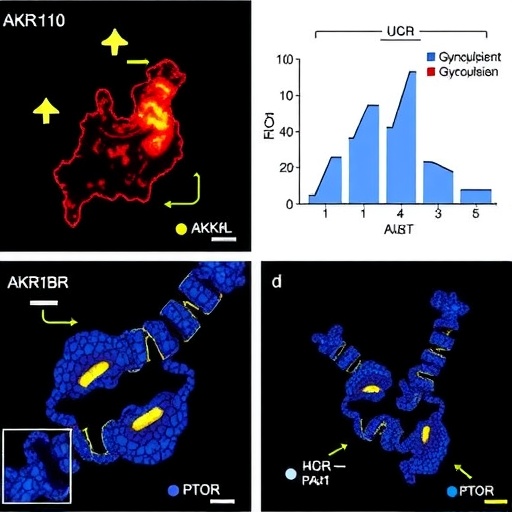
A metabolic enzyme that helps breast-cancer cells turn sugar into fuel may also be rewiring gene activity to accelerate tumor growth, according to a study that maps an unexpected chain of molecular events from glycolysis to proliferation. The research identifies AKR1B10 as a central connector in this process, linking the insulin-like growth factor 2 receptor, or IGF2R, to the glycolytic enzyme phosphoglycerate kinase 1, PGK1. Through this connection, the cancer cells increase lactate production, chemically modify a key histone protein and activate the growth-promoting mTOR pathway. The findings suggest that breast cancer’s appetite for glucose is not merely a consequence of rapid growth. It may be part of a self-reinforcing system in which metabolism directly changes the instructions that tell cancer cells to divide.
The phenomenon at the center of the study is the Warburg effect, a metabolic behavior first described nearly a century ago. Even when oxygen is available, many cancer cells rely heavily on glycolysis—the stepwise breakdown of glucose in the cell’s cytoplasm—and convert much of the resulting pyruvate into lactate. This is less efficient than mitochondrial oxidative phosphorylation in terms of ATP produced per molecule of glucose, but it can provide rapidly dividing cells with metabolic intermediates needed to build DNA, proteins and membranes. Glycolysis also allows cells to maintain energy production under fluctuating oxygen conditions. In breast cancer, the degree to which this metabolic program is engaged has been associated with disease behavior and patient outcomes, but the molecular switches that connect glycolysis to the cell’s transcriptional machinery have remained incompletely understood.
The investigators focused on AKR1B10, an enzyme involved in cellular metabolism whose abnormal overexpression has been observed in cancer. Enzymes of this kind can influence the balance of aldehydes, carbonyl compounds and other metabolic molecules, but AKR1B10’s precise relationship with glucose metabolism in breast cancer was unclear. To investigate it, the team combined bioinformatics with analyses of breast-cancer tissues and cell lines, measuring gene and protein activity using quantitative reverse-transcription polymerase chain reaction and western blotting. They also used metabolomics to survey changes in small molecules, glucose-metabolism assays to track the behavior of cancer cells, and mass spectrometry to examine protein modifications. This multi-layered approach allowed the researchers to follow the pathway from AKR1B10 expression to metabolic output and, ultimately, cell proliferation.
The experiments indicated that AKR1B10 is not simply correlated with aggressive cancer-cell behavior but is functionally important for it. When researchers reduced AKR1B10 activity, breast-cancer cells showed impaired glycolysis and reduced proliferation. Conversely, experiments designed to increase its activity supported the metabolic and growth-associated phenotype. The researchers tested these gain- and loss-of-function effects both in cultured cells and in animal models, providing evidence beyond a single laboratory system. Their results identified elevated AKR1B10 as a driver of the Warburg effect in the models examined, with increased glucose use and lactate generation accompanying the enzyme’s overexpression. The findings do not establish that AKR1B10 alone determines the course of human breast cancer, but they place the protein at a critical control point within the tumor’s metabolic network.
The mechanistic breakthrough came when the team examined how AKR1B10 communicates with other proteins. The study found that AKR1B10 acts as a molecular bridge between IGF2R and PGK1. IGF2R is a receptor involved in the trafficking and handling of insulin-like growth factor 2, while PGK1 catalyzes a reversible step in glycolysis, transferring a phosphate group from 1,3-bisphosphoglycerate to ADP and generating ATP. According to the researchers, the AKR1B10-linked interaction enables IGF2R to promote phosphorylation of PGK1 at the amino-acid position tyrosine 324, designated Y324. Phosphorylation can alter a protein’s activity, location or interactions, and in this case the modification appears to push PGK1 toward a state that supports stronger glycolytic flux. The resulting rise in lactate becomes the signal for the next stage of the cascade.
Lactate is often treated as a metabolic waste product, the acidic end point of glycolysis that must be exported from cells. Increasing evidence, however, shows that it can also act as a signaling molecule and a source of chemical groups used to modify proteins. The study links the lactate produced through the AKR1B10–IGF2R–PGK1 circuit to a process called histone lactylation. Histones are proteins around which DNA is wrapped, and chemical marks on histones can make particular genomic regions more or less accessible to transcriptional machinery. The researchers detected dynamic lactylation at lysine 12 of histone H4, referred to as H4K12la. In effect, the cancer cell’s altered metabolism appears to leave a chemical imprint on its chromatin. This provides a direct route by which excess glycolysis can influence gene expression rather than merely supplying energy.
The researchers then used RNA sequencing and chromatin immunoprecipitation sequencing to determine which genes were affected by this metabolic-to-epigenetic connection. Their results implicated transcriptional activation of mTOR, a master regulator of cell growth, protein synthesis, nutrient sensing and survival. The mechanistic sequence proposed by the study is therefore unusually long but tightly connected: increased AKR1B10 supports an interaction involving IGF2R and PGK1; IGF2R-dependent phosphorylation activates PGK1; enhanced PGK1 activity increases glycolysis and lactate production; lactate promotes H4K12 lactylation; and this chromatin modification helps activate mTOR transcription. Once engaged, mTOR signaling can encourage the synthesis of cellular components and the growth programs required for proliferation. The pathway illustrates how cancer metabolism and gene regulation can operate as a feedback system, with a biochemical change in the cytoplasm reshaping activity in the nucleus.
The therapeutic experiments offered an early test of whether this pathway could be disrupted. Knockdown of AKR1B10 suppressed the signaling axis and reprogrammed the metabolism of breast-cancer cells, reducing their proliferative capacity. The researchers also examined oleanolic acid, or OA, as an AKR1B10 inhibitor in combination with 2-deoxy-D-glucose, a glycolysis inhibitor commonly abbreviated 2-DG. The combination inhibited the AKR1B10-centered pathway more effectively in the reported experiments than leaving the metabolic circuit unchallenged, while also restraining cell proliferation. The logic behind the pairing is complementary: blocking AKR1B10 may weaken the upstream molecular bridge, while 2-DG limits glucose breakdown itself. Together, the compounds could attack both the regulatory trigger and the metabolic output. However, these findings remain preclinical. The study does not show that OA and 2-DG are safe or effective treatments for patients, nor does it establish how the proposed strategy would interact with standard breast-cancer therapies.
The work also highlights why metabolic targets can be difficult to translate into medicines. Glycolysis and mTOR signaling are used by healthy cells as well as tumors, so inhibiting them broadly could produce toxicity or affect immune, muscle and other tissues. AKR1B10 may offer a more selective point of intervention if its overexpression or pathway activity distinguishes particular breast-cancer subtypes, but that possibility will require detailed validation in larger patient cohorts. The study used clinical tissue samples collected with informed consent and approvals from institutional ethics committees, along with animal experiments conducted under approved guidelines. Even so, questions remain about which molecular breast-cancer subtypes depend most strongly on the pathway, whether tumors can bypass it through alternative glycolytic enzymes, and whether resistance emerges after prolonged treatment. Future studies will need to test the biomarkers that could identify responsive tumors and assess the pathway in clinically relevant treatment settings.
The significance of the findings lies less in presenting an immediate cancer cure than in revealing a form of molecular entanglement that may help tumors thrive. AKR1B10 appears to connect a metabolic enzyme, a receptor, a glycolytic catalyst, a histone modification and a growth pathway into one circuit. That architecture helps explain how breast-cancer cells can convert their demand for glucose into a durable proliferative advantage: nutrients are processed into lactate, lactate modifies chromatin, and chromatin activates signals that support further growth. By combining metabolic inhibition with targeted disruption of this signaling axis, researchers may eventually be able to interrupt the feedback loop at several points. For now, the study provides a mechanistic blueprint—and a potentially shareable target—for understanding why some breast tumors are so metabolically aggressive.
Subject of Research: AKR1B10-driven metabolic reprogramming, glycolysis and proliferation in breast cancer
Subject of Research: Cancer
Article Title: AKR1B10 mediates glycolysis and proliferation in breast cancer via the IGF2R-PGK1-H4K12la-mTOR signaling axis
Article References: Chen, S., Qiu, A., Hu, Q., Liu, Q., Zhang, Y., Wen, X., Wang, L., He, Y., Shen, Y., Cao, D., & Luo, D. (2026). AKR1B10 mediates glycolysis and proliferation in breast cancer via the IGF2R-PGK1-H4K12la-mTOR signaling axis. Cancer Cell International. https://doi.org/10.1186/s12935-026-04442-9
Image Credits: AI Generated
DOI: 10.1186/s12935-026-04442-9
Keywords: breast cancer, AKR1B10, glycolysis, Warburg effect, PGK1, histone lactylation, H4K12la, mTOR, metabolic reprogramming
Cite this news
APA MLA Chicago
SCIENMAG. (August 28, 2026). AKR1B10 Drives Breast Cancer Glycolysis and Growth Through IGF2R-PGK1-H4K12la-mTOR Signaling. https://scienmag.com/akr1b10-drives-breast-cancer-glycolysis-and-growth-through-igf2r-pgk1-h4k12la-mtor-signaling/
SCIENMAG. “AKR1B10 Drives Breast Cancer Glycolysis and Growth Through IGF2R-PGK1-H4K12la-mTOR Signaling.” Scienmag, 28 August 2026, https://scienmag.com/akr1b10-drives-breast-cancer-glycolysis-and-growth-through-igf2r-pgk1-h4k12la-mtor-signaling/. Accessed 28 August 2026.
SCIENMAG. “AKR1B10 Drives Breast Cancer Glycolysis and Growth Through IGF2R-PGK1-H4K12la-mTOR Signaling.” Scienmag. August 28, 2026. https://scienmag.com/akr1b10-drives-breast-cancer-glycolysis-and-growth-through-igf2r-pgk1-h4k12la-mtor-signaling/
Copy citation Download RIS
Tags: AKR1B10 and glycolysisAKR1B10 enzyme in cancer progressionbreast cancer metabolismcancer cell proliferation mechanismsepigenetic changes driven by cancer metabolismglucose dependence in cancer progressionglucose metabolism regulation in tumorsglycolysis and tumor growthglycolytic enzyme regulationhistone lactylation and gene expressionhistone modification in cancerIGF2R-PGK1 signaling pathwaylactate production and cancer proliferationlactate production in tumor growthmetabolic rewiring and gene expression in breast tumorsmetabolic rewiring in cancermTOR pathway activation in breast cancermTOR pathway activation in tumorsrole of PGK1 in cancer cell energyWarburg effect in breast cancerWarburg effect in cancer cells