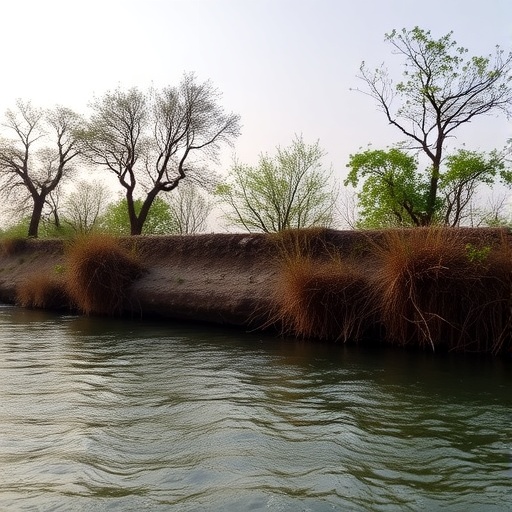
Bangladesh River’s Dry-Season Crisis Is Selecting for Microbes Built to Survive Pollution
A river supplying drinking water to millions of people in Dhaka undergoes a dramatic microbial transformation as Bangladesh’s dry season deepens, according to a new metagenomic study. In water collected from the Shitalakshya River, researchers found that falling river flow coincided with worsening oxygen depletion, rising nutrient and organic-carbon concentrations, increasing metal contamination and a major rearrangement of genes associated with antibiotic, metal and biocide resistance. The results suggest that the river’s resistance problem is not driven by antibiotics alone. Instead, a combination of industrial metals, chemical pollutants, hypoxia and concentrated sewage may be selecting for microbial communities with broad tolerance to multiple stressors. The findings are especially significant because the sampling site lies at the Sarulia intake, where raw water enters the Saidabad Water Treatment Plant, the largest surface-water treatment facility in Bangladesh and a major source of drinking water for Dhaka.
The study compared triplicate surface-water samples collected at the same intake zone during December 2024, described as the early dry season, and February 2025, when dry-season conditions were more intense. This design was not a year-round survey and cannot establish long-term trends, but it created a sharp contrast between two hydrological states. In February, turbidity had risen from 18.4 to 29.4 nephelometric turbidity units, while total dissolved solids increased from 283 to 372 milligrams per liter. Conductivity climbed by roughly one-third, suggesting a greater concentration of dissolved ions as the river lost dilution capacity. Dissolved oxygen fell from 2.16 to 1.69 milligrams per liter, indicating severe hypoxia. Ammoniacal nitrogen nearly doubled, from 5.1 to 9.95 milligrams per liter, nitrate increased eightfold from 0.1 to 0.8 milligrams per liter, and total organic carbon rose from about 7.91 to 15 milligrams per liter. The chemical changes are consistent with a river receiving continuing pollution while carrying less water.
Metals followed the same pattern. Aluminum increased from 0.384 to 0.702 milligrams per liter, iron rose from 0.451 to 0.628 milligrams per liter, and manganese increased from 0.145 to 0.185 milligrams per liter. Chromium tripled from 0.001 to 0.003 milligrams per liter, while arsenic, undetected in December, appeared at 0.001 milligrams per liter in February. The researchers measured dissolved metals in water passed through a 0.45-micrometer filter and acidified before analysis by inductively coupled plasma optical emission spectrometry, a technique that identifies elements from the light emitted by excited atoms in a high-temperature plasma. Although the concentrations varied by element and remained low for some contaminants, their simultaneous increase points to a changing chemical environment. The river receives discharges from textile, dyeing, pharmaceutical, chemical and food-processing facilities, as well as municipal sources, making industrial effluent and sewage plausible contributors to the late dry-season mixture.
To see how the changing chemistry affected the microbial ecosystem, the team filtered one-liter portions of each sample through 0.22-micrometer membranes, extracted total DNA and performed shotgun metagenomic sequencing. Unlike culture-based testing, which detects only organisms that grow under laboratory conditions, shotgun metagenomics sequences genetic material directly from the environmental sample. The approach can reveal uncultured organisms, microbial community composition and resistance genes simultaneously. After quality filtering, each sample retained an average of about 70.5 million paired-end reads. The researchers classified sequences with Kraken2 and Bracken, then searched for resistance determinants against the MEGARes database using the AMR++ pipeline. Only matches covering at least 99 percent of a reference gene were retained, a stringent threshold intended to reduce false positives from partial or ambiguous sequences.
The microbial community changed more dramatically than the river’s physical appearance might suggest. In December, two bacterial phyla dominated: Bacteroidota accounted for 55.62 percent of classified sequences and Pseudomonadota, formerly known as Proteobacteria, contributed 41.06 percent. By February, Pseudomonadota had surged to 78.19 percent, while Bacteroidota fell to just 6.40 percent. Bacillota increased from roughly 1 percent to 12.50 percent, with smaller increases among viral and other microbial groups. At the genus level, the early dry-season community was overwhelmingly dominated by Myroides, representing 51.56 percent of sequences. Two months later, no single genus held the same control. Comamonas accounted for 19.26 percent, Brevundimonas for 13.82 percent, Tissierella for 10.17 percent and Pseudochrobactrum for 10 percent. Aeromonas, Morganella and Proteus also became more prominent, a shift that raises concern because several members of these genera can act as opportunistic pathogens.
The species-level data reinforced the picture of ecological replacement. December samples were dominated by Myroides odoratimimus, Myroides species and Myroides profundi, which together accounted for much of the community. In February, the leading organisms were distributed among Comamonas thiooxydans, Brevundimonas diminuta, Tissierella carlieri, Aeromonas media and Pseudochrobactrum species, with no single species exceeding 15 percent of the total. The researchers interpret this as deterministic environmental filtering: as oxygen declined and pollutants became more concentrated, organisms unable to tolerate the combined stress lost ground while metabolically flexible organisms expanded. Some of the enriched taxa possess genes or pathways associated with degrading aromatic compounds, pesticides or other contaminants, while others are adapted to metal exposure or anaerobic metabolism. That does not prove that each organism was actively removing pollutants in the river, but it suggests that the late dry-season community had a different functional potential from the December assemblage.
The river’s resistome—the collection of resistance genes present in the microbial community—also shifted, although not in the simplest way. Antibiotic-resistance genes remained the largest category, but their relative share fell from 86.6 percent in December to 76.9 percent in February. Metal-resistance genes rose from 6.8 to 12.25 percent, while biocide-resistance genes increased from 2.8 to 3.2 percent. The researchers detected genes associated with 18 antibiotic classes. Resistance to macrolide-lincosamide-streptogramin drugs and aminoglycosides dominated early in the dry season, driven largely by genes that modify ribosomal targets, including MLS23S and A16S, and by macrolide efflux systems. In February, rifampicin-associated rpoB determinants increased from 3.32 to 6.29 percent, while elfamycin-associated tufAB genes rose from 3.45 to 5.98 percent. Colistin-resistance mcr fragments and NDM-like carbapenemase genes were detected, but each remained below 0.1 percent and showed no seasonal amplification.
The most striking increase involved resistance to metals, particularly mercury. The February samples contained more of the canonical mer genes, including merA, merT, merP, merR and merD. These genes form parts of a detoxification system in which bacteria bind, transport or chemically transform mercury, reducing its toxicity. Multi-metal resistance systems associated with cusABC, silABC and modABC efflux pathways also increased. Efflux pumps are membrane proteins that expel toxic compounds from bacterial cells; some can transport several chemically unrelated substances, including metals, antibiotics, disinfectants and industrial solvents. This overlap provides a plausible mechanism for co-selection. A metal-contaminated environment may favor bacteria carrying resistance systems that also reduce susceptibility to antibiotics, even if antibiotic concentrations do not rise. If resistance genes occur together on plasmids or other mobile genetic elements, selection for one trait can help preserve the others and potentially facilitate their movement through the community.
Functional profiling identified a targeted, rather than universal, change in multidrug-resistance systems. Of 85 genes representing 10 resistance mechanisms, 24 increased, 17 decreased and 44 remained relatively stable. RND-family efflux systems showed the clearest enrichment. The mexK gene was not detected in December but reached a normalized abundance of 0.893 in February; tetB and mexD1 more than doubled, while mexF, sme, sdeB and sdeY appeared later in the season. The biocide-associated efflux gene mexW likewise rose from undetectable to the most abundant biocide-resistance determinant, reaching 0.5826. Such systems can provide cross-resistance, but the sequencing results should not be interpreted as direct evidence that every detected gene was expressed or that the organisms carrying it were infectious. DNA-based metagenomics measures genetic potential and relative abundance; culture, RNA sequencing and laboratory susceptibility tests would be needed to determine viability, activity and clinical relevance.
The public-health implications are nevertheless difficult to ignore. The sampling point is not an isolated ecological site but part of a drinking-water supply chain, and the February community contained more Aeromonas, Acinetobacter and Morganella, alongside low but persistent signals from clinically important organisms such as Klebsiella pneumoniae, Acinetobacter baumannii and Pseudomonas aeruginosa. Some apparent increases may reflect concentration of sewage-derived material as water levels fall rather than microbial growth within the river. The study also detected sharper signals from organisms associated with fecal or environmental contamination, including Bacteroides thetaiotaomicron and Clostridium tetani. Their presence in sequencing data does not establish infectivity, and the research did not test whether the organisms were alive. Still, the results indicate that conventional water-quality measurements alone may miss an important dimension of risk. The authors argue that routine monitoring should combine chemical measurements, microbial community profiling and resistome surveillance, while pollution control should target industrial metals and organic contaminants as well as inappropriate antibiotic use.
The study’s strongest conclusion is also its most cautious: intensified dry-season stress appears to reorganize the river’s microbial and resistance landscape, but two sampling dates at one site cannot prove a causal chain. The samples were collected on single days, and the investigation focused on the water column rather than sediments, which can store contaminants and resistance genes over longer periods. More sites, repeated sampling across multiple years, measurements of antibiotic and metal concentrations, RNA-based activity assays and assembly of complete microbial genomes would help determine whether resistance genes are linked on mobile elements and which organisms carry them. Even with these limitations, the magnitude and consistency of the observed changes across water chemistry, taxonomy, metal-resistance genes and efflux systems make the Shitalakshya River a warning signal for other urban waterways. As dry seasons become hotter or longer, reduced flow may turn polluted rivers into evolutionary pressure cookers—concentrating contaminants and favoring microbial communities equipped to withstand them.
Subject of Research: Dry-season microbial community and antimicrobial-resistance gene restructuring in the Shitalakshya River, Bangladesh
Article Title: Dry-season pollution reshapes the microbiome and resistome of Bangladesh’s Shitalakshya River
Article References: Haque, M. E., Rahman, M. S., Sultana, M., and Begum, A. Research article on metagenomic and hydrochemical analysis of the Shitalakshya River; sequencing data available through the NCBI BioProject PRJNA1424261
Image Credits: AI Generated
DOI: 10.1002/mbo3.70359
Keywords: Shitalakshya River, Bangladesh water quality, antimicrobial resistance, shotgun metagenomics, metal resistance genes, dry-season pollution, multidrug efflux pumps, drinking-water safety
Tags: antibiotic and metal resistance genesBangladesh Shitalakshya Riverdry-season water qualityhypoxia and nutrient enrichmentindustrial pollutants and microbial adaptationmetagenomicspollution impact on microbesRiver microbial resistanceseasonal microbial community shiftssewage contamination and microbial resiliencesurface water microbiome analysiswater treatment challenges