Immune checkpoint inhibitors have transformed cancer treatment by releasing molecular brakes that otherwise restrain T cells, yet their benefits remain uneven. Many tumors contain T cells capable of recognizing malignant cells but suppress those immune responses through a hostile local environment dominated by regulatory signals, dysfunctional stromal cells and immunosuppressive macrophages. A study published in Nature Cancer identifies a previously unrecognized component of this environment: a tiny protein, or micropeptide, produced by a transcript long classified as noncoding. The researchers report that this micropeptide, named UEIS, is abundant in tumor-associated macrophages and helps tumors evade immune attack by weakening a central innate immune pathway known as cGAS–STING–type I interferon signaling.
The discovery adds to growing evidence that the genome contains many functional peptides hidden within RNA molecules annotated as long noncoding RNAs. Long noncoding RNAs, or lncRNAs, are generally defined as transcripts longer than 200 nucleotides that do not serve as conventional templates for large proteins. Increasingly, however, scientists have found that some lncRNAs contain short open reading frames capable of producing micropeptides. These molecules can be only a few dozen or a few hundred amino acids long, yet they may regulate signaling complexes, membrane processes and gene expression. In this case, the researchers traced an immune-suppressive activity associated with the lncRNA gene USP30-AS1 to a peptide encoded within it. They designated the peptide USP30-AS1-encoded immune suppressor, abbreviated UEIS.
UEIS was found to be highly expressed in tumor-associated macrophages, immune cells that accumulate within cancers and can be reprogrammed by the tumor microenvironment. Macrophages are highly adaptable: depending on the signals they receive, they can support inflammation and attack abnormal cells, or promote tissue repair, blood-vessel formation and tumor growth. In the cancer setting, tumor-associated macrophages frequently acquire a protumorigenic state. Rather than efficiently supporting cytotoxic lymphocytes, they can help create an immune-permissive environment in which malignant cells survive, invade surrounding tissue and resist therapy. According to the study, UEIS contributes to this transition by suppressing macrophage interferon responses and thereby reducing the conditions needed for effective antitumor T cell activity.
The pathway targeted by UEIS normally functions as an intracellular alarm system for abnormal DNA. When tumor-derived DNA reaches the cell cytoplasm, it can be detected by the enzyme cGAS, which synthesizes the signaling molecule cyclic GMP–AMP. This molecule activates the adaptor protein STING, initiating a cascade involving the kinase TBK1 and downstream transcription factors that stimulate production of type I interferons. These interferons, including interferon-beta and related molecules, can strengthen antigen presentation, activate innate immune cells and help recruit and sustain T cells capable of attacking cancer. The pathway is therefore considered one of the most important bridges between the detection of tumor-associated DNA and the development of antitumor immunity.
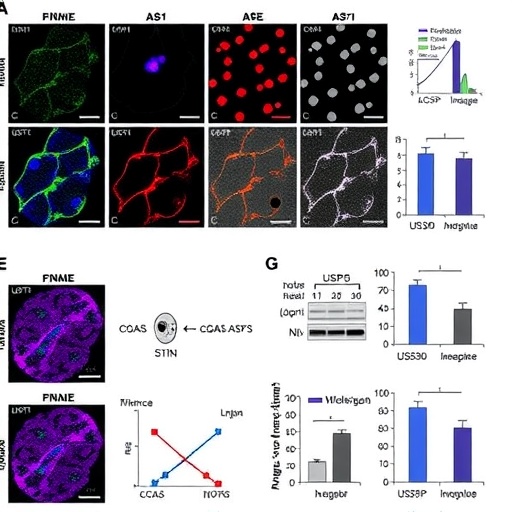
The researchers found that UEIS is not simply present in macrophages at a constant level. Instead, it is induced after tumoral DNA activates the cGAS–STING pathway, but it appears relatively late in the response. This timing suggests that UEIS acts as a negative-feedback regulator. Early pathway activation can generate an interferon response, while later production of UEIS helps dampen that signal. Such feedback mechanisms are common in immune biology because uncontrolled interferon signaling can damage healthy tissue and trigger excessive inflammation. Cancer, however, may exploit this protective brake. By increasing UEIS after the initial alarm has sounded, tumor-associated macrophages can limit the duration or intensity of the immune response before it becomes sufficiently strong to support sustained tumor destruction.
At the molecular level, the study links UEIS to the formation of biomolecular condensates involving TBK1. Condensates are dynamic, membrane-free assemblies in which proteins and nucleic acids concentrate through multivalent interactions. They are increasingly recognized as organizing centers for signaling reactions, allowing pathway components to gather in the correct place and at the appropriate time. The researchers report that UEIS forms condensates with TBK1 and, through this interaction, interferes with the kinase’s association with STING. Because STING must engage TBK1 to efficiently transmit the signal generated by cytoplasmic DNA, disrupting that interaction effectively weakens the pathway downstream of DNA sensing. The result is reduced type I interferon signaling in macrophages.
The architecture of UEIS was also important to its activity. Experiments indicated that both an intrinsically disordered region and an alpha helix located at the extreme N terminus of the micropeptide were required for its function. Intrinsically disordered regions lack a single rigid three-dimensional structure and often enable flexible, multivalent interactions with several partners. They can be particularly important in the formation of biomolecular condensates because they provide repeated or adaptable binding surfaces. Alpha helices, by contrast, are structured elements that can create defined contact points within protein complexes. The findings suggest that UEIS may use its disordered region to support condensation while relying on its N-terminal helix to engage a signaling partner such as TBK1, although the precise atomic structure of the complex remains to be determined.
The therapeutic implications were tested with a peptide designed to disrupt UEIS–TBK1 condensation. Rather than attempting to eliminate the lncRNA or broadly inhibit the interferon pathway, the strategy focused on the physical interaction that gives UEIS its suppressive activity. The researchers report that the disrupting peptide inhibited UEIS function in tumor-associated macrophages. In experimental cancer models, treatment was associated with reduced tumor growth and a stronger response to immune checkpoint blockade. These results are significant because checkpoint inhibitors depend on an immune system capable of recognizing and attacking tumor cells. If macrophages suppress interferon signaling and maintain an immunosuppressive environment, blocking checkpoints alone may not be enough. Interrupting UEIS activity could help convert that environment into one more permissive for T cell function.
The findings position UEIS as a potential therapeutic target at the intersection of innate sensing, macrophage biology and cancer immunotherapy. They also illustrate why the search for cancer regulators cannot be limited to conventional protein-coding genes. A transcript previously categorized as noncoding can produce a short peptide that reorganizes a signaling pathway and changes the behavior of immune cells within tumors. Before the approach can be considered for clinical use, important questions will need to be addressed, including how selectively UEIS is expressed across cancers and normal tissues, whether disrupting its condensates causes unwanted inflammation, and how effectively the peptide can reach macrophages in human tumors. Nevertheless, the study offers a new explanation for how tumors attenuate cGAS–STING–type I interferon signaling and provides a possible way to strengthen immune checkpoint therapy by targeting a molecular brake embedded within a lncRNA.
Subject of Research: A micropeptide encoded by the lncRNA USP30-AS1 that suppresses cGAS–STING–type I interferon signaling in tumor-associated macrophages and promotes tumor growth.
Article Title: A micropeptide encoded by the lncRNA USP30-AS1 promotes tumor growth by attenuating cGAS–STING–type I IFN signaling in macrophages.
Article References: Wang, X., Zhang, Y., Ma, J. et al. “A micropeptide encoded by the lncRNA USP30-AS1 promotes tumor growth by attenuating cGAS–STING–type I IFN signaling in macrophages.” Nature Cancer 7, 1047–1063 (2026). https://doi.org/10.1038/s43018-026-01195-2
Image Credits: AI Generated
DOI: July 2026
Keywords: UEIS, USP30-AS1, micropeptide, long noncoding RNA, tumor-associated macrophages, cGAS–STING signaling, type I interferon, TBK1, biomolecular condensates, immune checkpoint blockade, cancer immunotherapy.
Tags: cGAS–STING pathway suppressiondiscovery of functional peptides in noncoding regionsimmune checkpoint resistance mechanismsinnate immune signaling in tumorsinterferon signaling suppressionlong noncoding RNAs in cancermicropeptides as therapeutic targetsmicropeptides in cancernoncoding RNA translationTumor Immune Evasiontumor microenvironment regulationtumor-associated macrophages