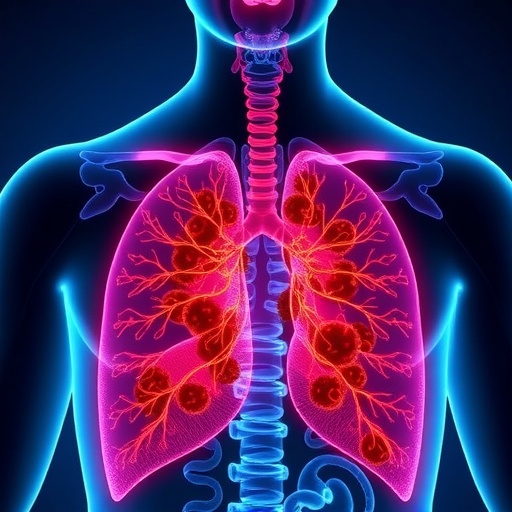
Mass General Brigham researchers have used artificial intelligence to identify a potential link between incidental radiation exposure to the thymus and poorer outcomes in patients receiving treatment for locally advanced non-small cell lung cancer. The findings, published in Annals of Oncology, suggest that the thymus—an immune organ long considered largely inactive in adulthood—may be an important, and previously overlooked, component of the body’s response to cancer therapy. The study does not establish that radiation to the thymus directly causes worse survival, but it provides large-scale clinical evidence supporting the possibility that preserving thymic health could become a consideration in the design of radiation treatments.
The thymus is located behind the breastbone, close to many structures involved in thoracic cancers. Its primary function is to produce and educate T cells, a class of lymphocytes responsible for recognizing abnormal cells, coordinating immune responses, and eliminating infected or malignant targets. During childhood, the thymus is highly active, generating large numbers of naïve T cells capable of responding to unfamiliar antigens. The organ gradually becomes smaller and is replaced in part by fatty tissue with age, a process known as involution. For decades, this transformation led clinicians to assume that the adult thymus had little remaining importance. Recent studies from the same Mass General Brigham research group, however, have challenged that assumption by showing that many adults retain measurable thymic structure and function.
Those earlier investigations, published in Nature, used medical imaging and clinical data to examine how thymic condition relates to health across the adult lifespan. They reported associations between healthier thymuses and lower mortality, reduced risks of cardiovascular disease and cancer, and more favorable responses to immune checkpoint inhibitors. These drugs, which include several modern cancer immunotherapies, work by releasing inhibitory signals that prevent T cells from attacking tumors. Their effectiveness depends not only on the presence of T cells but also on the diversity, fitness, and ability of the immune system to generate new antitumor responses. A functioning thymus may contribute to this process by maintaining or replenishing the pool of naïve T cells available for activation.
The new study examined more than a thousand patients with locally advanced non-small cell lung cancer, a disease commonly treated with combinations of chemotherapy, radiation therapy, and immunotherapy. Radiation is directed at tumors and nearby lymph-node regions, but the thymus can lie within or near the treatment field because of its position in the upper chest. As a result, the organ may receive radiation even when it is not a therapeutic target. The researchers analyzed routine computed tomography scans with artificial-intelligence methods to estimate each patient’s thymic health before treatment. They also used treatment-planning information to quantify the radiation dose delivered to the thymus, allowing them to investigate whether baseline thymic condition and incidental exposure were associated with subsequent outcomes.
The analysis showed that patients with relatively preserved thymic health before radiotherapy generally had the most favorable clinical outcomes. Within this group, however, patients exposed to higher radiation doses to the thymus experienced significantly worse overall survival and were more likely to develop distant metastatic disease. Follow-up scans also indicated that thymic health declined after treatment among patients receiving greater thymic radiation exposure. The pattern is biologically plausible: radiation can damage rapidly dividing cells, alter tissue architecture, and promote inflammation or fibrosis. Injury to the thymus could reduce the production of naïve T cells or disrupt the specialized cellular environment required for T-cell maturation, potentially weakening immune surveillance at a time when patients are relying on both their own immune systems and immunotherapy.
The results were particularly notable among patients treated with durvalumab, an immune checkpoint inhibitor used after chemoradiation in certain cases of locally advanced lung cancer. Durvalumab targets the PD-L1 pathway, blocking a signal that tumors can use to suppress T-cell activity. In the study, patients with preserved thymic health appeared to be especially affected by the amount of radiation delivered to the thymus when they received durvalumab. This observation is consistent with the possibility that thymic function helps determine how effectively a patient can mount or sustain an immune response once checkpoint inhibition removes suppressive signals. It also raises the possibility that the same patients most capable of benefiting from immunotherapy could be particularly vulnerable to treatment-related damage to immune organs.
Artificial intelligence was central to the investigation because thymic structure can be difficult to evaluate consistently by eye, especially in adults whose thymus contains a mixture of soft tissue and fat. Imaging-based algorithms can process large numbers of CT scans and extract quantitative features that may be missed during routine clinical interpretation. In this study, the technology enabled the investigators to assess thymic condition before therapy and track changes afterward across a large patient population. Such methods could eventually support automated treatment planning, alerting radiation oncologists when a meaningful amount of dose is likely to reach a potentially functional thymus. However, imaging measurements remain indirect indicators of biological activity, and the study cannot determine precisely how changes seen on CT correspond to T-cell production or immune competence.
The investigators caution that the work is observational. Patients who received higher thymic radiation doses may have differed from other patients in ways that also influenced outcomes, including tumor location, disease extent, treatment geometry, overall health, or the radiation dose delivered to other organs. Although the researchers accounted for clinical and imaging information available in their analysis, unmeasured factors could still contribute to the associations. The results therefore should not be interpreted as evidence that radiation therapy should be reduced or withheld when it is needed to control a lung tumor. Radiation remains a foundational treatment for locally advanced disease, and protecting the thymus would have to be balanced against delivering an adequate dose to the cancer and involved lymph nodes.
Prospective studies will be required to determine whether deliberately limiting thymic radiation improves survival, reduces metastasis, or enhances responses to immunotherapy. Future trials could compare conventional radiation plans with thymus-sparing plans while measuring immune markers such as naïve T-cell counts, T-cell receptor diversity, circulating immune-cell populations, and changes in thymic imaging features. Researchers will also need to establish which adults retain enough thymic activity for protection to be clinically meaningful and whether the effect varies according to age, sex, baseline immune status, cancer subtype, or treatment regimen. If the findings are confirmed, the thymus could join the heart, lungs, and spinal cord as an organ whose dose is considered during thoracic radiation planning—not because it is the tumor, but because preserving the patient’s immune capacity may be part of achieving durable cancer control.
Subject of Research: The association between incidental thymic radiation exposure, thymic health, and clinical outcomes in patients with locally advanced non-small cell lung cancer.
Article Title: “Thymic Radiation is Associated with Worse Outcomes in Patients with NSCLC”
Web References: https://www.annalsofoncology.org/article/S0923-7534(26)00997-X/fulltext; https://www.nature.com/articles/s41586-026-10242-y; https://www.nature.com/articles/s41586-026-10243-x
References: Prudente, V. et al. “Thymic Radiation is Associated with Worse Outcomes in Patients with NSCLC.” Annals of Oncology. DOI: 10.1016/j.annonc.2026.07.001
Keywords: Thymus, thymic health, radiation therapy, lung cancer, non-small cell lung cancer, immunotherapy, durvalumab, artificial intelligence, computed tomography, T cells, cancer outcomes, radiotherapy planning
Tags: artificial intelligence in cancer treatment planningclinical implications of thymus radiation exposureimmune organ preservation inimpact of incidental radiation on thymus and immune responsenon-small cell lung cancer treatment outcomesradiation therapy side effects on immune organsrole of thymus in adult immune systemsignificance of thymic health in cancer prognosisstrategies to preserve thymus function during radiotherapythymus and T cell development in cancer patientsthymus involution and agingThymus protection during cancer radiotherapy