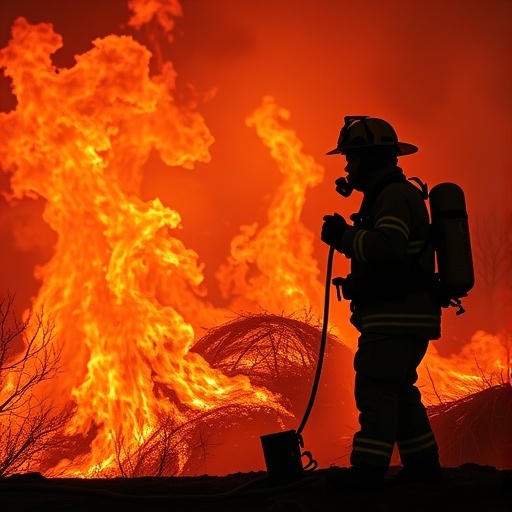
Firefighters experience measurable changes in proteins circulating through their bodies within a day of battling a fire, according to a new study from UTHealth Houston. The research, published in Environment & Health, provides one of the clearest snapshots yet of how the human body responds immediately after exposure to the complex mixture of chemicals released by burning buildings, vehicles, furnishings, plastics, and other materials. By comparing blood and urine collected before and after fire exposure, investigators identified molecular signals associated with inflammation, immune regulation, cellular stress, and biological pathways linked to cancer. The findings do not show that a single fire causes cancer, but they suggest that the body begins responding to potentially hazardous exposures almost immediately—and that urine may offer a practical, noninvasive way to monitor those responses.
Firefighters regularly encounter smoke containing fine particles, heavy metals, volatile chemicals, and polycyclic aromatic hydrocarbons, a broad family of compounds produced by incomplete combustion. Many of these substances can enter the body through inhalation, skin contact, and contaminated gear. Although respiratory protection can reduce inhalation, it cannot eliminate exposure completely, particularly during overhaul operations, when firefighters search for hidden flames and ventilate structures after the main fire has been extinguished. Contaminants can also remain on protective clothing, equipment, vehicles, and skin. Repeated exposure over years has been associated with elevated risks of several cancers, cardiovascular disease, respiratory illness, and other chronic conditions. However, the biological steps connecting an individual fireground exposure to later disease remain difficult to observe in real time.
To investigate those early steps, researchers collected blood and urine samples from 30 firefighters before and after they fought fires. The study used proteomics, a technology that measures large numbers of proteins in biological samples. Proteins are functional molecules that control communication between cells, regulate immune activity, transport substances, and respond to tissue injury or chemical stress. Because protein concentrations and interactions can change rapidly, proteomic analysis can reveal short-term biological reactions that may not be visible through conventional medical tests. In the firefighters’ pre-exposure samples, the researchers identified and quantified 330 protein groups in blood serum and 1,085 protein groups in urine, establishing a molecular baseline against which post-exposure changes could be compared.
The contrast between the two types of samples was striking. After fire exposure, scientists detected 75 significantly altered proteins in urine, compared with 10 altered proteins in blood serum. The result suggests that urine may capture a broader range of short-term exposure-related signals than blood, at least for the biological processes examined in this study. Urine is produced as the kidneys filter the blood and remove water-soluble waste products, metabolites, and other molecules. That filtering process can concentrate certain indicators of physiological stress, potentially making subtle changes easier to detect. Urine collection is also simpler and less invasive than blood sampling, an advantage for occupational health programs that may need to monitor large numbers of firefighters repeatedly over time.
Several of the altered urinary proteins were associated with pathways involved in cancer biology, including pathways connected to small-cell lung cancer. The researchers focused particular attention on a coordinated change involving four proteins: laminin subunit alpha 4, or LAMA4; laminin subunit gamma 1, or LAMC1; von Willebrand factor, or VWF; and beta-2-microglobulin, or B2M. These proteins perform different functions but are connected to processes such as cell adhesion, communication between cells and their surrounding tissue, blood-vessel biology, and immune surveillance. LAMA4 and LAMC1 are components of laminin-containing structures that help organize the extracellular matrix, the molecular scaffold surrounding cells. VWF contributes to blood clotting and vascular function, while B2M is associated with immune-system activity and the presentation of cellular signals to immune cells.
The coordinated movement of these proteins after exposure may indicate that smoke-related chemicals trigger a network-level response rather than isolated changes in individual molecules. Biological pathways involved in cancer can also participate in normal wound repair, inflammation, tissue remodeling, and immune regulation, so the presence of cancer-associated signals does not mean that tumors have formed or that an exposed firefighter will necessarily develop cancer. Instead, the findings suggest that toxic smoke may produce immediate cellular stress in systems that, when persistently disrupted, could contribute to disease development. The researchers also reported signs consistent with temporarily weakened immune defenses against abnormal cells. Determining whether these molecular patterns disappear quickly or remain altered after repeated exposures will require studies that follow firefighters for much longer periods.
Jooyeon Hwang, an associate professor in the Department of Environmental and Occupational Health Sciences at the UTHealth Houston School of Public Health, led the investigation. Hwang said the results show that biological responses begin long before chronic disease becomes clinically apparent and that urine could become a sensitive tool for identifying early distress signals. Such monitoring could eventually complement—not replace—established cancer screening and occupational medical evaluations. A protein signature detected shortly after a fire would not by itself diagnose cancer. It could, however, help researchers identify which exposures are most biologically disruptive, determine whether protective measures are working, and explore whether certain firefighters experience stronger or more persistent responses than others.
The study’s small sample size and short follow-up period limit what can be concluded. The participants were assessed within 24 hours of fire exposure, meaning the research captures an acute response rather than the cumulative effects of years on the fireground. Protein levels can also be influenced by physical exertion, dehydration, heat stress, diet, medication, injury, and the characteristics of the fire itself. Different structures and materials produce different chemical mixtures, while the duration and intensity of exposure can vary substantially between incidents. For these reasons, the observed protein changes must be replicated in larger groups and compared with detailed records of smoke conditions, protective equipment, firefighting tasks, and recovery time. Researchers will also need to determine whether the four-protein pattern predicts any measurable long-term health outcome.
Hwang and colleagues plan to extend the work through larger longitudinal investigations, including the Texas Firefighter Cancer Study. Repeated sampling could reveal whether exposure-related proteins return to normal after a single incident, accumulate after successive fires, or remain persistently altered in firefighters with the greatest occupational burden. The researchers envision that advanced biomarker testing might eventually be incorporated into routine occupational health assessments, including standards developed by the National Fire Protection Association. They are also interested in prevention strategies such as improved decontamination, more effective control of exposure during overhaul, and individualized hydration protocols that could support the clearance of toxins through the kidneys. For now, the study’s central message is both urgent and measured: fireground exposure leaves detectable molecular traces within hours, and understanding those traces may help transform firefighter health care from a system that reacts to disease into one that identifies risk earlier.
Subject of Research: Acute biological and protein-level changes in firefighters’ blood and urine following fire exposure, with a focus on biomarkers associated with cellular stress, immune regulation, and cancer-related pathways.
Web References: https://pubs.acs.org/ehnea2/article-pdf/doi/10.1021/envhealth.6c00062/66709763/envhealth.6c00062.pdf; https://www.uth.edu/news/story/uthealth-houston-study-links-firefighter-smoke-exposure-to-biological-changes-that-increase-cancer-risk; https://go.uth.edu/TexasFirefighterCancerStudy
References: Environment & Health; DOI: 10.1021/envhealth.6c00062
Image Credits: UTHealth Houston
Keywords: Firefighters, occupational exposure, fire smoke, biomarkers, proteomics, urine proteins, blood proteins, cancer risk, small-cell lung cancer, immune response, cellular stress, occupational health, LAMA4, LAMC1, VWF, B2M
Tags: biological changes within 24 hours of fireblood and urine biomarkers after fire exposurecellular stress and cancer pathways in fire victimschemical exposure and health risks in firefightingearly biological effects of fire-related chemical exposurefirefighter biological responsehealth effects of inhaled polycyclic aromatic hydrocarbonsimpact of smoke inhalation on blood proteinsinflammation and immune response in firefightersmolecular signals of inflammation and stress in firefightersnoninvasive monitoring of firefighter healthtoxic chemicals in firefighting smoke