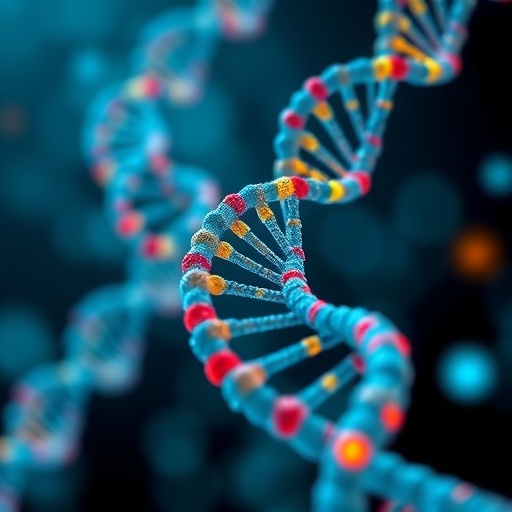
The molecular switch that helps determine whether a human gene is turned on or remains silent has been decoded with the help of artificial intelligence. Researchers at the University of California San Diego have used high-throughput DNA sequencing and machine learning to identify the sequence features of the human initiator, a critical regulatory element positioned at the beginning of many genes. Their findings offer a new way to predict how mutations may alter gene activity and could eventually help scientists design synthetic DNA switches with precisely controlled functions.
Every human cell contains essentially the same genome, yet a liver cell behaves very differently from a neuron or a muscle cell. The difference lies largely in gene regulation: the molecular systems that determine which genes are active, when they are activated, and how strongly they are expressed. Before a gene can be used to produce a protein or functional RNA molecule, its DNA sequence must be copied into RNA through a process called transcription. This process begins at a promoter, a regulatory region that recruits the molecular machinery responsible for reading the gene.
One of the most important elements within many promoters is the initiator, also known as the Inr element. It surrounds the transcription start site, the precise position at which RNA synthesis begins. The initiator helps position the transcription machinery correctly and can influence the efficiency and timing of gene activation. Although researchers have studied this region for decades, the initiator does not follow one simple, universal DNA sequence. Instead, it appears in multiple sequence forms, making it difficult to define its identifying features using conventional approaches.
In the new study, led by graduate student researcher Torrey Rhyne-Carrigg in the laboratory of UC San Diego molecular biologist James T. Kadonaga, scientists generated and analyzed approximately 500,000 different initiator sequences. Each sequence represented a variation in the DNA bases that could potentially affect transcription. The team measured the gene-expression activity associated with these variants using high-throughput experimental methods, producing a large dataset that connected specific DNA patterns with the ability to initiate transcription.
This approach allowed the researchers to examine the initiator as a quantitative regulatory system rather than as a simple sequence motif. A DNA base change may not completely eliminate promoter activity; it may instead make transcription weaker, stronger, or more dependent on the surrounding sequence. By measuring the activity of hundreds of thousands of variants, the scientists created a detailed map of how individual DNA positions contribute to the function of the initiator. Such maps are particularly valuable for understanding regulatory DNA, where small sequence changes can have substantial biological effects.
The team then used machine-learning algorithms to analyze the experimental results. Machine learning is well suited to this type of problem because it can detect patterns distributed across many sequence positions, including combinations of bases that may be difficult to recognize by eye. The resulting model learned to associate DNA sequence features with initiator activity and could predict whether a human gene was likely to contain an initiator. In effect, the model transformed a large collection of experimental measurements into a computational signature for this key regulatory element.
The researchers applied the model to human gene sequences and found that approximately 60 percent contain an initiator. This result reinforces the view that the human genome uses multiple types of core promoters to begin transcription. Some promoters rely heavily on initiator sequences, while others use different combinations of regulatory elements. The distinction is important because promoter architecture can influence how genes respond to cellular signals, developmental cues, and the molecular environment surrounding them.
According to Kadonaga, the AI models provided strong predictions, for the first time, of the presence or absence of the initiator in human genes and helped decode its underlying DNA pattern. The model does not merely identify a single short sequence shared by all initiators. Instead, it captures the sequence preferences and functional relationships that distinguish active initiators from inactive or less effective variants. This makes the approach more powerful than a conventional motif search, which can identify approximate matches but often cannot predict how strongly a sequence will function.
The findings could have important implications for medical genetics. Mutations in promoters and other regulatory regions are increasingly recognized as causes or contributors to disease, including cancer and developmental disorders. A mutation that changes a protein-coding sequence may be relatively easy to interpret if it disrupts an essential amino acid. Regulatory mutations can be more challenging because they may alter the amount, timing, or location of gene expression without changing the protein itself. A predictive initiator model could help researchers estimate whether a mutation is likely to weaken transcription, enhance it, or interfere with the precise start of RNA production.
The same principles may also support the design of synthetic promoters, engineered DNA sequences that activate genes under selected conditions or at defined strengths. Synthetic promoters are used in biotechnology, gene regulation studies, and emerging therapeutic technologies. By combining the experimental dataset with machine-learning predictions, researchers may be able to design promoter sequences that produce a desired level of gene expression rather than testing every candidate individually. Such tools could help scientists build more reliable genetic circuits and improve the control of engineered cells.
The study also illustrates how laboratory biology and artificial intelligence can complement one another. Experimental measurements provide the biological evidence needed to train a model, while the model can reveal patterns that would be difficult to extract from individual experiments. In this case, the researchers used a massive collection of sequence-function relationships to examine a regulatory element embedded within the six billion DNA bases present in a typical human cell. The resulting model represents a small but significant part of a much larger effort to decode the human gene-expression program.
That broader goal is to predict how genetic variants affect gene activity across different cell types and biological conditions. A complete model would need to account not only for initiators, but also for other promoter elements, enhancers, chromatin structure, transcription factors, DNA methylation, and the three-dimensional organization of the genome. It would also need to recognize that the same DNA sequence can behave differently depending on the cellular context. The new initiator model does not solve that entire problem, but it provides a technically detailed foundation for expanding predictive models of human gene regulation.
By revealing the sequence features that help launch transcription, the UC San Diego team has brought researchers closer to reading the regulatory instructions embedded in the genome. The work demonstrates how high-throughput functional testing can turn DNA sequence variation into measurable biological information, while machine learning can convert that information into predictions. As these approaches are applied to more regulatory elements, they may help explain previously mysterious disease-associated mutations and enable increasingly precise control over gene activity in research and medicine.
Subject of Research: Cells
Article Title: Machine learning analysis of the human initiator region reveals key features of different types of core promoters
News Publication Date: 31-Jul-2026
Web References: https://doi.org/10.1101/gad.353623.125
References: Genes & Development, DOI: 10.1101/gad.353623.125
Keywords: Gene expression, molecular genetics, expression patterns, genetic code, gene transcription, machine learning, artificial intelligence, initiator region, core promoters, DNA regulation
Tags: and could enable the design of synthetic DNA switches with precise control over gene expression.combined with high-throughput DNA sequencing techniquesgene start sites and plays a key role in initiating transcription. Researchers used artificial intelligencehelp predict the impact of genetic mutations on gene activityincluding machine learning algorithmsto decode the sequence features of the human initiator element. These insights improve understanding of gene regulation mechanisms