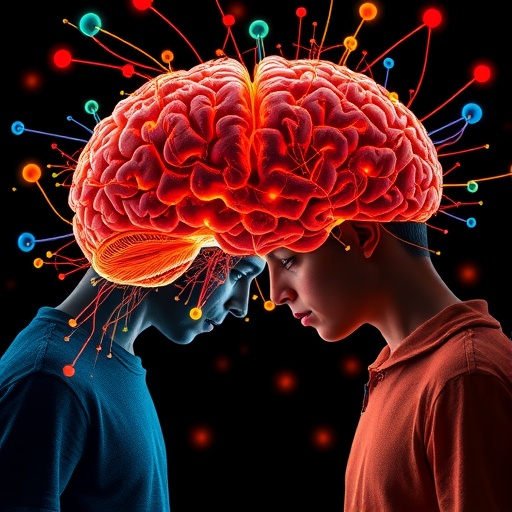
Loneliness is often described as an absence of social contact, but a new study suggests that the brain may reveal something more precise: how two people begin to coordinate with one another as a relationship develops. When older and younger adults created drawings together, their brain activity became more synchronized than when they worked separately. Yet the pattern was not simply “more synchrony equals better connection.” Instead, interpersonal neural synchrony changed according to the social context, the brain region involved, and whether participants were forming a bond with someone from the same or a different generation. The findings, published in PLOS Biology, offer a detailed look at how social relationships may emerge in the brain—and why the neural signature of connection is more complex than a single measure of similarity.
The study was led by Ryssa Moffat of ETH Zurich, Switzerland, with Guillaume Dumas and Emily S. Cross among the co-authors. The researchers recruited 31 pairs consisting of an adult over 70 and a younger adult between 18 and 35. For comparison, they also studied 30 pairs of younger adults from the same generation. Each pair participated in six sessions built around a creative drawing program. At different points, participants drew individually or collaborated on a shared image without speaking. This silent format reduced the influence of conversation and verbal explanation, allowing the researchers to examine how people coordinated through visual attention, movement, timing, and the emerging artwork itself. Across the sessions, participants also reported how lonely they felt, how socially close they felt to their partner, and how they viewed the other person.
To observe the brain while people interacted, the team used functional near-infrared spectroscopy, or fNIRS. This non-invasive technique uses light projected through the scalp to estimate changes in oxygenated and deoxygenated blood in the outer layers of the brain. Because neural activity increases local blood flow, fNIRS provides an indirect measure of cortical activity while participants are sitting, moving, and engaging in relatively natural social tasks. The researchers used a hyperscanning approach, recording both members of each pair at the same time. They then compared fluctuations in their brain signals to calculate interpersonal neural synchrony, a measure of how closely activity patterns changed together over time. Video-based motion capture simultaneously tracked body movements, enabling the investigators to monitor the physical coordination that accompanied the creative task.
The strongest general effect appeared when pairs drew together. Brain activity was more synchronized during collaboration than when the participants drew alone, suggesting that a shared task can align aspects of two people’s neural dynamics even without spoken communication. This alignment may reflect several processes at once: attending to the same visual material, anticipating a partner’s movements, adjusting one’s own actions, and responding to the evolving drawing. Neural synchrony does not mean that the two brains become identical, nor does it prove that one person’s brain directly causes a change in the other’s. Rather, it indicates that measurable activity patterns vary in a coordinated way. The result supports the idea that social interaction is not merely something the brain processes internally; it can also create measurable coupling between people as they jointly navigate an activity.
The researchers found especially important associations in the right inferior frontal cortex and the right temporoparietal junction. These regions are involved in functions relevant to social interaction, including interpreting another person’s actions, shifting attention, integrating sensory information, and reasoning about mental states. Among intergenerational pairs, synchrony in the right inferior frontal cortex and right temporoparietal junction while participants drew alone was associated with loneliness. In contrast, synchrony in the right inferior frontal cortex while intergenerational pairs drew together was associated with feelings of social closeness. The same region also showed a relationship with social closeness among same-generation pairs while they drew alone. These findings suggest that identical or similar neural patterns cannot be interpreted without considering what participants are doing and how they experience the relationship.
The longitudinal results added another layer of complexity. Over the six sessions, neural synchrony increased among same-generation pairs, while it decreased among intergenerational pairs. This may indicate that people who share a similar stage of life gradually develop increasingly aligned ways of attending and responding, whereas older and younger partners may initially coordinate strongly but later settle into a different form of interaction. The researchers emphasize that a decline in synchrony between intergenerational partners should not automatically be interpreted as a decline in connection. As people become more familiar with one another, they may rely less on moment-to-moment alignment or may develop complementary rather than matching strategies. In other words, a relationship can become more comfortable while the measurable synchrony associated with a particular task becomes weaker.
That distinction challenges the popular idea that greater brain-to-brain synchrony is always a sign of stronger social bonding. Interpersonal neural synchrony is influenced by attention, shared sensory input, movement, task demands, expectations, and emotional state. Two people can show similar brain fluctuations because they are watching the same event, moving at the same pace, or responding to a common stimulus, even if they do not feel close. Conversely, people who feel connected may coordinate through complementary roles rather than identical responses. The new study therefore supports a more cautious interpretation: neural coupling is dynamic and context-sensitive. Its meaning depends on who is interacting, what they are doing, which brain systems are involved, and how the participants understand the relationship.
The creative design of the experiment was also central to its social impact. Drawing together provided a structured but open-ended way for participants to cooperate, making it possible to observe interaction without forcing them into a conventional conversation. The researchers later invited participants to an event where the artwork was displayed and preliminary results were shared. According to Moffat, watching participants search for their own drawings and reconnect with their partners highlighted the personal significance behind the data. Such activities could eventually inform programs designed to create meaningful contact between generations, although the study does not establish that collaborative drawing reduces loneliness or that increased synchrony causes wellbeing. It shows instead that carefully designed social experiences can reveal measurable changes in coordination and subjective connection.
The study has important limitations. It included a relatively small number of participants and followed them for only six drawing sessions. The comparison group consisted of younger same-generation pairs, but the researchers could not include a corresponding group of older same-generation pairs. That makes it difficult to determine whether some effects reflect age differences specifically or broader differences in familiarity, life experience, or social expectations. fNIRS also primarily measures activity in cortical areas near the surface of the brain and cannot provide the same whole-brain coverage as some other imaging methods. Future research could track relationships for longer periods, include larger and more diverse samples, compare different kinds of collaborative tasks, and test whether changes in neural synchrony predict later social behavior. For now, the findings offer a vivid scientific message: when people create something together, their brains can briefly move in concert, but the meaning of that coordination depends on the relationship being built.
Subject of Research: People
Article Title: Social interactions between people of same and different generations shape longitudinal changes in interpersonal neural synchrony, loneliness, and social connection
News Publication Date: August 20, 2026
Web References: https://plos.io/4aQcW5S; https://osf.io/hz6tm/overview; https://doi.org/10.1371/journal.pbio.3003899
References: Moffat R, Dumas G, Cross ES (2026). “Social interactions between people of same and different generations shape longitudinal changes in interpersonal neural synchrony, loneliness, and social connection.” PLOS Biology 24(8): e3003899. DOI: 10.1371/journal.pbio.3003899
Image Credits: Ryssa Moffat, CC BY 4.0
Keywords: interpersonal neural synchrony, brain synchrony, hyperscanning, fNIRS, loneliness, social connection, intergenerational relationships, collaborative drawing, aging, social neuroscience
Tags: age-related differences in brain synchronizationbrain activity during collaborative creativitybrain region involvement in social interactioncollaborative drawing and brain synchronizationcross-generational social bondingdevelopment of social relationships in the brainimpact of social context on brain activityinterpersonal neural synchronyneural basis of loneliness and social engagementneural mechanisms of social connectionneural signatures of social bondingstudying social cognition across generations