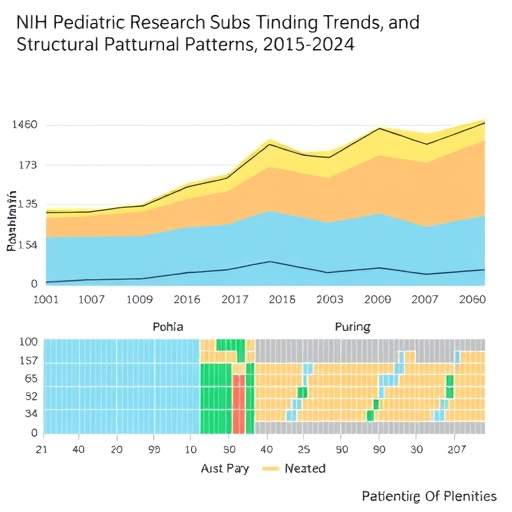
A new analysis of a decade of National Institutes of Health pediatric research funding is offering a detailed look at how the United States has supported science focused on children—and where the structure of that support may be leaving important questions unanswered. Published in Pediatric Research, the study by Christopher B. Forrest, Laura J. Koenigsberg, David C. Schwebel and colleagues examines recent trends in NIH investment from 2015 through 2024, a period marked by major changes in biomedical science, public health priorities and the organization of research itself.
The study arrives at a moment when pediatric medicine is under unusual pressure. Children experienced the continuing effects of the COVID-19 pandemic, growing rates of chronic disease, mental-health challenges, climate-related threats and widening health inequalities. At the same time, many illnesses that begin in childhood remain understudied compared with conditions affecting adults. Pediatric research also faces technical and ethical obstacles: children are not simply “small adults,” clinical trials often require age-specific designs, and researchers must account for rapid changes in growth, development, metabolism and social environment.
By examining NIH funding across ten years, the researchers aim to move beyond isolated success stories or individual grant announcements. Their approach focuses on the broader architecture of pediatric science: which research areas receive support, how funding patterns change over time, and whether the distribution of grants reflects the full range of health problems affecting children. This kind of structural analysis can reveal trends that are difficult to see from a single year’s budget. It can also show whether national research priorities are stable, shifting rapidly or concentrated in a relatively small number of fields and institutions.
NIH funding is not a single pool of money directed uniformly toward every disease. It is distributed through institutes and centers with distinct missions, grant mechanisms and scientific priorities. Support may flow through investigator-initiated awards, large cooperative projects, training programs, infrastructure grants and targeted initiatives. For pediatric science, this creates a complex funding environment in which a project can be highly relevant to children but still compete within a broader program designed around adult disease, basic biology or a particular technology. The authors’ analysis of structural patterns is therefore important because it treats funding as a network rather than merely a total dollar figure.
A central technical challenge in studying research investment is deciding what counts as pediatric research. Some projects are explicitly focused on children, while others study biological processes that affect people across the lifespan. A study of immune development, for example, may have direct implications for newborns and adolescents even if the grant is not labeled as pediatric. Conversely, a project involving young participants may not address a condition unique to childhood. Analyses must therefore classify grants using scientific topics, population characteristics, funding categories and institutional affiliations. The way these categories are defined can strongly influence the apparent size and direction of pediatric research.
The 2015–2024 period also includes a dramatic expansion of biomedical attention to infectious disease, vaccine science, immune responses and health disparities. Research priorities were reshaped by the emergence of SARS-CoV-2, the disruption of routine medical care and the unequal burden of illness across communities. Pediatric investigators contributed to studies of multisystem inflammatory syndromes, vaccine safety, long-term effects of infection and the indirect consequences of school closures and social isolation. Yet the pandemic may also have redirected resources away from other childhood conditions. A decade-long analysis can help distinguish temporary shifts caused by an emergency from longer-term changes in the research system.
The importance of such distinctions extends beyond academic bookkeeping. Funding patterns influence which scientific questions are asked, which technologies are developed and which treatments eventually reach patients. When a field receives sustained support, laboratories can recruit specialized researchers, build databases, enroll participants and develop measurement tools that make future discoveries easier. When funding is fragmented or unpredictable, promising programs may struggle to maintain cohorts or retain expertise. Pediatric studies can be especially vulnerable because recruiting participants often requires collaboration among hospitals, schools, families and community organizations, while follow-up may need to continue for years.
Structural concentration is another issue raised by this type of analysis. If a large share of pediatric funding is held by a limited number of institutions, those centers may gain valuable expertise and infrastructure, but the overall system may become less geographically diverse. Communities with different racial, ethnic, socioeconomic or environmental profiles may be underrepresented in research if studies are concentrated in major academic medical centers. Broader participation is not only a matter of fairness; it improves the scientific quality of pediatric evidence by testing whether findings apply across different populations and settings.
The study’s findings can also inform how researchers and policymakers interpret apparent growth in pediatric investment. An increase in the number of awards does not necessarily mean that children are receiving more support in practical terms. Inflation, rising trial costs, larger multidisciplinary projects and expensive data systems can reduce the purchasing power of nominal increases. Similarly, a surge in publications may reflect improved data sharing or large consortium studies rather than a broad expansion of research capacity. Looking simultaneously at funding levels, scientific areas, grant structures and institutional relationships provides a more technically meaningful picture of progress.
For families, the consequences of these patterns are ultimately measured in unanswered questions. Which children are most likely to develop persistent symptoms after infection? How can clinicians identify developmental or mental-health problems earlier? Why do some treatments work differently at different ages? How can researchers design trials that include infants, adolescents and children with complex medical needs without exposing participants to unnecessary risk? A funding system that recognizes these questions as interconnected may accelerate advances across pediatric medicine. The new analysis provides a framework for judging whether national investment is aligned with that goal and for identifying areas where future support may be most urgently needed.
As pediatric medicine enters an era shaped by genomics, artificial intelligence, advanced imaging and real-world health data, the organization of research funding may become as consequential as the technologies themselves. These tools can generate enormous quantities of information, but they do not automatically ensure that the right populations are studied or that discoveries become usable treatments. The decade reviewed by Forrest and colleagues offers a baseline for evaluating the next one. By making the hidden structure of pediatric research investment more visible, the study turns funding data into a scientific signal—one that can help reveal which parts of childhood health are advancing, which remain neglected and how the research ecosystem could be redesigned to serve children more effectively.
Subject of Research: NIH pediatric research funding trends and structural patterns from 2015 to 2024.
Article Title: Recent trends and structural patterns in NIH pediatric research funding, 2015–2024
Article References: Forrest, C.B., Koenigsberg, L.J., Schwebel, D.C. et al. Recent trends and structural patterns in NIH pediatric research funding, 2015–2024. Pediatric Research (2026). https://doi.org/10.1038/s41390-026-05379-5
Image Credits: AI Generated
DOI: 10.1038/s41390-026-05379-5
Keywords: pediatric research, NIH funding, childhood health, biomedical research, research policy, health disparities, clinical research, public health, scientific funding trends
Tags: challenges in pediatric clinical trialsethical and technical obstacles in pediatric studiesfunding gaps in childhood disease studiesgrowth and development considerations in pediatric researchhealth disparities in pediatric researchimpact of COVID-19 on children’s health researchinfluence of public health priorities on pediatric researchNIH funding patterns 2015-2024NIH pediatric research funding trendspediatric biomedical research funding analysisstructural patterns in NIH pediatric grantsUS pediatric health research investment