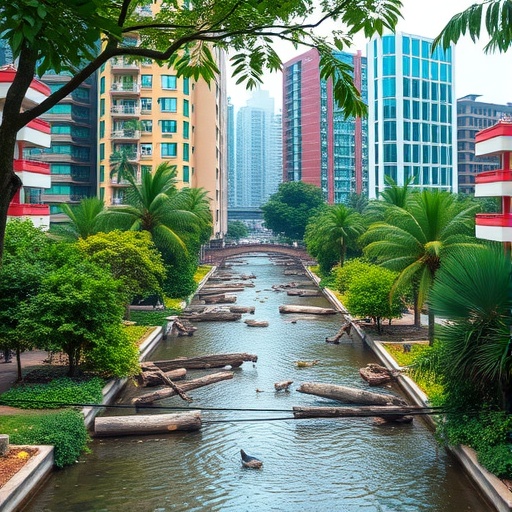
A new study from Brazil’s sprawling Metropolitan Region of São Paulo has revealed how dramatically urban expansion can reshape the living architecture of tropical streams. Rather than simply reducing the number of species, the growth of roads, buildings and other infrastructure appears to remove organisms according to their body size, selectively erasing crucial portions of the ecological spectrum. The result is a biological system dominated by small-bodied organisms, with far fewer predators, consumers and other large taxa capable of sustaining complex food webs. In the most degraded urban streams, the researchers found networks so simplified that only a handful of feeding connections remained, raising concerns about the loss of ecological functions on which cities ultimately depend.
São Paulo is one of the world’s largest urban regions, home to more than 22 million people, and its expansion has transformed vast areas of Atlantic rainforest and the streams that run through them. These waterways are not merely channels carrying rainwater away from the city. They host communities of insects, crustaceans, fish, amphibians, microorganisms and other organisms that transfer energy through the ecosystem and help process organic matter and nutrients. The research team, led by V. S. Saito, R. M. Pelinson and T. Leão-Pires, used comparative sampling surveys to examine how those communities differed between rainforest and urban environments. Their focus was not only on which species were present, but also on how large they were and how their feeding interactions were arranged.
Body size is a fundamental ecological trait because it influences what an organism eats, which predators can consume it, how much energy it requires and how far energy can move through a food web. A small aquatic insect larva, for example, may feed on algae or decaying leaves and then become food for a larger insect, fish or amphibian. A large predator can connect multiple parts of the community by consuming prey from different trophic levels. When organisms of particular sizes disappear, the damage can extend beyond the loss of individual species: entire pathways of energy transfer may vanish. The São Paulo study found that urbanization caused a strongly non-random decline in biodiversity, disproportionately removing very small, moderately large and large taxa.
This pattern produced what scientists describe as a truncation of the food-web size distribution. In rainforest streams, organisms occupied an extraordinarily broad range of body sizes. In urban streams, that range was compressed by four orders of magnitude, meaning the difference between the smallest and largest organisms was reduced by a factor of roughly 10,000. The remaining communities were heavily weighted toward small-bodied organisms. Such a shift matters because a stream filled mostly with small consumers may lack the larger predators and intermediate-sized species that normally regulate populations, recycle biological material and link multiple feeding levels. The loss is therefore structural as well as numerical: the stream retains some life, but its ecological organization becomes much simpler.
The researchers also documented a collapse in food-web complexity. In the least altered rainforest systems, networks contained more than 150 trophic links, representing documented feeding relationships among organisms. In the most urbanized streams, those networks contained as few as three links. A trophic link is more than a line on a diagram; it represents a route through which energy and carbon move from one organism to another. A leaf entering a stream, for instance, may be broken down by microbes and invertebrates before its stored energy passes to fish or other predators. The disappearance of links means that material has fewer biological destinations and that the ecosystem has fewer options for responding when conditions change.
The consequences were visible in the study’s estimate of energy flow. Compared with rainforest streams, urban systems experienced a 1,446-fold reduction in the movement of energy through their food webs. That number is striking because it captures more than a decline in species richness. It suggests that urbanization can reduce the intensity and reach of biological production, consumption and transfer across the entire community. A stream may still appear wet and may still contain organisms, but its capacity to support sustained ecological activity can be profoundly diminished. In practical terms, the loss of energy pathways could make urban streams less resilient to pollution, heat, drought, floods and additional disturbance.
The findings also challenge the idea that biodiversity loss is a uniform process in which species disappear at random. If all organisms were equally likely to vanish, the overall number of species might fall while the basic shape of the food web remained relatively intact. Instead, the São Paulo results indicate that urban infrastructure filters communities according to biological characteristics. Organisms at the smallest and largest ends of the size spectrum were especially vulnerable, while small-bodied survivors became increasingly dominant. This kind of trait-based filtering can create ecological “ghosts”: species may be absent, but so are the functions and interactions associated with their size, feeding behavior and position in the network.
The study’s implications extend beyond stream ecology. Rivers and streams help cycle nutrients, transform organic waste and support biological processes that contribute to clean water and other ecosystem services. When food webs lose connections, their ability to process carbon and nutrients may also be weakened. The researchers emphasize that the observed degradation is likely to have extensive consequences for urban societies because nutrient cycling underpins important river functions. The work does not suggest that every consequence was directly measured in the surveys, but it provides a mechanistic explanation for why simplified urban food webs may deliver fewer ecological benefits and become more vulnerable to further stress.
São Paulo’s streams offer a warning for other rapidly expanding cities, particularly in tropical regions where urban growth often overlaps with extraordinary biological diversity. Protecting isolated patches of forest may not be enough if the streams connecting those landscapes are transformed into heavily engineered or polluted channels. Conservation strategies will need to consider not only species counts, but also the body-size distribution of communities, the presence of large predators and the integrity of feeding interactions. Restoring riparian vegetation, reducing pollution and preserving stream connectivity could help retain the organisms and energy pathways that urban expansion currently erases. The study’s central message is both simple and unsettling: when cities grow without ecological safeguards, they may leave behind streams that still contain life, but no longer function as complete ecosystems.
Subject of Research: The effects of urban expansion on the body-size structure, biodiversity, food-web complexity, energy flow and ecosystem functioning of tropical stream communities in the Metropolitan Region of São Paulo, Brazil.
Article Title: Urban expansion and the collapse of tropical stream ecosystems
Article References: Saito, V.S., Pelinson, R.M., Leão-Pires, T. et al. “Urban expansion and the collapse of tropical stream ecosystems.” Nature Cities (2026). https://doi.org/10.1038/s44284-026-00495-z
Image Credits: AI Generated
DOI: https://doi.org/10.1038/s44284-026-00495-z
Keywords: urbanization, tropical streams, São Paulo, biodiversity loss, body-size structure, food webs, energy flow, ecosystem functioning, nutrient cycling, freshwater ecology
Tags: biodiversity decline in São Paulo metropolitan regionconsequences of urbanization on ecosystem functionsdisruption of food webs in urban stream habitatsecological simplification in urbanized waterwayseffects of city growth on aquatic biodiversityhabitat alteration in Atlantic rainforest streamsimpacts of infrastructure development on tropical freshwater systemsloss of large-bodied aquatic organisms in urban streamsselective species removal due to urban developmentthreats to ecological complexity in urban aquatic environmentsurban expansion impact on tropical stream ecosystemsurbanization and biodiversity loss in tropical freshwater