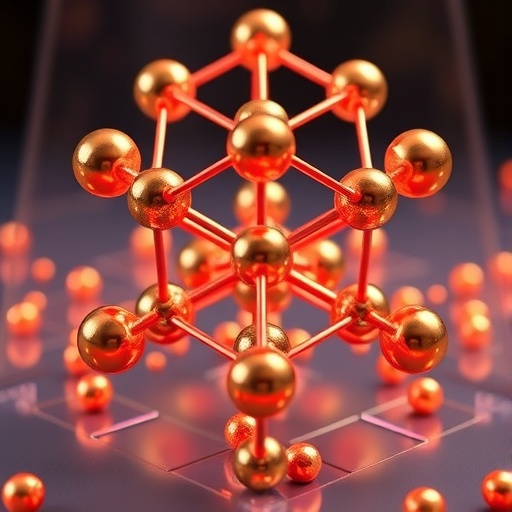
Atomic layers are rewriting the design rules of three-dimensional quantum matter. In a study of tantalum disulfide, or TaS₂, researchers have shown that the way layers are stacked—and the way individual atoms rearrange within those layers—can be used to create new electronic and superconducting states without altering the material’s chemical composition. The work, led by Associate Professor Liang Cao of the High Magnetic Field Laboratory of the Chinese Academy of Sciences, reveals that bulk layered crystals can behave like programmable architectures. By coordinating microscopic sliding between neighboring sheets with reconstruction inside the sheets themselves, the team produced ordered hetero-phase superlattices containing distinct structural phases. These results elevate stacking from a passive geometric detail to an active design variable, potentially opening a route toward “sliding electronics” in which quantum properties are controlled through atomic motion rather than chemical substitution.
The central material, TaS₂, belongs to the family of van der Waals crystals. Its atoms are strongly bonded within two-dimensional planes, while adjacent planes are held together comparatively weakly. This unusual bonding arrangement allows one layer to shift laterally with respect to another, much like a stack of cards. In conventional three-dimensional solids, such relative motion is generally difficult because atoms are locked into a rigid three-dimensional framework. In layered crystals, however, interlayer sliding can modify orbital overlap, charge transfer, and the effective dimensionality of electronic states. Even a displacement on the scale of a fraction of a nanometer can therefore alter how electrons move through the crystal. The research team set out to determine whether this structural flexibility could be harnessed deliberately in a macroscopic, three-dimensional material rather than only in isolated atomically thin flakes.
The researchers’ earlier experiments provided the first part of that answer. By creating periodic interlayer-sliding superlattices in single crystals of the 1T structural phase of TaS₂, they produced a material referred to as LC-TaS₂. Although the chemical formula and stoichiometry remained unchanged, the altered stacking sequence substantially modified the electronic ground state. The team showed that subtle changes in interlayer coupling could move the system between a three-dimensional band-insulating state and a two-dimensional Mott-insulating state. A band insulator is electrically inactive because filled electronic bands are separated from empty bands by an energy gap. A Mott insulator, by contrast, may be predicted to conduct by conventional band theory but becomes insulating because strong electron-electron repulsion prevents charge carriers from moving freely. The distinction demonstrated that stacking could control correlation-driven physics as powerfully as composition.
That conclusion was not easy to establish. The structural differences created by sliding are extremely small, and their signatures can be comparable to the uncertainty of ordinary measurements. The team relied on advanced spectroscopic techniques and atomic-resolution imaging to connect the arrangement of layers with the resulting electronic behavior. Such sensitivity was essential because the relevant structural information is effectively hidden from conventional crystallographic descriptions that average over many unit cells. Professor Hai Xu of Anhui University, one of the collaborators, emphasized that without sufficiently precise measurements, the electronic consequences of different stacking sequences could easily have been missed. The findings suggested that layered crystals might contain a much larger catalogue of accessible quantum states than their chemical formulas alone would indicate.
The new study pushes the concept further by showing that interlayer sliding does not act in isolation. Under suitable conditions, sliding between layers can cooperate with reconstruction of atoms within a layer, producing what the researchers describe as “two-tier sliding.” This coupled process can drive a layer-resolved transformation from the metastable 1T phase of TaS₂ into the stable 1H phase. The two structures have different atomic arrangements and electronic environments, even though both consist of the same elements in the same overall proportion. The 1T-to-1H conversion therefore represents a structural phase transition rather than a chemical reaction. What makes the observation especially striking is that the transformed regions do not appear as random defects or isolated patches. Instead, they organize into regular, nanoscale patterns that behave as self-adaptive hetero-phase superlattices.
These superlattices combine domains of different crystal phases within a single coherent material. Atomic-resolution aberration-corrected high-angle annular dark-field scanning transmission electron microscopy revealed ladder-like structures as well as more complex arrangements containing alternating 1H and 1T regions. In some cases, the interfaces include a 60-degree-rotated variant of the 1H structure, designated 1H’. The resulting sequences can be described as 1H/1T or 1H/1T/1H’ heterostructures, with atomically sharp boundaries between phases. Rather than being imposed through lithography or assembled from separate crystals, these architectures emerge through the material’s own structural response. Their formation indicates that the crystal can redistribute strain, charge, and local bonding to stabilize a repeating pattern, effectively building a superlattice from within.
Interphase charge transfer appears to play a key role in this self-organization. When two structural phases meet, their electronic bands and local chemical environments need not align. Electrons can therefore move across the interface until the combined system reaches a lower-energy configuration. This redistribution changes the electrostatic landscape and can help stabilize specific domain widths and interface geometries. In TaS₂, the coupling between phase boundaries and charge transfer creates a form of structural feedback: the arrangement of phases influences the electronic distribution, while the electronic distribution helps determine which arrangement is energetically favorable. Such feedback is central to many emergent phenomena in quantum materials, but here it is expressed through a controllable combination of layer sliding and atomic reconstruction.
The electronic consequences are particularly important because the engineered interfaces exhibit different superconducting transition temperatures. Superconductivity occurs when electrons form correlated pairs that can move without electrical resistance below a characteristic temperature. The transition temperature depends sensitively on the electronic structure, lattice vibrations, dimensionality, and interactions between carriers. By creating neighboring phases with distinct local environments, the TaS₂ superlattices provide multiple superconducting settings within one crystal. The research therefore demonstrates that structural reorganization alone can generate differentiated quantum states, without relying on dopants, external chemical pressure, or changes in stoichiometry. This result could prove valuable for designing materials in which superconducting regions, insulating regions, and conducting interfaces are positioned through atomic-scale architecture rather than conventional chemical synthesis.
The broader significance extends beyond TaS₂. In recent years, twisted and slid two-dimensional materials have shown that small changes in relative orientation or displacement can produce dramatic effects such as flat electronic bands, correlated insulating phases, and superconductivity. The new work suggests that related principles can operate in bulk layered crystals, which are generally more robust, scalable, and stable in practical environments than isolated monolayers. A three-dimensional crystal with programmable stacking could combine the mechanical resilience of a bulk material with the electronic tunability associated with two-dimensional systems. It may also allow researchers to investigate how quantum states evolve across interfaces, how charge moves between phases, and how collective behavior changes when superlattice periodicity is varied.
Together, the studies establish stacking sequence as a fundamental materials-design parameter alongside chemical composition and stoichiometry. The ability to coordinate interlayer motion with intralayer reconstruction creates a pathway for building adaptive quantum architectures directly inside a crystal. Although considerable work remains before such structures can be incorporated into devices, the concept points toward a new generation of electronics based on controlled sliding, phase conversion, and interface engineering. Instead of treating atomic rearrangements as unwanted instability, scientists may be able to use them as functional operations—turning layers, interfaces, and phase boundaries into active components. TaS₂ has thus become a model for a broader idea: in layered quantum matter, changing where atoms sit may be nearly as powerful as changing what the material is made of.
Subject of Research: Atomic stacking, interlayer sliding, intralayer reconstruction, hetero-phase superlattices, and superconducting states in TaS₂.
Web References: https://doi.org/10.1093/nsr/nwag246
References: National Science Review, DOI: 10.1093/nsr/nwag246
Image Credits: Ding et al., National Science Review, CC BY 4.0.
Keywords
TaS₂, van der Waals materials, interlayer sliding, stacking engineering, superlattices, superconductivity, Mott insulator, quantum materials, phase transformation, sliding electronics
Tags: atomic layer engineering for quantum device innovationatomic layer reconstructionatomic motion control of quantum stateshetero-phase superlatticesLayered atomic structuresprogrammable quantum architecturessliding electronics in layered materialsstacking order in quantum materialssuperconductivity in layered materialstantalum disulfide (TaS₂) propertiesthree-dimensional quantum materials designvan der Waals crystals