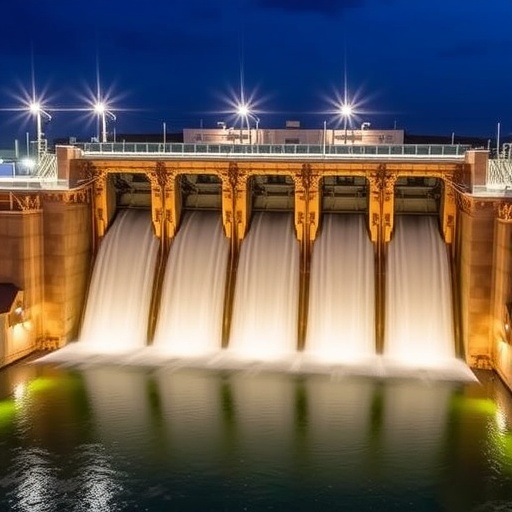
Cascade gate-pumping systems rarely attract public attention, yet they quietly perform one of the most energy-intensive jobs in modern water infrastructure: moving enormous volumes of water through linked reservoirs, channels and pumping stations. A new study by Xu, Wang and Wang, published in Scientific Reports, examines how the electrical demand of these systems can be classified and coordinated to support demand response. The research addresses a challenge emerging at the intersection of water management and renewable energy: pumps must operate reliably, but their electricity consumption can also be adjusted in response to grid conditions. By treating pumping infrastructure as an active participant in the power system rather than a passive consumer, the work points toward a new strategy for making both water networks and electricity grids more flexible.
The term “cascade” describes a sequence of connected pumping and control structures in which the operation of one section influences the hydraulic conditions of the next. Gate mechanisms regulate water levels and flows, while pumps consume electricity to maintain the movement of water through the system. This creates a tightly coupled physical and electrical network. A change in pumping at one station can affect water availability, pressure, storage levels and operating requirements elsewhere. At the same time, electricity prices, renewable generation and grid demand can change from hour to hour. The central problem is therefore not simply deciding when to switch a pump on or off. It is determining which parts of the system can respond, how quickly they can respond, and how those responses can be coordinated without compromising hydraulic safety or service reliability.
Xu and colleagues focus first on the classification of flexible loads. In energy systems, a flexible load is an electricity-consuming device or process whose timing, power level or operating pattern can be modified while still meeting its essential function. Pumps may possess several kinds of flexibility. Some can shift their operating schedules, allowing water transfer to occur earlier or later. Others can reduce or increase their power temporarily, within technical limits. Certain pumping units may be interrupted briefly, while others must continue operating because of water-level constraints or downstream demand. Distinguishing these categories is crucial because treating every pump as equally flexible could produce an optimization plan that looks attractive mathematically but is impossible or unsafe in practice.
The classification approach described by the study provides a way to connect engineering characteristics with demand-response potential. A pumping load can be assessed according to factors such as its controllability, response speed, operating duration, minimum and maximum power, recovery requirements and influence on the surrounding hydraulic network. These characteristics determine whether a unit is suitable for peak shaving, load shifting, renewable-energy absorption or short-term balancing. Peak shaving reduces electricity use during periods of high grid demand. Load shifting moves consumption to more favorable hours, while renewable-energy absorption increases pumping when surplus wind or solar power is available. Each service requires a different response profile, making a structured classification system essential for coordinated control.
The research then moves from identifying flexibility to using it through multi-objective collaborative optimization. “Multi-objective” means that the operating plan must balance several goals at once rather than maximize a single quantity. In a cascade gate-pumping system, those goals may include reducing electricity costs, lowering peak demand, improving the use of renewable power, maintaining appropriate water levels and preserving equipment performance. These objectives can conflict. Running pumps during the cheapest hours may create excessive water storage or violate hydraulic limits. Reducing peak electricity demand may require more frequent switching, potentially increasing mechanical stress. Maximizing renewable-energy consumption may be difficult when water-transfer requirements do not coincide with periods of solar or wind generation.
Collaborative optimization is intended to address those conflicts across multiple pumping stations and system layers. Instead of allowing each station to pursue its own local target, the method coordinates decisions throughout the cascade. This is technically important because a locally efficient action can create a problem downstream. For example, lowering the output of one pump may reduce immediate electricity demand but leave another station without the water volume or pressure it needs to operate efficiently. A coordinated model can consider these interactions simultaneously, linking electrical decisions to hydraulic states and operational constraints. The result is a planning framework in which individual pumps contribute to a system-wide response rather than acting as isolated devices.
The significance of the work extends beyond pumping schedules. Electricity grids are becoming more dependent on variable renewable sources, whose output changes with weather and time of day. Solar generation typically peaks around midday, while wind production can fluctuate over much shorter intervals. Flexible industrial loads can help absorb these variations, but only if their physical limitations are understood. Water infrastructure is especially promising because reservoirs, channels and storage tanks can provide a form of operational buffering. They do not store electricity directly, but they can create room to adjust when electricity is consumed. When conditions permit, pumps can operate during periods of abundant renewable generation; when the grid is strained, some consumption can be postponed or reduced.
At the same time, the study highlights why demand response in water systems cannot be reduced to a simple price signal. A lower electricity price does not automatically mean that every pump should run at full power. Hydraulic head, gate position, water-level targets, equipment limits and downstream requirements all shape what is possible. Pumps may also have minimum operating times, start-up restrictions or efficiency curves that make rapid switching undesirable. A technically credible optimization system must therefore include both electrical and hydraulic constraints. This integrated perspective is one of the study’s most important features: energy flexibility is treated as a property governed by the entire water network, not merely by the rated capacity of individual motors.
The framework could also support more sophisticated control rooms in which operators receive several feasible strategies rather than one rigid schedule. Depending on grid conditions, water demand and renewable availability, the system could prioritize cost reduction, peak-load control, equipment protection or renewable integration. Such flexibility could be valuable during extreme events, including heat waves, droughts or periods of unusual power-system stress. However, real-world deployment would require accurate monitoring, reliable communication and models capable of handling uncertainty. Forecast errors in rainfall, water demand, electricity prices and renewable generation could all affect the quality of an operating plan. Future systems may therefore combine optimization with real-time sensing, predictive analytics and automated feedback.
The study arrives as governments and utilities search for ways to connect traditionally separate infrastructures. Water and energy systems are often planned independently, even though pumping can represent a substantial share of operational electricity consumption. By classifying flexible loads and coordinating them through a multi-objective strategy, Xu, Wang and Wang offer a framework for treating cascade gate-pumping systems as controllable assets in the emerging smart grid. The concept is compelling because it does not require water infrastructure to abandon its primary mission. Instead, it seeks to align necessary pumping activity with the needs of the electricity system whenever physical conditions allow. If refined through field testing and real-time control, this approach could transform hidden water-network flexibility into a valuable tool for cheaper operation, smoother renewable integration and more resilient infrastructure.
Subject of Research: Classification of flexible loads in cascade gate-pumping systems and multi-objective collaborative optimization for demand response
Article Title: Classification of flexible loads in cascade gate-pumping systems and multi-objective collaborative optimization for demand response
Article References: Xu, K., Wang, C. & Wang, H. “Classification of flexible loads in cascade gate-pumping systems and multi-objective collaborative optimization for demand response.” Scientific Reports (2026). https://doi.org/10.1038/s41598-026-66518-w
Image Credits: AI Generated
DOI: 10.1038/s41598-026-66518-w
Keywords: Flexible loads, cascade gate-pumping systems, demand response, multi-objective optimization, collaborative optimization, smart grids, renewable energy integration, water-energy systems
Tags: cascade gate-pumping system optimizationclassification of water pump loadscoordinated water and power system controldemand response strategies for water infrastructureenergy management in water networksenergy-efficient water pumping operationsflexible water pumping loadsgrid-responsive water pumping systemshydraulic-electrical coupling in cascade systemsintegration of renewable energy with water systemssustainable water infrastructure managementWater infrastructure demand response