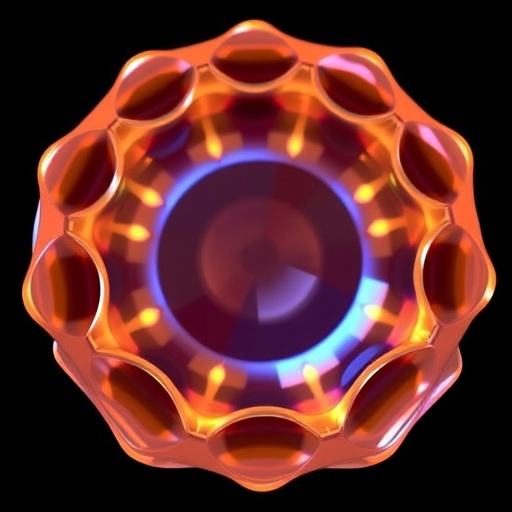
Researchers in Japan and Germany have created a self-healing hydrogel whose internal architecture is so precisely organized that it resembles a microscopic plumbing system. Built from a single synthetic peptide, the material forms helical nanofibers containing water-filled channels only a few atoms wide. Because the molecules inside each fiber point in the same direction, the hydrogel also develops an electrical polarization—giving it capabilities that could extend far beyond those of conventional soft biomaterials.
The team, from the RIKEN Center for Sustainable Resource Science, the RIKEN Pioneering Research Institute, and the University of Münster, designed the material around a peptide called FQ(Pyr). The molecule is assembled from the amino acids phenylalanine and glutamine, with a pyrene group attached to the side of the glutamine unit. Pyrene is a large, flat aromatic structure that encourages molecules to stack and interact through their aromatic surfaces. In this case, however, the researchers placed it along the peptide backbone rather than simply capping the molecule at its end.
That structural decision helped solve a long-standing problem in peptide-based hydrogels. Aromatic groups can make peptide gels stronger by promoting orderly stacking, but many of these materials still contain disorganized water and molecular networks. Peptides without aromatic groups can create more defined channels, yet they often form weak, disordered assemblies rather than robust gels. FQ(Pyr) combines both advantages: the pyrene groups stabilize the growing fibers, while the peptide arrangement creates continuous internal pathways for water.
The hydrogel forms through a carefully controlled self-assembly process. The synthetic peptide first dissolves in highly alkaline water, where the individual molecules remain separated. As the researchers gradually add acid, the pH falls and the molecules begin to associate. Near pH 4, they assemble into a translucent gel composed of a dense network of nanofibers. The resulting material is both strong and flexible, properties that are essential for biomaterials expected to withstand movement, deformation, or mechanical stress inside the body.
The material also demonstrated an unusual ability to repair itself. When violently shaken, the gel broke apart, but after approximately 24 hours it recovered its structure and returned to a gel with comparable quality. This behavior is possible because the network is held together by reversible molecular interactions rather than permanent chemical cross-links. Once the disruptive force is removed, the peptide molecules can gradually find their preferred positions again and reconstruct the organized nanofiber network.
The most remarkable details emerged through cryo-electron microscopy at a resolution of 1.7 angstroms. The images revealed uniform helical nanofibers, each containing five narrow channels filled with water. In cross-section, four structural units were arranged around a central channel. Each of those units contained 12 FQ(Pyr) molecules, together forming a tightly controlled molecular architecture. The central channel was approximately 15 angstroms in diameter—roughly 50,000 times narrower than the width of a human hair.
Water inside the channels was not randomly distributed. Instead, the molecules adopted a highly ordered arrangement, while the peptide units all oriented in the same direction along the nanofiber. This combination produced a persistent electrical polarization, effectively giving each fiber a molecular “direction.” The organized water pathways and aligned peptide dipoles could allow the material to influence the movement of ions and water, respond to external electric fields, or convert mechanical pressure into electrical signals.
That electrical behavior could make the hydrogel useful in applications where ordinary peptide gels are limited. Conventional hydrogels are already being investigated as scaffolds for tissue regeneration and as injectable systems for controlled drug release. The polarized FQ(Pyr) gel could add new functions, including electrically triggered drug delivery, pressure-sensitive biological sensors, and interfaces capable of communicating with cells. Researchers also suggest that such materials might eventually contribute to artificial muscles or other soft devices that respond to electrical stimulation.
The discovery is especially striking because it arises from a relatively small and simple molecule. Rather than relying on a complex polymer mixture or elaborate fabrication process, the researchers used molecular design to make the components organize themselves in water. The resulting structure combines mechanical strength, flexibility, self-healing behavior, nanoscale channels, and electrical polarization in one material. Although further studies will be needed to determine its stability, biological compatibility, and performance in living systems, the hydrogel offers a powerful example of how precise control at the molecular level can produce entirely new macroscopic properties.
Subject of Research: Self-healing, electrically polarized peptide hydrogel with ordered water channels and helical nanofibers
Web References: https://doi.org/10.1038/s41467-026-75984-9
References: Nature Communications, DOI: 10.1038/s41467-026-75984-9
Image Credits: RIKEN
Keywords
Self-healing hydrogel, peptide hydrogel, FQ(Pyr), nanofibers, cryo-electron microscopy, electrical polarization, biomaterials, tissue engineering, nanotechnology, drug delivery, biomedical engineering, ordered water channels
Tags: advanced hydrogel for regenerative medicineamino acid peptide hydrogelsbiomaterial electrical polarizationelectrically polarized biomaterialsmicroscopic plumbing system in hydrogelsnano-structured soft biomaterialspeptide-based hydrogelspyrene-modified peptidesSelf-healing hydrogelself-healing tissue scaffoldssustainable biomedical materialswater-filled nanofibers