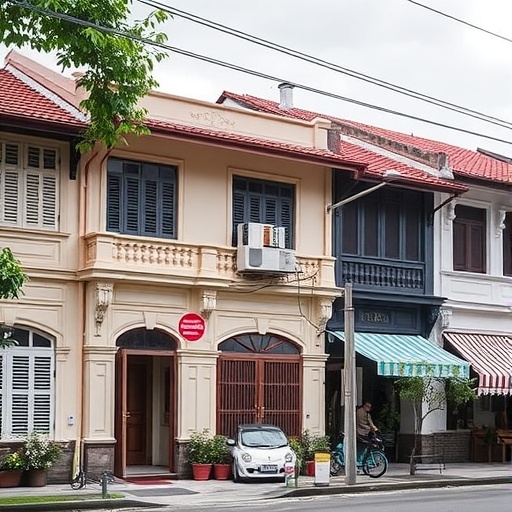
Singapore’s historic shophouses have long been read as fragments of the city’s past: rows of colourful façades, covered walkways and ornamental details shaped by trade, migration, climate and colonial-era urban growth. Now, researchers at the National University of Singapore (NUS) have used artificial intelligence and mathematical methods borrowed from evolutionary biology to reconstruct how these buildings may have developed as a connected architectural “family tree.” The study, published in Nature Communications, analyses 1,276 shophouses in Singapore’s Chinatown and reveals a far more complex history than a simple sequence of architectural styles replacing one another.
The research was led by Professor Heng Chye Kiang of the NUS Department of Architecture, within the College of Design and Engineering. Its central goal was to create a repeatable computational framework for studying vernacular architecture—buildings that evolve through local practice, available materials, environmental conditions and cultural exchange rather than through a single formal design plan. Traditional architectural histories often depend on expert observation and broad stylistic categories. While valuable, those methods can make it difficult to compare thousands of buildings systematically or detect subtle relationships among structures separated by time, location or cultural origin.
The NUS framework converts that interpretive challenge into a structured sequence of data collection, classification and analysis. Researchers first assembled georeferenced images of shophouse frontages from Google Street View and field photography. Architectural specialists then created a glossary of façade elements and selected the visual features most relevant to stylistic change. This expert-guided preparation was essential: the artificial intelligence system was not asked to decide independently what counted as meaningful architecture, but was trained to recognise features defined through architectural knowledge.
Using an AI-based object-detection model, the team identified 14 architectural elements across the photographed façades. These could include recurring components such as windows, doors, columns, decorative features and other elements that distinguish one frontage from another. Each building was translated into a structured profile showing whether particular elements were present or absent. In effect, the system converted an image into a visual data record. Shophouses sharing recurring combinations of features could then be grouped into façade types, allowing researchers to compare buildings at a scale that would be difficult to achieve through manual inspection alone.
The most striking step came after classification. The researchers applied mathematical techniques associated with phylogenetic analysis, a family of methods traditionally used to investigate relationships among biological species, languages and archaeological artefacts. In biology, shared traits can help reconstruct how populations diverged from common ancestors. In the Singapore study, shared façade features served as architectural traits. The resulting analysis did not claim that buildings reproduce biologically; instead, it used the logic of inherited, modified and exchanged characteristics to map possible relationships among shophouse forms.
The resulting network organised Singapore’s Chinatown shophouses into nine distinct clusters. Rather than producing only a chronological ladder—from older styles to newer ones—the network showed that several architectural tendencies existed at the same time. Some styles appear to have changed through cultural evolution, as designers and builders modified existing forms. Others show signs of diffusion, in which design features spread between locations or communities. This distinction is important because it suggests that Singapore’s built environment was shaped not only by gradual transformation, but also by contact, imitation, competition and the movement of ideas across cultural boundaries.
The findings challenge the expectation that architectural history should be represented as a single, orderly progression. Shophouse design developed within a multi-ethnic trading city where different communities interacted while maintaining distinct traditions. According to the researchers, the network indicates that architectural forms associated with different ethnic groups could coexist, producing parallel lines of development rather than blending into one uniform style. A façade element may therefore reflect more than decoration: it can provide evidence of social connection, cultural exchange or adaptation to local circumstances.
“By recasting an architectural question as a mathematical one, we uncovered deeper synchronic threads of development that were previously invisible,” said Professor Heng. The approach, he explained, can reveal “the underlying forces of cultural competition and evolution” while providing a more precise description of architectural form. The study’s first author, Dr Xue Xuan, formerly a research fellow in the NUS Department of Architecture and now a professor at Suzhou University of Science and Technology, stressed that the technology is intended to support—not replace—architectural expertise. In the framework, expert judgement determines the research questions and meaningful features, while computational analysis helps expose patterns that human observers may overlook.
The researchers say the method could influence how historic buildings are documented and conserved. Conservation decisions often require authorities to determine which structures, features or groups of buildings best represent a city’s architectural heritage. A quantitative genealogy could provide an additional evidence base by showing how individual façades relate to broader patterns of variation and change. It may also help identify buildings that appear visually unusual but occupy an important position within the network. More broadly, the study demonstrates how computer vision can be combined with cultural and historical interpretation to investigate large collections of buildings without reducing them to purely numerical objects.
The Singapore case study also points to wider applications beyond Chinatown. The same framework could potentially be adapted to other forms of vernacular architecture, provided researchers have suitable imagery, a carefully defined architectural vocabulary and historical knowledge of the region under study. Its significance lies not simply in using AI to recognise building features, but in connecting visual recognition to a defensible account of how styles emerge, spread and diverge. By turning thousands of façades into evidence of cultural history, the research offers a new way to see familiar streets—and a powerful computational lens for deciding how their stories should be preserved.
Subject of Research: Vernacular architecture and computational architectural analysis
Article Title: Reconstructing building genealogy with visual intelligence
News Publication Date: 16-Jun-2026
Web References: https://doi.org/10.1038/s41467-026-73376-7
References: Nature Communications, DOI: 10.1038/s41467-026-73376-7
Image Credits: College of Design and Engineering, NUS
Keywords
Architecture, vernacular architecture, Singapore shophouses, artificial intelligence, computer vision, phylogenetic analysis, architectural conservation, cultural evolution, urban heritage, machine perception
Tags: AI reconstruction of vernacular architecturearchitectural family tree modelingcomputational analysis of historic buildingsdata-driven analysis of colonial-era shophousesdigital reconstruction of Singapore’s architectural DNAevolutionary biology methods in architectureheritage preservation through AIhistoric shophouse facade analysismathematical approaches to architectural evolutionSingapore shophouses architectural historystudying cultural exchange in architectureurban development of Singapore Chinatown