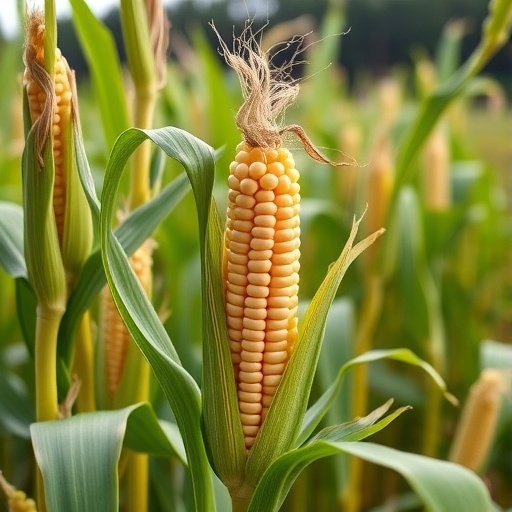
Engineers at the University of California San Diego have evolved a strain of the bacterium Pseudomonas putida that can consume three major sugars found in corn stalks—glucose, xylose and arabinose—at the same time. The achievement could help address one of the central challenges in sustainable biomanufacturing: developing microbes that can efficiently process complex, inexpensive raw materials instead of relying on a single purified ingredient. The work, published in Nature Communications, offers a new strategy for turning agricultural waste and other mixed feedstocks into valuable chemicals and materials.
Corn stalks and similar plant residues contain lignocellulose, a tough structural material made largely from cellulose, hemicellulose and lignin. When this biomass is broken down, it releases a mixture of sugars rather than one uniform carbon source. Although glucose is readily metabolized by many microorganisms, xylose and arabinose are often consumed more slowly or only after glucose has been depleted. This sequential behavior can create long delays in fermentation and reduce the efficiency of industrial bioprocesses. The UC San Diego team sought to overcome that limitation by using evolution to produce a bacterial strain capable of rapidly consuming all three sugars simultaneously.
The project was led by Adam Feist, a bioengineering professor at UC San Diego and director of the university’s Future Biomanufacturing Center. His team began with a previously engineered strain of Pseudomonas putida that could already use glucose, xylose and arabinose. However, the starting organism had not been optimized for the speed and reliability required in biomanufacturing. Rather than attempting to redesign every metabolic pathway manually, the researchers subjected the bacteria to repeated rounds of controlled growth under conditions that favored cells able to use the complete sugar mixture.
To conduct the long-running experiments, the researchers used the automated ALEbot, or Adaptive Laboratory Evolution robot, developed by Feist’s group. The platform can maintain cultures, transfer cells, monitor growth and repeat experimental cycles with limited human intervention. By operating multiple evolution experiments in parallel around the clock for months, the system allowed the team to explore how P. putida populations changed under sustained selection pressure. This approach is particularly useful for microbial engineering because beneficial mutations can emerge through natural genetic variation and become enriched when they provide a growth advantage.
A key feature of the experiment was the selection environment. The bacteria were not simply rewarded for consuming one preferred sugar faster than the others. Instead, the researchers designed conditions in which successful competitors needed to consume all three sugars in the mixture. Cells that specialized in glucose, xylose or arabinose alone were less competitive than variants that could coordinate the use of every available carbon source. This distinction shaped the outcome of evolution, producing what the researchers describe as versatile “generalist” strains rather than narrow specialists.
The resulting bacteria showed improved simultaneous utilization of the lignocellulosic sugars and were better suited to the demands of a mixed-feedstock fermentation process. At the biochemical level, this kind of improvement requires coordinated changes in sugar transport, regulatory circuits and central carbon metabolism. The cells must import chemically different sugars, activate the appropriate catabolic pathways and distribute carbon through metabolic networks without allowing one pathway to suppress the others. Evolution under complex selection pressure enabled the researchers to improve this integrated behavior rather than optimizing each sugar pathway in isolation.
The team also programmed the evolved strain to produce indigoidine, a blue pigment with potential applications in textile dyeing. Indigoidine is a useful demonstration product because its formation tests whether the bacterium can direct carbon from multiple sugars toward a desirable molecule rather than using the sugars only for growth. In a future industrial process, similar microbial platforms could be adapted to make fuels, organic acids, specialty chemicals, pigments or other compounds from agricultural residues. The ability to use a variable mixture of sugars could reduce the need for costly feedstock purification before fermentation.
The implications extend beyond corn stalks. Many proposed biomanufacturing systems depend on feedstocks that are chemically inconsistent, including crop waste, forestry residues and mixed plastic streams. Such materials can contain several usable compounds in changing proportions, making them difficult to process with microbes designed for a single, highly purified substrate. Generalist organisms that remain productive across changing mixtures could make biological manufacturing more resilient and economically practical. The study therefore presents adaptive laboratory evolution not only as a way to improve one bacterial strain, but also as a framework for building microbes capable of handling the messy chemistry of real-world waste.
The research brought together scientists from UC San Diego, the Joint BioEnergy Institute and Inha University in South Korea, along with collaborators from three U.S. national laboratories. Their results demonstrate how automated experimentation and evolutionary selection can complement conventional metabolic engineering. Instead of predicting every useful genetic modification in advance, researchers can construct a starting strain, define the desired competitive behavior and allow populations to explore solutions under carefully chosen conditions. As biomanufacturing moves toward lower-cost and less uniform raw materials, that combination of automation, microbial evolution and systems-level metabolic analysis could help transform agricultural waste and other complex mixtures into reliable sources of industrial products.
Subject of Research: Cells
Article Title: Simultaneous optimization of lignocellulosic sugar catabolism via systematic laboratory evolution under complex selection pressure
News Publication Date: 29-Jul-2026
Web References: Nature Communications article; Adam Feist Lab; Future Biomanufacturing Center at UC San Diego
References: Nature Communications, DOI: 10.1038/s41467-026-75974-x
Image Credits: University of California San Diego
Keywords
Pseudomonas putida, bioengineering, adaptive laboratory evolution, ALEbot, lignocellulosic sugars, glucose, xylose, arabinose, agricultural waste, biomanufacturing, metabolic engineering, biofuels, indigoidine, sustainable biotechnology
Tags: advanced microbial strain developmentagricultural residue bioconversionbioengineering for complex feedstocksconverting corn stalks into valuable chemicalsgenetically engineered Pseudomonas putidalignocellulosic biomass conversionmicrobial biomanufacturingmicrobial evolution for bioprocessingmulti-sugar fermentation efficiencysimultaneous sugar consumption in bacteriasustainable agricultural waste utilizationsustainable biomanufacturing innovations