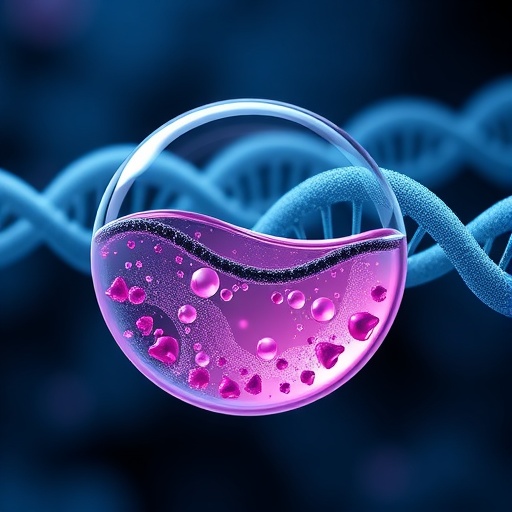
A subtle chemical switch on histone proteins may determine whether DNA gathers into liquid-like droplets inside the cell, according to a new study from researchers at the National Institute of Advanced Industrial Science and Technology (AIST), the Institute of Science Tokyo, and Ritsumeikan University. The team found that the biological consequences of histone acetylation depend not only on whether the modification is present, but also on its precise location along the histone molecule. Their findings reveal a previously underappreciated connection between epigenetic regulation and liquid–liquid phase separation, a process increasingly recognized as central to the organization of genetic activity.
DNA is not stored in cells as a loose, extended molecule. It is wrapped around histone proteins to form nucleosomes, the fundamental units of chromatin. This packaging allows enormous DNA molecules to fit inside the nucleus, but it also controls how accessible genes are to the molecular machinery responsible for transcription. Chemical modifications added to histones can alter the physical and electrostatic properties of chromatin, influencing whether particular genomic regions become more open or more compact. Histone acetylation is one of the best-known modifications because it often correlates with active gene expression, but its effects are more complex than a simple on-or-off signal.
Liquid–liquid phase separation offers a physical explanation for how groups of biomolecules can organize themselves without being enclosed by a membrane. Similar to the separation of oil and water, proteins, nucleic acids, and other molecular components can spontaneously concentrate into dense, droplet-like condensates while remaining distinct from the surrounding solution. Within cells, these condensates can create temporary biochemical compartments, bringing selected molecules together and accelerating or regulating reactions. In the nucleus, phase-separated environments are thought to influence transcription, chromatin architecture, DNA repair, and other essential processes.
The AIST-led team focused on histone H3, one of the core histones around which DNA is wrapped. Histone H3 contains several lysine residues that can be acetylated, and these sites are not chemically interchangeable. Adding an acetyl group neutralizes the positive charge of a lysine side chain, weakening its electrostatic attraction to negatively charged DNA. However, the researchers’ results show that the position of the modified lysine relative to the ends, or termini, of histone H3 can strongly influence the behavior of histone–DNA mixtures. This positional effect changes how the molecules interact and whether they form condensates.
Using experiments together with computational simulations, the researchers examined how acetylation at different sites affected the phase behavior of histone H3 and DNA. The experiments revealed that some acetylation patterns increased or reduced the propensity of the molecular mixture to form condensates, even when the modification involved the same type of chemical group. Simulations helped explain these observations by showing how the location of the acetylation site changes molecular contacts, charge distribution, and the flexibility of the histone–DNA assembly. In other words, the modification acts not only as a chemical mark, but also as a spatially positioned physical control element.
The findings challenge a simplified view of histone acetylation in which all acetylated sites are treated as equivalent indicators of gene activation. The same broad modification can produce different structural and phase-separation outcomes depending on where it occurs. Because condensate formation depends on many weak interactions acting collectively, even a localized change in charge or molecular geometry can shift the balance between a dispersed state and a condensed one. This may allow cells to fine-tune nuclear organization with remarkable precision, using combinations of histone modifications rather than isolated signals.
The work also offers a new way to think about the relationship between epigenetics and chromatin-based condensates. Histone modifications may influence gene regulation through at least two interconnected routes: by changing the accessibility of DNA and by altering the physical properties of the surrounding molecular environment. A modified histone could therefore affect transcription not only by loosening or tightening nucleosome structure, but also by changing the ability of chromatin-associated molecules to assemble into concentrated compartments. Such compartments could enrich transcription factors, enzymes, or regulatory RNAs near specific genomic regions.
This connection may be important in disease. Abnormal histone acetylation patterns have been associated with cancer and neurodegenerative disorders, including Alzheimer’s disease, while defects in phase separation have also been linked to pathological changes in cellular organization. If the position of an acetylation mark helps determine whether a condensate forms, then disease-associated changes in histone-modifying enzymes could have consequences that extend beyond gene accessibility. They might also reconfigure the physical landscape of the nucleus, disrupting the concentration and timing of molecular interactions required for normal gene expression.
The study, published online in the Journal of the American Chemical Society on May 7, 2026, provides a molecular framework for investigating how individual epigenetic marks control collective behavior in chromatin. The researchers say that understanding these mechanisms could eventually support the development of diagnostics or therapies aimed at correcting aberrant gene regulation. More broadly, the results highlight a central principle of cellular biology: molecular location can be as important as molecular identity. A single chemical modification, placed at a different position on the same protein, may help determine whether genetic material remains dispersed or condenses into a dynamic biochemical compartment.
Subject of Research: Cells
Article Title: Proximity of the Histone-Acetylation Site to the Termini Shapes Phase Behavior with DNA
News Publication Date: 7 May 2026
Web References: https://doi.org/10.1021/jacs.6c02267
References: Journal of the American Chemical Society, DOI: 10.1021/jacs.6c02267
Image Credits: National Institute of Advanced Industrial Science and Technology (AIST)
Keywords
Histone acetylation, histone H3, DNA, liquid–liquid phase separation, biomolecular condensates, epigenetics, chromatin, gene regulation, molecular simulations, cancer research, neurodegenerative disease
Tags: chemical switches on histones affecting gene expressionchromatin dynamics and phase separation in epigeneticsepigenetic modifications and gene activityhistone acetylation and chromatin organizationimpact of histone acetylation location on gene regulationinfluence of histone modifications on chromatin accessibilityliquid-liquid phase separation in gene regulationmolecular mechanisms of liquid droplet formation in nucleinuclear organization and genephase separation and DNA packaging in cellsrole of histone proteins in nuclear architecture