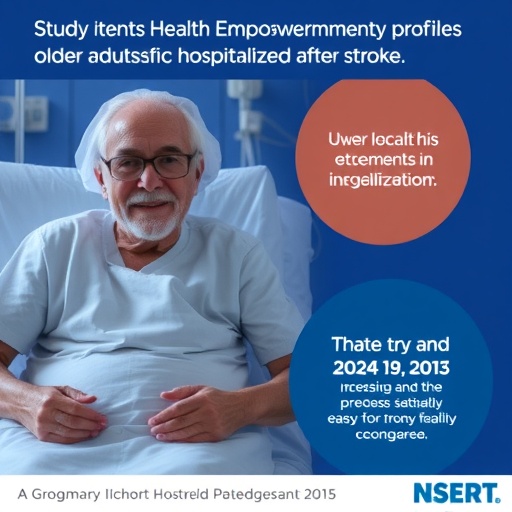
Stroke recovery may depend on more than the visible damage recorded on a brain scan. A new study in BMC Geriatrics examines how older adults hospitalised after stroke differ in their sense of “health empowerment”—the degree to which they feel capable of understanding their condition, making health decisions, managing treatment and taking an active role in recovery. By searching for hidden patterns among patients rather than treating all older stroke survivors as one uniform group, the researchers aim to bring a more personalised perspective to an increasingly urgent public-health challenge.
The study, led by Q. Xin, Y. Mao, Y. Lei and colleagues, uses a single-centre cross-sectional design to investigate latent profiles of health empowerment and the factors associated with them. Stroke is one of the leading causes of long-term disability worldwide, and its effects can extend far beyond weakness or impaired speech. Older patients may also face cognitive changes, depression, fatigue, communication difficulties and dependence on family members. These factors can influence whether a person feels able to participate in rehabilitation or follow a complex medical plan after leaving hospital.
Health empowerment is a particularly important concept in stroke care because recovery often continues for months or years. Patients may need to take several medications, monitor blood pressure, modify their diet, attend rehabilitation sessions and recognise warning signs of another stroke. Empowerment does not mean that patients must manage illness alone. Instead, it describes a partnership in which patients receive the information, confidence, skills and support needed to participate meaningfully in decisions about their health. In older adults, that partnership may also involve caregivers and clinical teams.
To identify patterns within the patient population, the researchers used a statistical approach known as latent profile analysis. Unlike a conventional comparison of averages, latent profile analysis attempts to uncover unobserved subgroups within a sample by examining how participants score across several measured characteristics. In practical terms, the method can reveal that some patients show consistently strong empowerment, while others may have a mixed pattern—for example, confidence in communicating with clinicians but difficulty managing treatment independently. The technique is exploratory: it estimates the probability that each participant belongs to a particular profile based on the observed data.
The researchers also examined factors associated with differences in empowerment. Such factors may include demographic characteristics, health status, functional limitations, psychological wellbeing, social support and the patient’s experience of care. Understanding these relationships is clinically significant because a low sense of empowerment may not be caused by a lack of motivation. It could reflect aphasia, memory problems, physical dependence, limited health literacy, inadequate family support or an environment in which decisions are made without sufficient patient involvement. Distinguishing these pathways is essential if hospitals are to design interventions that address the real barriers faced by patients.
The study’s focus on hospitalised older adults is timely. Population ageing is increasing the number of people living with stroke-related disability, while health systems are attempting to shorten hospital stays and shift more care into homes and communities. That transition can be difficult when patients and families are unprepared. A patient who understands a discharge plan but lacks confidence to act on it may need a different intervention from someone who is willing to participate but cannot access transportation, rehabilitation or caregiver assistance. Profile-based care could help clinicians identify those needs before discharge.
However, the study’s design also defines what its findings can and cannot show. Because the research is cross-sectional, information was collected at one point in time. This allows the investigators to identify associations between empowerment profiles and related characteristics, but it cannot establish that one factor causes another. For example, lower empowerment may be linked with poorer physical function, yet the study alone cannot determine whether physical limitations reduce empowerment, whether low empowerment limits rehabilitation participation, or whether both arise from a third factor. Longitudinal research would be needed to track how empowerment changes during recovery.
The single-centre setting is another important consideration. Patients treated in one hospital may differ from those in other regions, healthcare systems or cultural environments. Expectations about family involvement, communication with physicians and personal responsibility for health can vary substantially across communities. Even so, the research provides a useful framework for future studies and clinical practice. If patient groups with distinct empowerment needs can be reliably identified, stroke services could combine standard medical treatment with targeted education, caregiver training, psychological support, communication assistance and rehabilitation planning.
The broader message is that successful stroke care should measure more than survival, neurological impairment or length of hospital stay. It should also ask whether patients feel equipped to understand what has happened, participate in decisions and continue managing their health after discharge. By applying latent profile analysis to older adults recovering from stroke, Xin and colleagues highlight the possibility of moving from a one-size-fits-all model toward care that recognises different forms of vulnerability and strength. The study does not eliminate the complexity of stroke recovery, but it points toward a future in which empowerment becomes a measurable and actionable part of geriatric medicine.
Subject of Research: Health empowerment profiles and associated factors among older adults hospitalised with stroke
Article Title: Latent profiles of health empowerment and associated factors among older adults hospitalised with stroke: a single-centre cross-sectional study
Article References: Xin, Q., Mao, Y., Lei, Y. et al. “Latent profiles of health empowerment and associated factors among older adults hospitalised with stroke: a single-centre cross-sectional study.” BMC Geriatrics (2026). https://doi.org/10.1186/s12877-026-08040-2
Image Credits: AI Generated
DOI: 10.1186/s12877-026-08040-2
Keywords: stroke, older adults, health empowerment, latent profile analysis, hospitalisation, geriatric medicine, patient-centred care, rehabilitation, cross-sectional study
Tags: cognitive and emotional challenges after strokeelderly stroke patient supportfactors influencing health empowermenthealth decision-making in stroke recoveryhealth empowerment in older adultshospital-based stroke outcome profileslong-term disability managementpatient-centered stroke carepersonalized healthcare for stroke survivorspost-stroke rehabilitationstroke recoverystroke recovery motivation