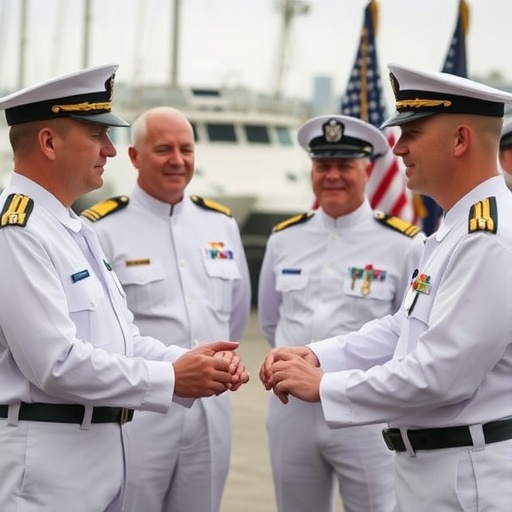
ARLINGTON, Va.—The Office of Naval Research (ONR) marked its 80th anniversary with a celebration at the Pentagon, highlighting how decades of scientific research have transformed naval warfare, protected service members and prepared the U.S. Navy and Marine Corps for increasingly complex technological challenges. The event, held July 31 in the Pentagon Auditorium, brought together senior military leaders, scientists, engineers and technology strategists to examine both ONR’s historical achievements and its plans for future naval power.
Acting Secretary of the Navy Hung Cao described ONR’s impact from the perspective of a former Navy diver and explosive ordnance disposal officer who served in Iraq, Afghanistan and Somalia. He emphasized that the organization’s work is not confined to laboratories or theoretical models. Technologies developed through naval research, he said, have directly affected the survival and effectiveness of Sailors and Marines operating in dangerous environments. From improved protective equipment to advanced sensors and autonomous systems, research funded or guided by ONR has helped convert scientific discoveries into tools used on the front lines.
“While many of ONR’s discoveries shaped the wider world, other less well-known breakthroughs transformed the daily lives of our Sailors and Marines on the front lines,” Cao said. His remarks reflected one of the central themes of the anniversary: basic research can take years to mature, but its eventual effects may appear across the entire military system. A material developed for extreme environments, for example, can improve body armor, vehicles or underwater equipment, while advances in signal processing can enhance radar, sonar and communications simultaneously.
Founded in 1946, ONR was created to ensure that the Navy could maintain a long-term scientific advantage after the technological breakthroughs of the Second World War. Its original research portfolio included fields such as physics, fluid mechanics, aviation and physiology. Over eight decades, those disciplines have expanded into cyber operations, robotics, artificial intelligence, directed energy, hypersonics, ocean science and human performance. The organization now connects academic institutions, government laboratories, private companies and military users in an effort to move promising ideas from experimental research toward operational capability.
Chief of Naval Research Dr. Rachel Riley used the anniversary to discuss ONR’s newly released 2026 Science and Technology Strategy for the Navy and Marine Corps. The strategy calls for a fundamental change in how naval research priorities are identified, developed and delivered to the fleet. Such a transformation is increasingly important as military technologies become interconnected. A new sensor, for instance, is most valuable when its data can be processed rapidly, shared securely and integrated with command systems, autonomous platforms and human decision-making.
Riley also introduced the CNR Fellows program, which will bring newly tenured academic professors to ONR for one-year appointments. The program is designed to give leading researchers a deeper understanding of naval requirements while allowing the organization to draw on current academic expertise. Fellows are expected to provide technical oversight and independent insight in fields where rapid developments may outpace traditional military planning. The arrangement could help narrow the gap between university research and the engineering demands of operating systems at sea, underwater, in the air and across contested communications networks.
During the event, author and strategist Dr. Peter W. Singer identified five technological lineages that illustrate ONR’s influence: unmanned systems and autonomy; sensor improvement and integration; positioning, navigation and timing, or PNT, combined with C5ISR and battlespace awareness; ocean science, acoustics and undersea warfare; and troop protection, materials and human performance. These areas represent interconnected scientific challenges. Autonomous vehicles require navigation systems and sensors, while undersea platforms depend on acoustics to detect objects in an environment where radio signals often cannot travel effectively. Human performance research, meanwhile, examines how fatigue, stress, heat, pressure and demanding equipment affect mission success.
Singer noted that ONR’s evolution is visible in the language used to describe its research. Fields that now occupy entire departments, including cyber operations, autonomy and directed energy, were not established military categories when ONR began. Directed-energy systems use concentrated electromagnetic energy, such as high-power lasers or radio-frequency beams, to affect targets or disable electronic equipment. Autonomy combines sensors, software and artificial intelligence so that unmanned platforms can interpret their surroundings and perform selected tasks with limited human control. These technologies require not only hardware but also new methods for testing reliability, managing risk and maintaining human oversight.
Vice Chief of Naval Operations Adm. James Kilby said ONR has long worked beyond immediate operational requirements, imagining capabilities that may not yet exist. That approach is particularly significant in areas such as hypersonics, where vehicles travel at speeds above Mach 5 and experience intense aerodynamic heating, or in undersea warfare, where ocean temperature, salinity and pressure can alter how sound propagates. Assistant Secretary of War for Science and Technology Dr. Joseph S. Jewell, a former university professor and recipient of ONR’s Young Investigator Program, credited the organization with sustaining academic research in hypersonics and other fields essential to national security.
More than 20 ONR technology displays were presented along the Pentagon’s Apex corridors during the celebration, offering visitors a view of how research is being translated into naval applications. The anniversary message was ultimately both retrospective and forward-looking: the scientific problems facing the Navy and Marine Corps are becoming more interconnected, while the consequences of technological delay are growing more serious. As ONR begins its ninth decade, its mission remains centered on turning advances in science and engineering into practical capabilities that can protect service members, strengthen maritime power and preserve an advantage in future conflicts.
Subject of Research: Naval science, defense technology and military research and development.
Web References: https://www.onr.navy.mil/media-center/news-releases/onr-announces-new-2026-science-and-technology-strategy-navy-marine-corps; https://www.onr.navy.mil/media-center/news-releases/chief-naval-research-announces-prestigious-new-fellowship-program
Image Credits: U.S. Navy photo by Michael Walls.
Keywords
Office of Naval Research, naval technology, military science, autonomous systems, robotics, artificial intelligence, hypersonics, undersea warfare, ocean acoustics, sensors, C5ISR, directed energy, human performance, Navy research, Marine Corps technology
Tags: autonomous systems in naval operationsdevelopment of protective equipment for Sailors and Marinesfuture naval power strategieshistory of naval research achievementsimpact of scientific research on naval warfaremilitary leadership and scientific collaborationnaval defense technology developmentNaval research innovationOffice of Naval Research anniversaryreal-world applications of naval sciencetechnological advancements in U.S. Navytransforming military technology through research