Credit: The Dartmouth Institute
Do wealthier people receive too much medical care? In a Perspective article recently published in the New England Journal of Medicine, H. Gilbert Welch, MD, and Elliott Fisher, MD, of The Dartmouth Institute for Health Policy and Clinical Practice examine the association between income level and cancer diagnosis.
Using data from the Surveillance, Epidemiology, and End Results (SEER) program, Welch and Fisher examined incidence and mortality trends for four types of cancers: breast cancer, prostate cancer, thyroid cancer and melanoma. They chose these specific cancers because the likelihood of diagnosis is sensitive to the intensity with which physicians look for these cancers–the combined effect of factors, including the frequency of screening and diagnostic exams, the ability of exams to detect small irregularities, and the threshold used to label results as abnormal. As Welch and Fisher note, these factors can have a dramatic effect on the apparent amount of disease. In simple terms, the harder doctors look for these cancers, the more they find.
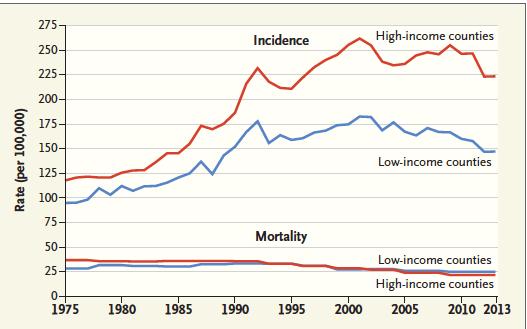
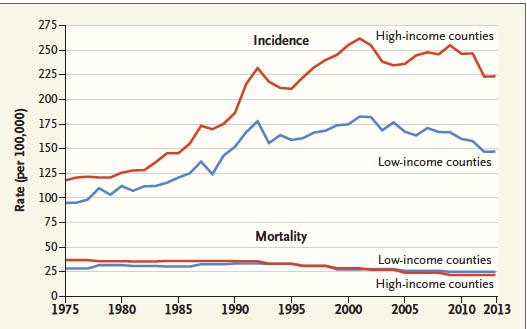
Using 2000 U.S. census data, Welch and Fisher compared incidence and mortality of the four cancers in high- vs. low-income counties (median incomes greater than $75,000 and less than $40,000, respectively). Among their findings:
- High-income counties have recorded a much greater increase in the incidence of these four cancers than low-income counties.
- The combined death rate from the four cancers is similar in high- and low-income counties, which Welch and Fisher say suggests that the underlying burden of disease is actually similar in high- and low-income counties.
- Mortality from these cancers hasn't been increasing (as one might expect given the increase in diagnosis), but rather decreasing-due largely to improved treatments for breast and prostate cancer.
What accounts for the higher incidence of cancer in high-income counties? Welch and Fisher say there could be several contributing factors: affluent people may expect and demand more testing. Also, health systems serving relatively wealthy and healthy populations may see offering more testing "as a good way to produce more patients and increase business."
"If we want to move toward more sustainable and affordable health care systems, we're going to have to understand what's driving the overutilization of care and develop better ways to address it," Fisher said.
Among the remedies Welch and Fisher suggest are moving toward alternative payment models, such as accountable care organizations, that move us away from the traditional fee-for-service model; reducing, or at least disclosing, financial conflicts of interest (such as doctors who receive payments from breast and prostate care centers); and promoting a more nuanced and balanced view of medical care.
"Doctors and other health care professionals tend to overstate the role of medical testing in promoting health–particularly in people who aren't sick," Welch said. "A healthy diet, regular exercise, and a sense of purpose are very often the best tools people, at every income level, have to maintain good health."
###
Media Contact
Paige Stein
[email protected]
603-653-0850
@DartmouthInst
http://www.tdi.dartmouth.edu
############
Story Source: Materials provided by Scienmag