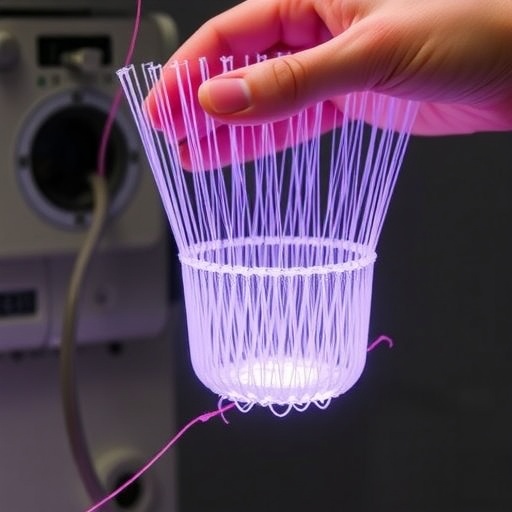
A team of researchers has unveiled a manufacturing route that turns electrospinning from a slow, laboratory technique into a high-throughput way to build nanofibrous yarns. Reported in Communications Engineering (2026), the work focuses on alternating-current (AC) electrospinning—an approach designed to stabilize fiber formation while enabling rapid production.
In conventional electrospinning, creating continuous, aligned structures often requires careful tuning and can be bottlenecked by inconsistent jet behavior. When the electric field is switched from direct current to alternating current, the process gains an additional degree of control: the field oscillations help manage charge accumulation and can reduce the likelihood of catastrophic jet disruptions.
The researchers describe a workflow aimed at producing yarn-like assemblies rather than loose mats. The key idea is to coordinate multiple steps—spinning, collecting, and consolidating fibers—so that individual nanofibers integrate into coherent strands. By engineering the AC waveform and the collection strategy, the system yields yarns with improved structural regularity compared with traditional electrospun webs.
High throughput is central to the study. Instead of relying on one-off, low-rate runs, the platform is configured for scalable operation, allowing many fibers to be produced and assembled in a shorter time window. The team emphasizes that the method can be tuned across operating conditions, which is important for adapting yarn properties to different formulations.
Because nanofibrous yarns combine the surface area of electrospun fibers with the handling practicality of yarns, the manufacturing advance could unlock new device architectures. From wearable sensing textiles to filtration media and biomedical scaffolds, the ability to fabricate continuous, fiber-based strands at scale is a step toward practical deployment.
Technically, the alternating-current strategy also supports broader material compatibility. Many polymer solutions that form stable jets under DC may behave differently under AC, so the authors highlight the need to match solution conductivity, viscosity, and applied field parameters. Achieving consistent spinning depends on controlling the electrohydrodynamic balance that governs jet stretching.
The results suggest that AC electrospinning can be engineered into a reproducible “production line” concept rather than a single demonstration. If further optimized, the technology could reduce cost and time for nanofiber manufacturing while improving uniformity—two requirements for moving from academic prototypes to commercial products.
For readers who love viral science news: this is the kind of breakthrough that makes “nanofiber yarn” feel less like a lab curiosity and more like a manufacturable material platform. By rethinking the power input itself—using alternating current—the researchers offer a scalable pathway that could reshape how next-generation textiles and functional coatings are made.
Subject of Research: High-throughput fabrication of nanofibrous yarns via alternating-current electrospinning.
Article Title: High-throughput fabrication of nanofibrous yarns produced by alternating-current electrospinning.
Article References: Mikule, J., Friedrich, O., Perez Aguilera, J.P. et al. High-throughput fabrication of nanofibrous yarns produced by alternating-current electrospinning. Communications Engineering (2026). https://doi.org/10.1038/s44172-026-00737-x
Image Credits: AI Generated
DOI: 10.1038/s44172-026-00737-x
Keywords: alternating-current electrospinning; nanofibrous yarns; high-throughput manufacturing; electrospinning; nanofibers; electrohydrodynamics; scalable fabrication.
Tags: advancements in electrospinning process controlalternating current electrospinning techniquescharge management in electrospinningcontinuous nanofiber yarn assemblycontrolled electric field in electrospinningfiber alignment and stabilizationhigh-speed nanofiber manufacturinghigh-throughput AC electrospinningindustrial applications of nanofibrous yarnsnanofibrous yarn fabricationscalable nanofiber productionstructural regularity in electrospun yarns