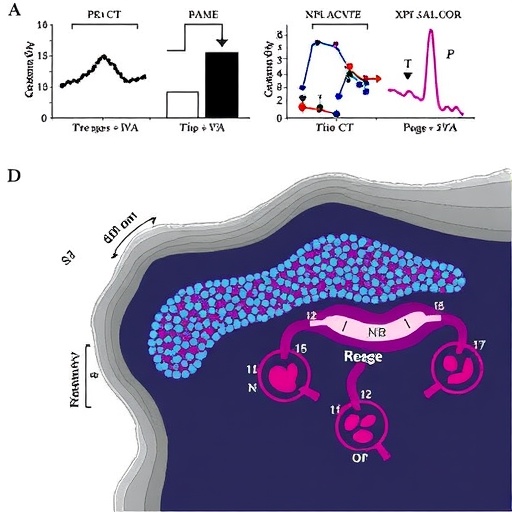
A newly identified RNA regulator is reshaping how scientists think about the genetic choreography that keeps the heart’s internal structure in order. In a study published in Nature Communications, researchers report that a long non-coding RNA called Trdn-as helps ensure the correct termination of transcription in an m6A-dependent manner. By doing so, the team argues that Trdn-as acts as a molecular editor that determines which triadin isoform is produced—an outcome critical for maintaining properly organized calcium-handling machinery in cardiomyocytes.
Triadin is a key component of cardiac dyads, specialized junctions where excitation signals meet calcium release pathways. Trouble with dyad organization is a hallmark of cardiomyopathy, but the upstream steps that decide triadin isoform choice have remained unclear. Here, the authors show that Trdn-as is not merely correlated with triadin expression; it actively influences the transcriptional endpoint, thereby shaping the isoform landscape.
The work centers on how transcription termination intersects with RNA chemical modification. N6-methyladenosine (m6A), a common modification on RNA, can affect RNA processing, stability, and gene regulation. The researchers propose that Trdn-as recruits or positions the cellular machinery responsible for m6A marking near triadin transcripts, tuning the likelihood that RNA polymerase II disengages at the right genomic location.
When Trdn-as function is disrupted, transcription termination becomes less precise. That, in turn, leads to aberrant triadin isoform switching and the formation of abnormal dyads—structures that do not support correct calcium signaling. In cellular and molecular experiments, these defects translate into a pathway-level impairment consistent with cardiomyopathy risk, suggesting that termination fidelity is a functional determinant of heart health.
Crucially, the study frames transcription termination as an active regulatory step rather than a passive finishing line. Trdn-as appears to convert a potentially noisy transcriptional process into a controlled decision-making event: where transcription ends determines which isoform emerges. This adds a new layer to models of how isoform diversity can be governed.
Beyond its immediate relevance to triadin biology, the findings highlight a broader principle: epitranscriptomic marks like m6A can be coupled to transcription termination control to achieve context-specific gene regulation. Such coupling may help explain how cells rapidly reconfigure RNA outputs without altering underlying DNA sequences.
Overall, the research spotlights Trdn-as as a viral-science-style “precision switch” that links RNA modification, transcriptional stopping, and protein isoform production. If validated in vivo, this mechanism could become a targetable vulnerability in cardiomyopathy pathways where dyad architecture goes awry.
Subject of Research: RNA-based regulation of transcription termination and triadin isoform switching in cardiomyocytes
Article Title: Trdn-as directs m6A-dependent transcriptional termination for accurate triadin isoform switching, preventing aberrant dyads and cardiomyopathy
Article References: Hofmann, T., Hettrich, S., Idrissou, B.M.G. et al. Trdn-as directs m6A-dependent transcriptional termination for accurate triadin isoform switching, preventing aberrant dyads and cardiomyopathy. Nat Commun 17, 7269 (2026). https://doi.org/10.1038/s41467-026-75985-8
DOI: https://doi.org/10.1038/s41467-026-75985-8
Image Credits: AI Generated
Keywords: m6A, transcription termination, long non-coding RNA, Trdn-as, triadin isoforms, dyads, cardiomyopathy
Tags: calcium signaling in cardiomyocytescardiac dyad organizationcardiac gene regulationgene expression control in heart tissueheart disease and cardiomyopathyLong non-coding RNAlong non-coding RNAs in cardiac functionm6A-dependent transcription terminationRNA editing and molecular regulationRNA modification in heart cellsRNA polymerase II transcription regulationtriadin isoform switching