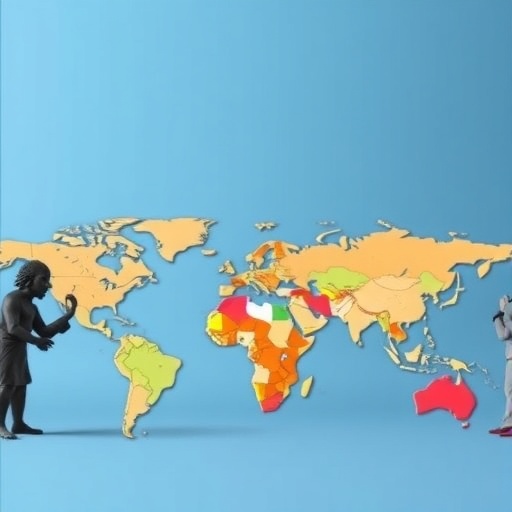
Human language diversity may have reached a remarkable peak long before written records, according to a new modeling study in Science. The authors argue that the common intuition of a steady, centuries-long decline is incomplete. Instead, they reconstruct a deeper arc: increasing diversity during much of the Holocene, followed by a rapid collapse in the last two millennia. The work addresses a major problem in linguistics—direct evidence is sparse because writing only reliably extends back around 6,000 years.
Today, the world is home to roughly 7,500 spoken and signed languages, yet nearly half are endangered. At least four languages are lost each year, reflecting how dominant languages expand and smaller communities shrink. But what happened earlier—during the rise of farming and the growth of larger societies—has remained difficult to quantify.
To estimate past language counts, Damián Blasi and colleagues built a demographic model using ethnographic data from 171 hunter-gatherer societies as proxies for early human populations. Because these groups are typically small and culturally cohesive, the model assumes they generally maintain a single primary language. By combining group sizes with estimates of ancient global population, the researchers infer how many languages could have existed when humans were fewer.
The model’s key assumption is a coupling between population growth and language sharing. As agriculture and technology increase carrying capacity, more people come under fewer social networks, leading to slower growth in language diversity than in population. This framework lets the team estimate how linguistic variety likely changed as humans shifted from small bands toward larger, interconnected societies.
The results suggest the world had fewer languages 12,000 years ago than it does today, contradicting a simple post–Ice Age decline. Instead, language diversity likely increased alongside population, reaching a peak between 1,000 and 3,000 years ago. At that point, the planet may have supported on the order of tens of thousands of languages.
Crucially, the authors find that this “golden age” was followed by an exceptionally fast downturn. Over the last two millennia, expanding societies appear to have replaced smaller language communities at an accelerated rate. The authors interpret this as an outcome of long-term cultural homogenization driven by demographic expansion, rather than colonialism alone.
In short, the study reframes the “language crisis” as the late-stage consequence of processes that likely began much earlier. If the model is right, then preserving linguistic diversity requires recognizing that the steepest losses may be the most recent chapter in a much longer demographic story.
Subject of Research: Language diversity over the Holocene; demographic modeling of linguistic change.
Article Title: The rise and fall of language diversity through the Holocene
News Publication Date: 23-Jul-2026
Web References: http://dx.doi.org/10.1126/science.adx4343
References: 10.1126/science.adx4343
Image Credits:
Keywords: language diversity, Holocene, demographic modeling, language endangerment, cultural homogenization, linguistic change
Tags: ancient language extinctiondemographic modeling in linguisticsearly human language communitiesendangered languages and preservationethnographic data in language studiesglobal population estimates for language diversityHistorical language diversityHolocene language evolutionimpact of agriculture on language diversitylanguage decline and collapsemodeling of prehistoric languagesprehistoric societal development and language