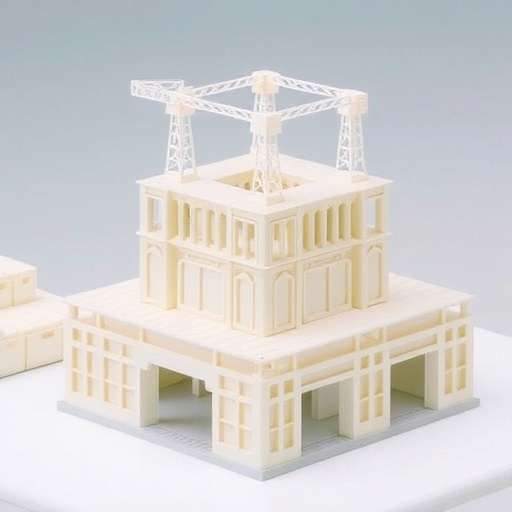
Civil additive manufacturing is moving from lab demonstrations to real construction sites, and a new research synthesis by Kaur, Lee, Kulkarni and colleagues argues that the technology is reaching a definable “foundations and frontiers” moment. The field, often called large-scale 3D printing for buildings, aims to automate how concrete and cementitious composites are shaped into walls, blocks, and structural components. Rather than treating printing as a novelty, the paper frames it as an engineering platform that blends materials science, digital design, and production control.
At the core is nozzle-based deposition, where mixtures are extruded layer-by-layer while maintaining rheology, setting behavior, and dimensional stability. The review highlights how tuning particle size distributions, admixtures, and water-to-binder ratios can extend pumpability and preserve shape fidelity after each pass. For structural reliability, researchers also examine early-age strength development and interlayer bonding—two properties that govern whether printed elements perform like conventional concrete.
A second pillar is process monitoring. Modern systems increasingly rely on sensor feedback—tracking temperature, deposition rate, and geometric deviation—to correct errors during printing. The work emphasizes that closed-loop control can reduce warping and improve surface quality, especially when outdoor conditions fluctuate. In practice, this turns the printer from a purely mechanical tool into a cyber-physical manufacturing system.
Digital workflows are equally central. Parametric design tools and slicing strategies convert architectural intent into toolpaths that account for build orientation, nozzle travel, and curing constraints. The review points to “design for printability,” where geometry is adapted to what the material and equipment can realistically produce.
The authors also address scalability challenges that determine whether the approach scales for cities. These include feedstock consistency across batches, jobsite logistics for large components, and durability under weathering and repeated loading. Standardization—covering testing protocols, acceptance criteria, and quality assurance—is presented as a necessary step for mainstream adoption.
Environmental impact is a recurring theme, with the promise of reducing formwork waste and enabling material-efficient designs. Yet the paper notes that benefits depend on mixture optimization, energy use during processing, and the life-cycle performance of printed structures. In other words, the sustainability story must be measured, not assumed.
Looking forward, the “frontiers” portion highlights hybrid construction strategies, faster curing pathways, and multi-material printing for functional layers such as insulation or embedded conduits. These directions suggest that additive methods will not only shape geometry but also integrate performance features directly into building components.
Civil additive manufacturing, the authors conclude, is converging on a future where construction becomes more automated, data-driven, and adaptable to local needs. If monitoring, materials, and standards keep advancing together, printed construction could shift from viral prototypes to dependable infrastructure.
Subject of Research: Civil additive manufacturing (foundations and frontiers for modern construction industry)
Article Title: Civil additive manufacturing: foundations and frontiers of the modern construction industry.
Article References: Kaur, A., Lee, C., Kulkarni, S. et al. Civil additive manufacturing: foundations and frontiers of the modern construction industry. npj Advanced Manufacturing (2026). https://doi.org/10.1038/s44334-026-00094-9
Image Credits: AI Generated
Tags: automation and digital control in constructioncivil additive manufacturingclosed-loop control systems for additive manufacturingconcrete 3D printing technologydigital design in constructioninnovations in civil additive manufacturinginterlayer bonding and early-age strength in 3D printed concretelarge-scale 3D printing for constructionmaterials science for 3D printed buildingsprocess monitoring and sensor feedback in construction 3D printingrheology and flow control in civil additive manufacturingstructural reliability of 3D printed building components