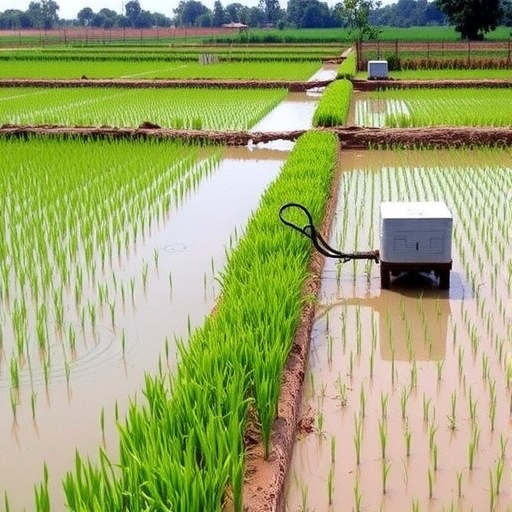
A new study is turning climate uncertainty into a controllable variable for rice farming by using grid-scale, high-efficiency precision irrigation. The research, published in 2026, addresses a problem familiar to farmers worldwide: rainfall patterns and evapotranspiration demands are shifting, while water supply and distribution infrastructure must still deliver stable yields. Instead of relying on fixed irrigation schedules, the authors propose a dynamic regulation framework that adapts irrigation decisions in near real time as climate conditions change.
At the core of the approach is the idea that irrigation should respond to both weather variability and field-level water needs. The method integrates climate-driven signals with crop water requirements, enabling the system to adjust delivery rates across a network rather than treating fields as isolated units. This “dynamic” control aims to reduce the gap between what crops need and what irrigation provides, especially during volatile periods when temperature, radiation, and atmospheric demand fluctuate.
The study’s design is particularly relevant for rice, a crop that is both water-intensive and highly sensitive to timing. Over-irrigation can waste water and exacerbate nutrient losses, while under-irrigation can stress plants and suppress growth. By continuously recalibrating irrigation based on climate variability, the framework targets more accurate water delivery aligned with crop growth stages.
Importantly, the work focuses on grid-scale systems—meaning irrigation management is coordinated at the scale of water distribution infrastructure. This shifts the challenge from optimizing a single plot to optimizing performance across a larger service area. In practice, such coordination can help prevent bottlenecks, reduce operational inefficiencies, and improve overall reliability when weather shocks disrupt typical water planning.
The authors also emphasize high-efficiency precision irrigation, which typically relies on targeted delivery rather than uniform flooding. Under dynamic regulation, the system can fine-tune irrigation intensity, improving the match between water applied and water used. This capability is crucial when climate variability creates sudden changes in demand, such as heat waves or unusual dry spells.
From a technical perspective, the study leverages modeling and control logic to interpret climate inputs and translate them into irrigation commands. The researchers frame the system as a closed-loop decision process: observe variability, estimate crop water need, regulate irrigation accordingly, and maintain performance targets. Such control-oriented approaches are increasingly seen as a bridge between agricultural science and operational engineering.
Beyond water savings, the proposed strategy has implications for sustainability and resilience. More efficient irrigation can lower pressure on freshwater resources and help buffer farms against extremes. For rice-growing regions facing more erratic climates, adaptive irrigation may become a key component of future climate-smart agriculture.
As irrigation networks modernize, dynamic regulation could become a scalable template for other crops and regions. This research suggests that “precision” is not only about equipment accuracy, but also about decision-making that evolves with the atmosphere above the field. If validated broadly, the framework may help turn climate variability from a threat into a signal the irrigation system can respond to.
Subject of Research: Dynamic regulation of grid-scale high-efficiency precision irrigation for rice under climate variability
Article Title: Dynamic regulation of grid-scale high-efficiency precision irrigation for rice under climate variability
Article References: Dong, W., Xu, Y., Zhangzhong, L. et al. Dynamic regulation of grid-scale high-efficiency precision irrigation for rice under climate variability. npj Sustainable Agriculture 4, 61 (2026). https://doi.org/10.1038/s44264-026-00172-7
DOI: https://doi.org/10.1038/s44264-026-00172-7
Image Credits: AI Generated
Tags: adaptive water managementclimate variabilityclimate-smart agriculturedynamic irrigation schedulingevapotranspiration-based irrigationhigh-efficiency irrigation systemsimpact of climate swings on rice yieldsinfrastructure for grid-scale irrigationprecision irrigation for ricereal-time irrigation controlsustainable water management practiceswater use optimization in rice farming